

Published Aug 15, 2026 | 10:51 AM ⚊ Updated Aug 15, 2026 | 10:51 AM

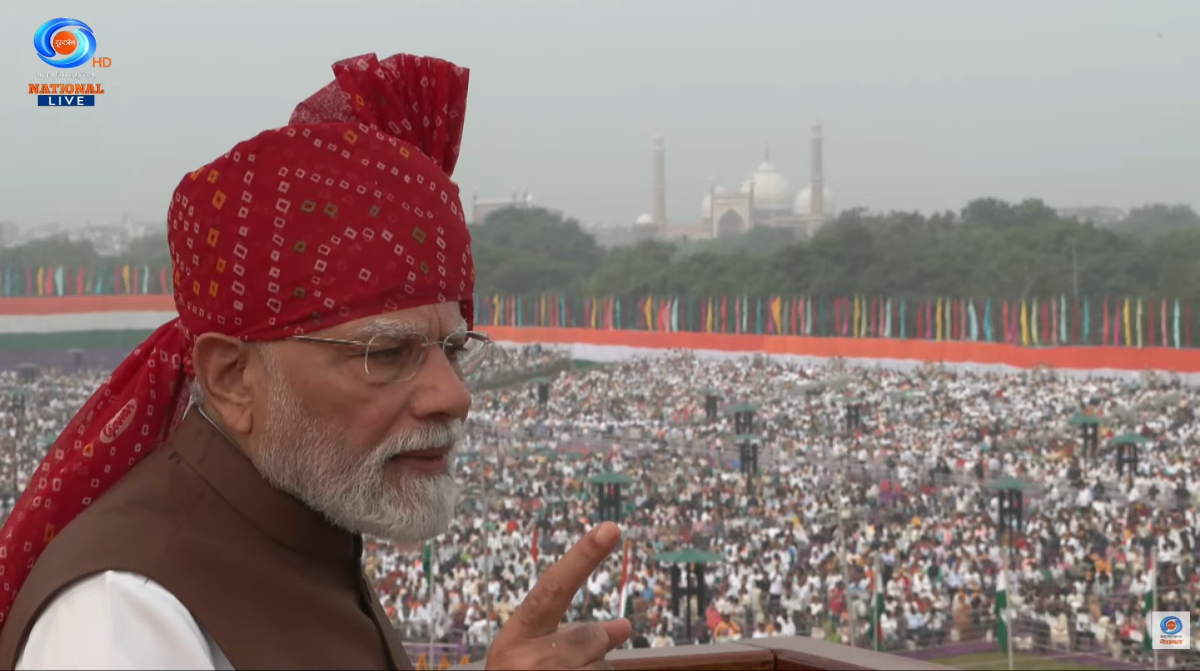
PM Modi addresses the nation. (Screengrab)

Synopsis: “While we have succeeded in eliminating Naxals who took up arms in the forests, the ‘dimagi’ Naxals are still in search of an opportunity to dig up paths of violence and anarchy. They are trying to drag the country to a wrong path. We need to identify these dimagi Naxal, isolate them, and bring the youth together for a developed country.”
Prime Minister Narendra Modi addressed the nation from the Red Fort in Delhi on Saturday, 15 August, on the occasion of the 80th Independence Day.
Remembering the freedom fighters, Modi noted that it is the first time since Independence, that the national song Vande Mataram was sung at the Red Fort on Independence Day.
Speaking of the pledge the government took in 2014 to free India from Naxalism, the prime minister alleged, “The armed naxals are gone, but ‘dimagi’ naxals (ideological naxals) is looking for an opportunity. They are digging up paths of violence and anarchy.”
Addressing the nation, Modi said, “Naxalism and Maoism have ruined countless youngsters futures, it took away the children of hundreds of mothers. It had also held control over a large population and area of the country. It had also undermined the constitution.”
Modi also highlighted how more than 3,500 security personnel were killed in various operations “in order to protect the people from Naxalism. It had covered the country in blood. In 2014, when you gave us the opportunity we had decided that we will rid the country of naxalism, and today I am happy to announce that naxalism does not have even the strength for breathing.”
Claiming that it cannot be taken lightly, Modi alleged, “For years, people with Maoism mindset were present in power corridors. They were also present in government committees as advisors, and the ideology had influenced the public policy.”
“While we have succeeded in eliminating Naxals who took up arms in the forests, the ‘dimagi’ Naxal are still in search of an opportunity to dig up paths of violence and anarchy. They are trying to drag the country to a wrong path. We need to identify these ‘dimagi naxal’, isolate them, and bring the youth together for a developed country.”
“May the challenge arise from across the border or from within the country, India is ready for both. The nature of war is changing nowadays, there is no guarantee that the war will only happen at the border, it can even happen within the borders by attacking the infrastructure,” he added.
Also Read: The soft echo of paper and gum: Remembering the world that arrived by post
The theme of this year’s national celebrations is “Yuva Shakti for Viksit Bharat@2047,” highlighting the role of India’s youth in the country’s journey towards becoming a developed nation.
He further said, the whole India, had in the last 12 years have worked together to become Viksit Bharat by 2047. Modi added that, with the collective efforts, 50 crore people have come out of the poverty.
Modi further claimed that “though the country became independent with dreams, India could not catch speed. By 2014, the world had put us in ‘Fragile Five’. In the last 12 years, India is moving ahead with great speed.”
Reacting to criticism, the prime minister said, “Over the past 10–12 years, we have faced many challenges and dangers. Just as we were beginning to emerge from the Covid pandemic, conflicts erupted in Ukraine and West Asia, creating an atmosphere of uncertainty and tension. During this period, we heard countless predictions about what might happen next.
Unfortunately, some people seemed to derive satisfaction from keeping the nation in a constant state of fear by spreading rumours—that vaccines would not be available, or that the country would face shortages of petrol, diesel, and fertilizers. Instead of reassuring people during difficult times, they contributed to an atmosphere of anxiety and apprehension.”
Also Read: The chauvinism of clothing: What the “lungiwala” remark against John Brittas reveals about India
Speaking the 33 percent reservation for women in State Legislative Assemblies and the Lok Sabha, he urged all political parties to support the move, and take credit.
“Today, from the ramparts of the Red Fort, standing under the shadow of the Tricolor, I earnestly appeal to and urge all political parties of our nation: Come forward and celebrate the strength and capability of our women. Step forward in honor of our women, and as swiftly as possible, ensure our mothers and sisters receive 33 percentrepresentation in the State Legislative Assemblies and the Lok Sabha so that they can actively contribute to shaping India’s policies,” he said.
Also Read: Are they really serious about women’s reservations in Lok Sabha, state Assemblies?
Modi also unveiled the ‘Sapta Dhara’ framework, calling for seven streams of strength to drive India’s transformation into a Viksit Bharat.
“Today, I would also like to recall that era when the nation knew, understood, and heard of India’s prowess in the form of the ‘Sapta Sindhu’. Now, to build a Viksit Bharat, we need a new current. Today, from the ramparts of the Red Fort, I invoke the ‘Sapta Dhara’ of strength before the nation. In the coming 5 to 7 years, what could not be achieved in the last 5 to 7 decades, through the prowess and power of this Sapta Dhara, we will give the nation new heights, new momentum, and the capability to surpass new goals. Alongside this, the power and potential of our youth will be fully harnessed and integrated into nation-building…”
The seven streams outlined by Modi are:
Prime Minister Modi also pitched for making India a global hub for defence manufacturing, placing special emphasis on self-reliance in advanced capabilities such as hypersonic technology and drone systems.
Also Read: ‘If we could die together, can’t you live together?’: Freedom as Ashfaq and Bismil saw it
(Edited by Sumavarsha)



