

Published Apr 14, 2026 | 7:58 AM ⚊ Updated Apr 14, 2026 | 7:58 AM

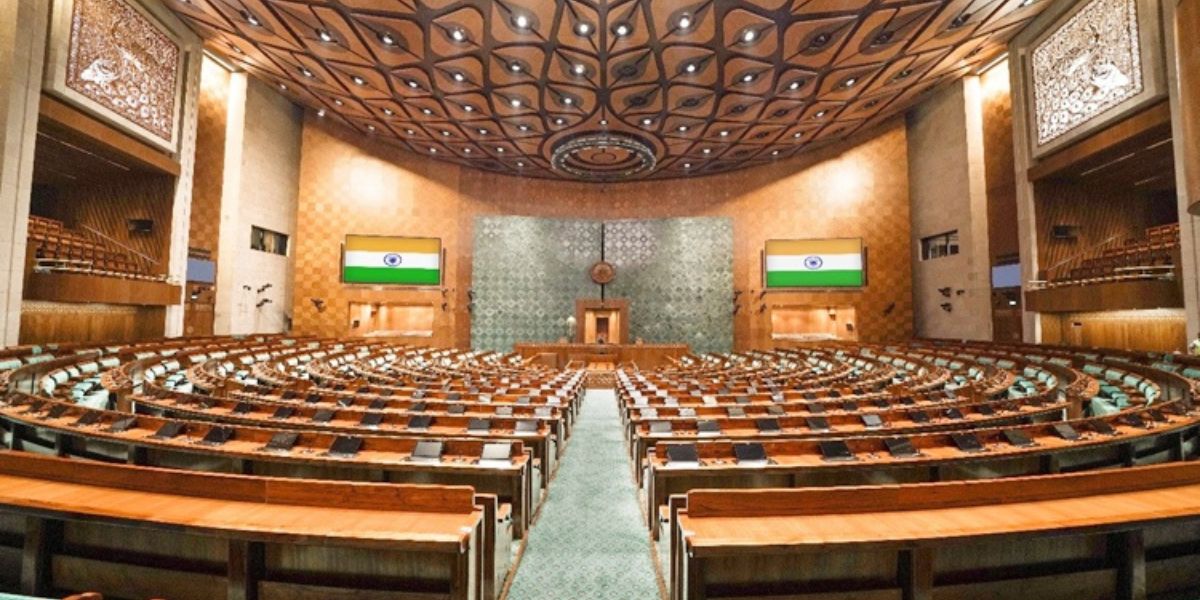
Union Home Minister Amit Shah justified the Bill, saying it was meant to be correct "declining moral standards" in politics.

Synopsis: The Parliament prepares for a special three-day session to fast-track 33 percent reservation for women in the Lok Sabha and state Assemblies from the 2029 elections. A closer, critical examination reveals a pattern of strategic delay, selective urgency, and convenient constitutional engineering that raises legitimate doubts about sincerity.
The question hangs in the air like an unfulfilled promise: Is the NDA genuinely committed to empowering women in India’s political sphere, or is the Women’s Reservation Act another masterstroke of political theatre?
As Parliament prepares for a special three-day session from 16 April to 18 April to amend the Nari Shakti Vandan Adhiniyam and fast-track 33 percent reservation for women in the Lok Sabha and state Assemblies from the 2029 elections, the NDA government under Prime Minister Narendra Modi is projecting historic resolve.
Yet, a closer, critical examination reveals a pattern of strategic delay, selective urgency, and convenient constitutional engineering that raises legitimate doubts about sincerity.
Also Read: Opposition seeks clarity on delimitation
Let us begin with the facts. The Constitution (One Hundred and Sixth Amendment) Act, 2023, passed with much fanfare during a special session, was hailed by the NDA as a landmark in gender justice. It reserves one-third of seats for women in the lower house and state legislatures, with rotation of reserved constituencies after every delimitation.
The NDA took full credit, and rightly so, for shepherding it through Parliament. But the legislation came with a critical caveat: Implementation would occur only after the next census and subsequent delimitation exercise. At the time of passage, the 2021 Census — already overdue — had been repeatedly postponed under the Modi government.
Critics warned then that this linkage effectively deferred the quota until the 2030s. Three years later, with the 2029 polls looming and state elections in full swing, the same government is now rushing amendments. The Union Cabinet has cleared bills to expand the Lok Sabha from 543 to 816 seats (with 273 reserved for women), delink the quota from a fresh census, and rely on existing data to enable rollout by 2029.
This sudden pivot invites scrutiny. Why did the NDA, which enjoyed a comfortable majority since 2014, wait until 2023 to pass the bill when it had languished for 27 years? Previous governments, including the UPA, had attempted it but lacked the numbers or consensus.
The BJP-led alliance could have prioritised it earlier without the census-delimitation tether. Instead, the delay clause was baked in, ensuring no immediate disruption to the 2024 electoral landscape.
Now, post-2024 polls, where the BJP fell short of a solo majority, the amendments arrive with almost theatrical timing — precisely when Opposition parties are mounting campaigns and southern states are voicing fears over delimitation’s North-South tilt.
Prime Minister Modi’s letter to floor leaders on 11 April, urging “one voice” for women’s empowerment, sounds noble, yet it coincides with a special session extended amid ongoing Assembly polls.
The NDA’s defenders will argue that expanding Parliament avoids penalising any region and fulfils the promise without zero-sum politics. Fair enough on paper. But this solution exposes the original bill’s half-hearted design.
If the government had been serious in 2023, it could have decoupled implementation or conducted the census promptly. The 2011 Census data is now being invoked as a workaround, underscoring how the initial linkage was never inevitable but a choice.
Opposition leaders like Congress’s Shashi Tharoor and Mallikarjun Kharge have called it a “political tool” that undermines federalism and bypasses consultation. DMK’s Kanimozhi has labelled the entire exercise a “spectacle” and “gimmick.” Even supporters of the quota, such as athlete PT Usha, stress that what remains is “political will to implement it fully, faithfully, and without delay.”
A truly critical lens must go beyond timing to substance. The bill offers no sub-quotas for OBC, SC, or ST women — demands long raised by allies like Nitish Kumar and even some within the NDA. Without them, the reservation risks benefiting upper-caste or dynastic women rather than the most marginalised. Nor does it apply to the Rajya Sabha or legislative councils.
More damningly, the NDA’s own record on intra-party democracy remains patchy. The BJP rarely fields 33 percent women candidates in unreserved seats, and several NDA-ruled states have lacked women chief ministers for years.
Reservation in legislatures is meaningless if parties themselves do not nurture women leaders through winnable tickets, training, or safe political environments.
Women MPs and MLAs still face disproportionate online abuse, family pressures, and dynastic gatekeeping — issues the NDA’s “Nari Shakti” rhetoric rarely addresses with matching policy muscle.
Also Read: Revanth Reddy proposes ‘hybrid’ delimitation model
Economically and socially, the move is overdue. India’s female labour-force participation lags, and political under-representation perpetuates policy blind spots on issues like maternal health, education, and safety. Studies show that women-led panchayats have delivered better outcomes in local governance.
Yet scaling this nationally requires more than seats; it demands cultural shifts the NDA has not prioritised. The government’s emphasis on simultaneous elections and delimitation alongside the quota also risks entangling women’s empowerment with broader political reforms that favour the ruling dispensation’s electoral math.
None of this negates the bill’s potential. When implemented in 2029, it could transform India’s democracy, giving nearly 300 women a direct voice in national law-making for the first time. That is progress worth celebrating.
But sincerity is measured not by legislation alone but by consistency, urgency, and follow-through. The NDA’s decade in power saw the bill stalled until electoral exigency demanded action. The 2026 amendments, while welcome, arrive after engineered delays and amid accusations of political expediency.
If the government truly believes in Nari Shakti, it must now demonstrate it — not through special sessions and press statements, but by ensuring the expanded Parliament reflects genuine diversity, by enforcing party-level reforms, and by treating women’s leadership as a right, not a reserved concession timed for the next election cycle.
India’s women have waited long enough. The NDA has the numbers and the narrative to deliver. Whether it does so with conviction or calculation will define its legacy on gender justice. For now, the jury remains sceptical.
(Views are personal.)



