

Published Nov 29, 2026 | 5:12 PM ⚊ Updated Nov 29, 2026 | 7:50 PM

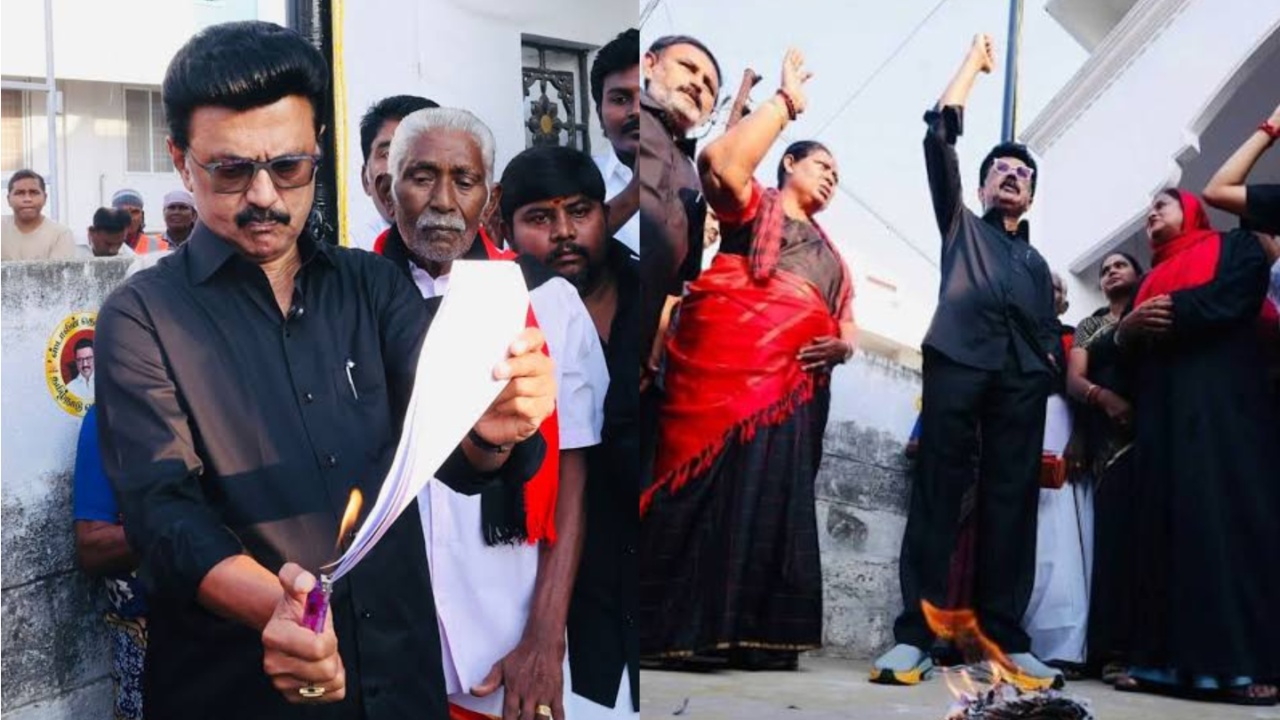
M.K. Stalin burning the Constitution (131st Amendment) Bill during a protest against the proposed delimitation exercise in April 2025.

On November 29, Rahul Gandhi, Sonia Gandhi, Mallikarjun Kharge and other INDIA bloc leaders came down to Chennai to persuade Dravida Munnetra Kazhagam (DMK) president M.K. Stalin to reconsider his support for the Union Government’s revised delimitation proposal.
Stalin had defended his decision a day earlier on the grounds that the proposal safeguards southern India’s parliamentary representation. On Sunday, after the meeting with the INDIA bloc leaders, he reiterated that this was the best choice available to safeguard Tamil Nadu’s interests. Does this reflect a tacit acknowledgement that southern India must reconcile itself to its existing share of national political power?
The arithmetic of the proposed delimitation reveals the modest extent of the political gains secured by the South.
According to the illustrative allocation released by Union Law Minister Arjun Ram Meghwal, the collective representation of the five southern states would increase from 129 to 195 seats in an expanded Lok Sabha of 816 members. Their proportionate representation, however, would increase just by 0.14 percentage points, from 23.76% to 23.90%.
Furthermore, the proposed constitutional amendment would freeze the relative allocation of seats among states until the publication of the relevant figures of the first Census conducted after 2051.
What southern India has secured is protection against political regression rather than an expansion of its political influence.
The contrast between this settlement and the aspirations previously articulated by southern leaders is instructive. At the Joint Action Committee meeting on fair delimitation held in Chennai on March 22, 2025, Telangana Chief Minister Revanth Reddy demanded an increase in southern India’s parliamentary representation to 33% if the Union government proceeded with the expansion of the Lok Sabha.
Although the committee’s collective resolution sought an extension of the existing freeze by 25 years, Reddy’s intervention articulated an alternative political ambition. Instead of merely defending the South’s existing position, it sought to reconsider its place within the distribution of national political power. That distinction between preservation and aspiration has received insufficient attention in the present negotiations.
Also Read: Explained: The southern challenge facing the Centre’s delimitation Bill
The South’s unresolved grievances over fiscal federalism provide a compelling reason to question whether its existing political influence is adequate. In February 2026, the Union government accepted the Sixteenth Finance Commission’s recommendation to retain the states’ collective share of the divisible pool of central taxes at 41%, despite demands from several state governments for an increase to 50%.
Although the revised distribution formula benefits the southern states, concerns over the exclusion of cesses and surcharges from the divisible pool persist. The difficulty of securing greater fiscal autonomy raises questions about the adequacy of the political bargaining power that the delimitation proposal seeks to preserve.
The prolonged absence of southern leadership from the country’s highest political office offers another perspective on this predicament. India has not had a Prime Minister from southern India since H.D. Deve Gowda demitted office on April 21, 1997.
An entire generation of southern Indians has grown up without witnessing a leader from their region occupy that office. Although the prime ministership is not a matter of regional entitlement, this absence invites reflection on whether southern political leadership can aspire to shape the national political agenda rather than remain principally concerned with protecting regional interests.
The institutional architecture of Indian federalism provides limited safeguards against the concentration of political influence in more populous regions. While the Lok Sabha represents citizens through territorial constituencies, the Rajya Sabha represents states. However, the allocation of seats in the Rajya Sabha also broadly reflects historical population differences among states. Uttar Pradesh, for instance, has 31 seats in the Rajya Sabha, whereas Tamil Nadu has 18 and Karnataka has 12. The delimitation negotiations could therefore have provided an occasion to reconsider how India balances demographic representation with the federal principle of territorial representation.
Also Read: What the Delimitation Bills give the South, and what they quietly take
The fundamental limitation of the present compromise is that it postpones these questions without resolving them. The safeguards negotiated by the DMK address the immediate danger of diminished parliamentary representation. They do not, however, address whether the existing distribution of political power adequately serves southern India’s aspirations. A constitutional settlement that preserves this distribution for another quarter of a century could consequently narrow the scope for renegotiating the South’s position within the Union.
What makes this settlement particularly consequential is the support extended by the Telugu Desam Party (TDP), Bharat Rashtra Samithi (BRS) and DMK, parties whose political histories are rooted in the assertion of regional interests. Their acceptance of the proposed settlement raises the question of whether the preservation of the South’s existing political influence has become the overriding objective of regional politics rather than the expansion of its role in national decision-making.
For a region that has so often demonstrated what India could become, that is a remarkably modest political ambition.
(Edited by Fayisa CA)



