

Published Nov 28, 2026 | 12:09 PM ⚊ Updated Nov 28, 2026 | 12:11 PM

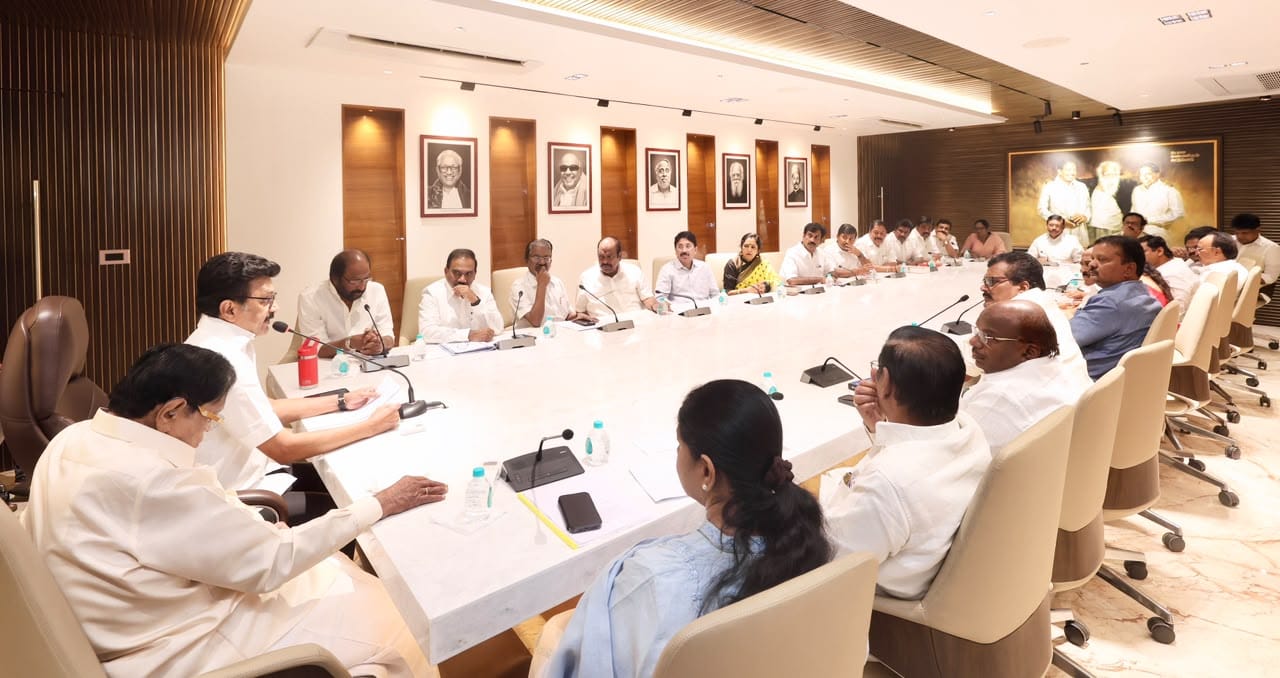
M.K. Stalin chairs the DMK MPs' meeting at Anna Arivalayam, Chennai, on 28 November.

Synopsis: The DMK has defended its ‘Fair Delimitation’ position, claiming its sustained campaign has secured safeguards for Tamil Nadu’s parliamentary representation for the next 25 years—Party leader A. Raja said the State’s share would increase from 7.18% to 7.21%, dismissing allegations that the party had changed its stand after its differences with the Congress.
The Dravida Munnetra Kazhagam (DMK) has decided to back the amended delimitation package that the central government is set to introduce in Parliament on Monday, 30 November.
DMK decided to support the repackaged Delimitation Bill after it promised Tamil Nadu a 7.21 per cent share of parliamentary representation, up from the existing 7.18 per cent, and that the arrangement would remain unchanged for 25 years.
DMK MPs, chaired by party supremo MK Stalin, decided in Chennai on Saturday. The meeting adopted a resolution to back “fair delimitation”.
The latest development is being viewed as a U-turn, since the DMK convened a meeting of the Joint Action Committee (JAC) of chief ministers of southern states in 2025. The JAC then urged the Union government to extend the freeze on the number and state-wise distribution of Lok Sabha seats for another 25 years beyond 2026.
DMK later parted ways with the Congress after the latter decided to support the Tamilaga Vettri Kazhagam to form the government in Tamil Nadu.
After the meeting on Saturday, DMK, however, said it stands on delimitation; it has not changed.
“Since the Bill allows a 50 per cent uniform increase in the number of seats for all states, the DMK has decided to support the Bill. We have always batted for fair delimitation. Our stance on this issue has not changed,” the party’s deputy general secretary and MP A Raja told reporters in Chennai.
He rejected the view that the DMK had adopted a different position because it left the Congress-led alliance. He also disputed the allegation that the DMK had contradicted the Congress on the issue.
“Fair Delimitation was the position taken by the Congress as well. No political party had advocated anything other than this at that time. Our position has always been that delimitation must be carried out fairly,” he justified his party’s stand.
The DMK has 22 MPs in the Lok Sabha and eight in the Upper House.
Raja claimed that the proposed arrangement would give Tamil Nadu a 7.21 per cent share of parliamentary representation instead of the existing 7.18 per cent. He maintained that the State’s proportional representation would not change adversely.
He said the arrangement would remain frozen for 25 years, ensuring that Tamil Nadu would not suffer any disadvantage in parliamentary representation during that period.
“Instead of 7.18%, Tamil Nadu has received a share of 7.21%. There is no change in this regard. We have frozen it for 25 years,” he said.
Raja maintained that the proposed arrangement would not harm the country or Tamil Nadu, and reiterated that the DMK’s position was guided by the need to protect the State’s interests without compromising a fair delimitation process.
Earlier, addressing the MPs, Stalin said the DMK had approached the delimitation issue with a long-term perspective rather than reacting emotionally.
“For the past few months, the question across the country has been about what position the DMK would take when the Delimitation Bill was reintroduced. We gave a clear answer to that yesterday,” he said.
Stalin claimed that the DMK was the first political party in the country to raise concerns about the potential consequences of delimitation for southern States, particularly the possibility of a reduction in their share of parliamentary representation.
He said the party had worked to create awareness about the issue and had brought together political leaders from across the country to discuss its implications.
Recalling the developments surrounding the earlier delimitation proposal, Stalin said the Union government had introduced a Bill in April, during the Assembly election period, without consulting the States or providing adequate assurances.
Describing it as a unilateral move, he alleged that the government had not given Parliament sufficient time to examine the proposed legislation before attempting to push it through.
“We defeated that Bill in Parliament and exerted considerable pressure on the BJP,” he said.
Stalin said that while the DMK preferred the existing number of constituencies to continue, it had also recognised the constitutional provisions for increasing the number of constituencies.
Therefore, the party had proposed a practical solution to ensure that Tamil Nadu was not disadvantaged if the number of seats was increased.
He pointed out that the Tamil Nadu Legislative Assembly had adopted a resolution on February 14, 2024, demanding that any increase in the number of Assembly and parliamentary constituencies should preserve the existing inter-State proportional representation based on the 1971 Census.
Stalin said the party’s intervention was crucial in preventing a situation in which northern States could gain a larger share of parliamentary seats based on population. At the same time, southern States faced a relative decline in their representation.
“If we had not raised our voice, they would have increased the number of constituencies only for the northern States based on population and reduced our percentage of representation,” he said.
Stalin further claimed that the copy of the proposed Bill was now available and that both the key demands raised by the DMK had been incorporated into it.
“This is a victory achieved through our continuous three-year struggle,” he said.
He warned that if the DMK had not intervened at this stage, delimitation could have been undertaken based on the most recent Census instead of retaining the 1971 Census-based proportional representation, potentially causing serious consequences for Tamil Nadu.
He said the proposed legislation now addressed the party’s concerns.
“As far as we are concerned, we remain firm on the two demands we put forward. Tamil Nadu’s interests must not be taken away, and we will not compromise on them,” he said.
He added that the party had succeeded in protecting Tamil Nadu’s parliamentary representation for the next 25 years.
Stalin also recalled that Tamil Nadu’s Lok Sabha representation had been reduced from 42 to 39 seats during the delimitation exercise following the 1976 constitutional changes.
He said the DMK had now ensured that the number of seats allocated to Tamil Nadu could increase without altering its proportional share of representation.
He urged party MPs to communicate the DMK’s position clearly during the special session of Parliament and avoid any hesitation in articulating the party’s stand.
Quoting former Chief Minister M Karunanidhi, Stalin said political leaders should know when to draw the sword and when to raise the shield, emphasising the need for strategic political decisions.
Also Read: Will the DMK back the delimitation Bill? Stalin, Kanimozhi and the deliberations behind the scenes
The DMK’s opposition to a delimitation exercise based solely on population has been part of a broader political campaign involving several southern States.
On 14 February 2024, the Tamil Nadu Legislative Assembly adopted a resolution demanding that the existing inter-State proportional representation based on the 1971 Census be protected in any future delimitation exercise.
On 5 March 2025, the Tamil Nadu government convened an all-party meeting to discuss the potential implications of delimitation. Subsequently, a Joint Action Committee comprising representatives of States likely to be affected by the exercise was formed.
Stalin wrote to the chief ministers and political leaders of seven States on 7 March 2025, seeking their participation in the joint initiative. A meeting of the committee was later held in Chennai on 22 March 2025.
The DMK has consistently argued that States which successfully implemented population control measures should not lose their political representation as a consequence of their demographic achievements.
The party’s latest resolution reiterates that position, asking its MPs to defend Tamil Nadu’s representation and the interests of southern States during the upcoming parliamentary deliberations.
Also Read: Explained: The southern challenge facing the Centre’s delimitation Bill
(Edited by Sumavarsha)



