
Published Nov 29, 2026 | 9:30 AM ⚊ Updated Nov 29, 2026 | 9:30 AM


Seven months ago, on April 17, the Union government lost a constitutional amendment on the Lok Sabha floor for the first time in the Modi era.
The Constitution (131st Amendment) Bill, which sought to enlarge the House and fast-track women’s reservation through a fresh delimitation, received 298 votes for and 230 against. It needed 352. The southern States, led then by the DMK government in Chennai and Congress governments in Bengaluru and Hyderabad, had read the package as a quiet transfer of political weight to the north, and enough members of the Parliament agreed for the Bill to fail.
On Monday, November 30, the government will try again. Two new Bills, signed by Law Minister Arjun Ram Meghwal on 27 November — the Constitution (132nd Amendment) Bill, 2026 and the Delimitation (Second) Bill, 2026 — will be moved in a special sitting of the Lok Sabha.
The Rajya Sabha meets on December 2, and the sitting is expected to close on December 3. The April Delimitation Bill is being withdrawn.
Much has changed since April.
The BJP now governs West Bengal. Twenty Trinamool MPs have crossed over to the NDA under a new label.
In Tamil Nadu, the DMK lost power to Vijay’s TVK, the Congress walked out of the DMK alliance, and the DMK — the party whose leader burnt a copy of the April Bill on the day it was introduced — is now ready to support it.
The Bill itself has also changed, in ways that answer the South’s loudest objection.
For southern readers, the new formula is clearly better than April’s. What matters now is what else the package does while attention stays on the headline number.
The amendment does four things.
First, it raises the Lok Sabha ceiling from 550 to 850 members (815 from States, 35 from Union Territories) and each State Assembly ceiling from 500 to 650.
Second, it rewrites Article 334A so that women’s reservation takes effect after “the first delimitation exercise” under this Act, and — this is new — it writes into the Constitution itself that this delimitation “shall provide for an increase of fifty per cent” in the seats of every State and Union Territory in the Lok Sabha, and in the total strength of every Assembly.
Third, it keeps the allocation of seats between States tied to the 1971 census, and freezes both that allocation and the new constituency map until 2051. Fourth, it adds the Union Territory of Jammu and Kashmir to the electoral college for the President.
The Delimitation (Second) Bill supplies the machinery.
A three-member Delimitation Commission will fix seat numbers, reserve seats for Scheduled Castes and Tribes, reserve “as nearly as may be, one-third” of seats for women, rotate those seats, and redraw every constituency in the country. Its orders will have the force of law and “shall not be called in question in any court”. The Delimitation Act, 2002, is repealed.
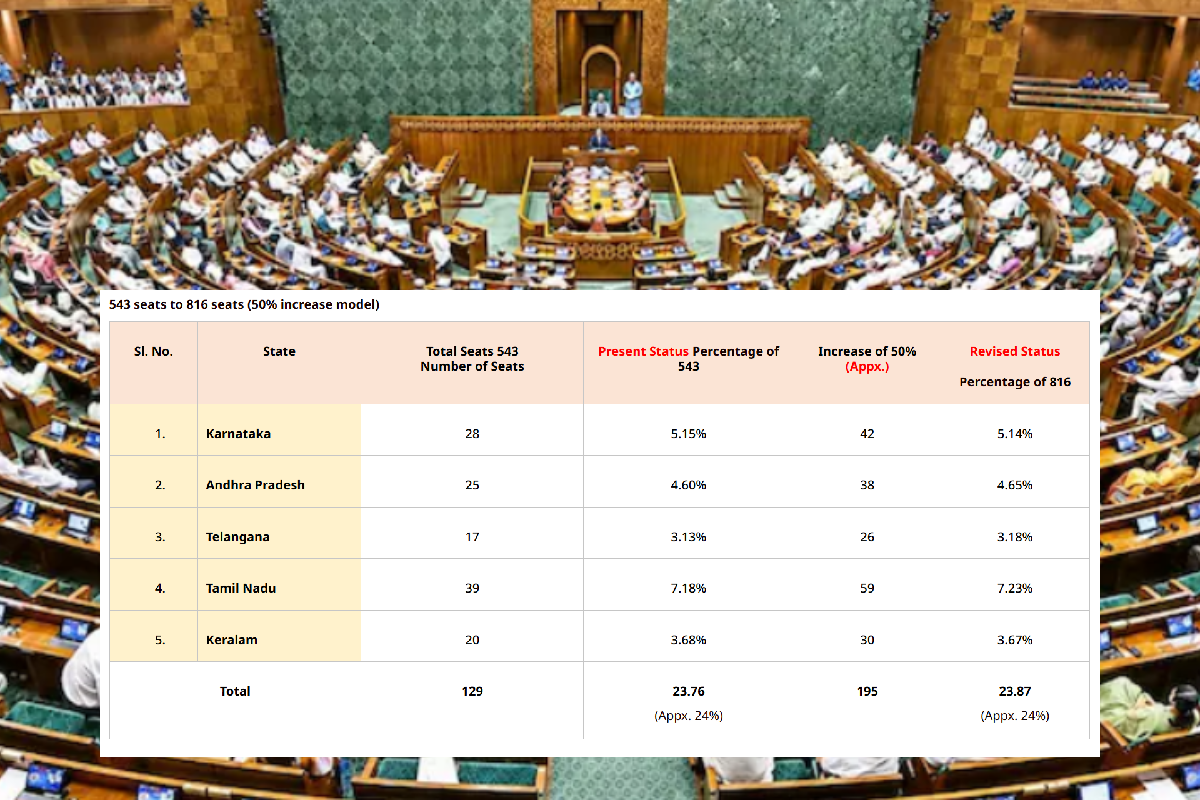
In plain numbers, applying the 50% rule to today’s allocation (and rounding halves up, since the Bill is silent), the Lok Sabha grows from 543 to about 824 seats. The government has spoken of 816; the gap is entirely a matter of rounding the 19 States and Union Territories that have an odd number of seats today.
Assemblies grow from 4,123 to roughly 6,190 members. Uttar Pradesh goes from 80 to 120 MPs, Tamil Nadu from 39 to 59, Karnataka from 28 to 42, Andhra Pradesh from 25 to 38, Kerala from 20 to 30, Telangana from 17 to 26. The Rajya Sabha stays at 245.
On the narrow question that animated the April protests, the answer is yes. Because every State gets the same proportional increase, every State keeps almost exactly its present share of the House.
The five southern States hold 129 of 543 seats today, 23.76%. Under the new formula, they would hold 195 of about 824, 23.67%. The tiny difference comes from rounding: the smallest States and Union Territories jump from one seat to two and gain a sliver at everyone else’s expense.
The contrast with population-based allocation is stark. Had the 2011 census been used to divide the same number of State seats, the South would have dropped to about 20.4%, losing about 27 seats — a figure close to the Carnegie Endowment’s own estimate. On 2026 population projections, the loss would be larger. Tamil Nadu alone would have about 48 seats instead of 59; Kerala 22 instead of 30. Uttar Pradesh would have 134 instead of 120, Bihar 70 instead of 60.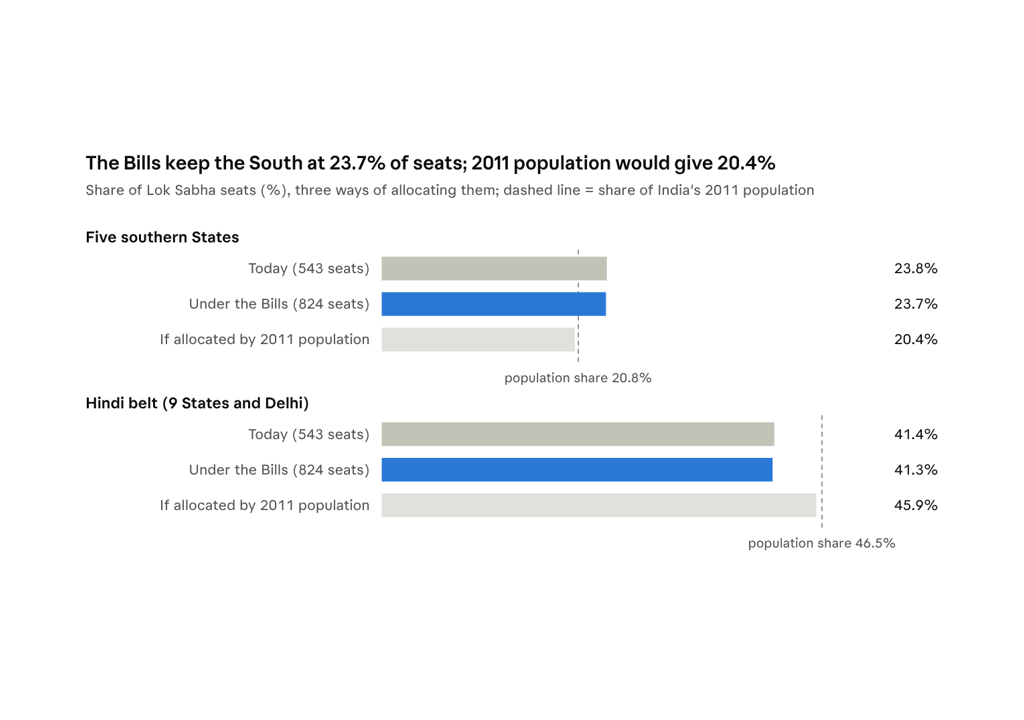
Author’s calculation: current seats; the Bills’ 1.5× rule with halves rounded up; Webster allocation on Census 2011 population. Hindi belt = UP, Bihar, MP, Rajasthan, Jharkhand, Chhattisgarh, Haryana, Uttarakhand, Himachal Pradesh, Delhi.
So the DMK has a point when it says its two principal demands were met. The 7.18% line Tamil Nadu has defended since the 2025 all-party meeting is, in practice, held: at 824 seats the State’s share is 7.16%, at the government’s 816 it would be 7.23%. That a few hundredths of a percentage point now depend on how a commission rounds half-seats tells us how thin the protection really is when it is not written down.
But three cautions apply.
First, “proportional” here means proportional to the 1971 census, not to people. A Rajasthan MP will represent about 1.80 million people (on 2011 figures) against 1.11 million for a Kerala MP. The southern advantage in the value of a vote, earned by decades of successful population policy, is preserved — and so is northern resentment of it, for another 25 years.
Second, absolute gaps widen. Uttar Pradesh’s lead over Kerala grows from 60 seats to 90; the Hindi-speaking States move from 225 to 340 seats. In a first-past-the-post Parliament, shares rather than raw numbers decide majorities, but politics runs on optics.
Third, the freeze ends in 2051. By then the inter-State map will be 80 years old, and the correction, when it comes, will be far more painful than one made today. The South has bought time, not a settlement.
A close reading of the Bills throws up four problems, none of which has featured much in the past week’s debate.
There is no schedule of seats. For all the talk of protecting shares, neither Bill contains a State-wise table.
The text says “fifty per cent”, which is arithmetically impossible for Tamil Nadu (39 seats becomes 58.5), Andhra Pradesh, Telangana, Madhya Pradesh, Rajasthan, Odisha, Punjab and a dozen smaller units.
How halves are rounded is left to the Commission, whose orders cannot be challenged in court. A one-page schedule appended to the amendment would have settled the matter for 25 years. Its absence is a choice.
Two clauses contradict each other. Section 8 of the Delimitation Bill revives an old rule that every Assembly must be an exact multiple of the State’s Lok Sabha seats. Section 10 demands an exact 50% increase “notwithstanding anything” else. Both cannot be satisfied in most States.
Punjab, with 13 MPs and 117 MLAs, can have 19 and 171 (a 46% rise) or 20 and 180 (54%), as the commentator KBS Sidhu has pointed out. Uttar Pradesh (80 and 403) and Bihar (40 and 243) do not meet the multiple rule even today. Telangana’s 119 MLAs would become either 156 or 182, not 179. Again, the Commission decides.
The census switch is in the Centre’s hands. Constituency boundaries and the reservation of seats for Scheduled Castes and Tribes are to be redrawn on the “latest census figures” published on the date the Act commences.
The Centre notifies that date. Census 2027’s population count runs until March, with provisional figures expected around March–April 2027. Commence the Act before then, and the 2011 census — already 15 years old — will govern every constituency boundary and every SC/ST seat in India until 2051.
This is the basis of the Congress complaint that SCs and STs “will not get increased seats according to their increased numbers”. Politics aside, a map drawn on 2011 data will be 40 years old when it expires in 2051.
The clocks do not match. The new Article 334A says women’s reservation ceases fifteen years after the 2023 amendment commenced. That amendment was brought into force on April 16, 2026. The quota therefore lapses in April 2041 unless Parliament extends it, covering at most the 2029 and 2034 general elections. The enlarged seat structure, meanwhile, is frozen until 2051. Women get a guarantee for 15 years; the new seats are guaranteed for 25.
If the 50% rule settles how many seats each State gets, the Commission settles almost everything else: rounding, the multiple rule, where SC and ST seats fall, which third of constituencies are reserved for women, how those seats rotate, and the boundaries of roughly 824 parliamentary and 6,200 Assembly constituencies. So who sits on it?
There are three voting members.
The chair is a serving or retired Supreme Court judge appointed by the Central Government; the Bill does not require consultation with the Chief Justice.
The second is the Chief Election Commissioner, or an Election Commissioner he nominates.
The third is the State Election Commissioner of the State whose map is being drawn.
Decisions are by majority. Five MPs and five MLAs from each State, nominated by the Speakers, sit as “associate members” but cannot vote or sign decisions; they can only publish dissent. The secretariat is staffed by the Election Commission. The Centre fixes the Commission’s term and may extend it.
In practice, then, the Union government and the Election Commission hold two of three votes in every State: the staff, the timetable and the choice of census. The only member with any link to a State government can always be outvoted two to one. Final orders are published in the Gazette, “shall not be called in question in any court”, and are merely laid before the Lok Sabha and the Assemblies. Nobody votes on them. The Supreme Court did say in 2024 that a manifestly arbitrary delimitation order can still be examined, but that is a narrow door.
This structure is not new; it largely copies the 2002 Act, under which Justice Kuldip Singh’s Commission worked without great controversy. What is new is the context.
The Election Commission is in the middle of the most serious crisis of confidence in its history. Opposition MPs have twice moved notices to remove the Chief Election Commissioner, Gyanesh Kumar, over the Special Intensive Revision of electoral rolls. In September, the Indian Express reported that the other two Election Commissioners had formally objected to SIR decisions 14 times in ten months. The Commission maintains its decisions were unanimous.
Delimitation uses census population, not electoral rolls, so the SIR does not change how many seats a State gets. But the same institution will help decide where seats begin and end, which seats go to women, which to Dalits and Adivasis, and then build the rolls and polling-station maps for the new constituencies.
Opposition parties remember the Election Commission’s 2023 delimitation in Assam, after which commentators counted Muslim-majority Assembly seats falling from about 35 to about 20. In a winner-takes-all system, where you draw a line can matter more than how many lines there are. A Commission that cannot be appealed, chaired by a government appointee and staffed by a contested Election Commission, is the weakest part of this package.
A constitutional amendment needs a majority of each House’s total membership and two-thirds of those present and voting, in each House separately. This one also changes the presidential election and the representation of States in Parliament, so at least half the State legislatures — 14 of 28 — must ratify it before the President can assent.
The Lok Sabha has 540 sitting members. If all vote, the bar is 360.
On the figures compiled by the press on 27–28 November, the NDA and its outside supporters number about 320 to 322, now including the 20 former Trinamool MPs of the Nationalist Citizens Party of India. The DMK’s 22 and the NCP (Sharadchandra Pawar)’s 8 have signalled support; the YSRCP’s 4 are likely to follow. That makes roughly 354 to 356 — four to six short at full attendance.
Opposing are the Congress (98), the Samajwadi Party (37), the remaining Trinamool MPs, the Left, the RJD, the AAP and others: about 179. A handful — two Akali Dal (Amritsar) members, Chandrashekhar Azad and two independents — are uncommitted.
So, the outcome turns on attendance.
In April, 11 members abstained. If a similar number of opposition or uncommitted members are absent, the bar falls to about 353, and the Bill passes by two or three votes. If the DMK abstains rather than votes yes, it fails by about a dozen. If the opposition walks out — the one tactic it must avoid — the Bill sails through.
The government claims 380 or more; the INDIA bloc, which met at Mallikarjun Kharge’s house on Saturday and called the Bill a “grave threat to democracy”, has issued whips. On these numbers, the Bill is more likely than not to pass, but by a single-digit margin.
The Rajya Sabha is easier. With 244 members, two-thirds is 163.
The NDA has about 155; the DMK’s 8 and YSRCP’s 4 take it to roughly 168. Even without the DMK, the BJD’s 5 could close the gap. Ratification is easiest of all: NDA parties govern about 19 States.
For the DMK, backing the Bill honours its own stated condition and puts distance between it and the TVK–Congress alignment that defeated it in May. Congress leaders warn that it will hand Tamil Nadu to Vijay, who wants a permanent freeze at 543.
For the Congress governments in Karnataka and Telangana, which championed southern unity in April, the new formula removes their sharpest argument; Chief Minister Revanth Reddy’s alternative of allocating half the new seats by GSDP has found no takers. The southern front of April has, for now, dissolved.
The majority mark in the Lok Sabha would rise from 272 to 413. The new Lok Sabha chamber, built with 888 seats, can hold the enlarged House; the 1,272-seat joint-sitting capacity is also sufficient. The building was designed with this expansion in mind.
The less noticed change is to the federal balance inside Parliament. The Rajya Sabha, the House of the States, is untouched at 245.
In a joint sitting on an ordinary Bill, the Lok Sabha’s share rises from 69% to 77%. In the presidential election, each MP’s vote is worth less (about 514 instead of 700) because a fixed total of MLA votes is divided among more MPs, and the Rajya Sabha’s share of the electoral college drops from 15% to 11%.
The constitutional cap on the size of the Union Council of Ministers, 15% of the Lok Sabha, rises from 81 to 123; State caps rise likewise. A Bill sold as women’s empowerment also quietly enlarges the executive.
On cost, the Financial Memorandum offers nothing beyond saying the Commission’s expense is non-recurring and “not possible to estimate”. Using the 2026–27 Budget, where Parliament gets ₹1,492 crore and ₹416 crore of that goes to MPs’ salaries, allowances and facilities, 281 more MPs would cost around ₹215 crore a year, plus perhaps ₹150 crore in secretariat expenses.
Some 2,065 more MLAs at an average of ₹35 lakh a year add about ₹720 crore, plus support costs. The core bill is roughly ₹1,450–1,600 crore a year — about ₹10 per Indian.
The real money is elsewhere: if every new member also receives a local-area development fund at current rates (₹5 crore for MPs, ₹2–5 crore for MLAs), the annual increase approaches ₹9,000 crore. Add one-time spending on Assembly chambers, MLA hostels and MP housing, plausibly ₹6,000–11,000 crore. Nothing in the Bills caps the development-fund pools.
Will a bigger House work better?
Constituency service should improve: the average MP will represent about 1.5 million people on 2011 figures, rather than 2.2 million. But sitting days, Question Hour slots and debate time do not grow with membership, so each member’s voice on the floor shrinks by about a third, and the anti-defection law ensures that more members means more voices, not more independent votes. The gains depend on reforms not in the Bills: more sitting days, stronger committees, more research support for members.
India will still be an outlier.
Even at 824 seats, an Indian MP will represent about 1.8 million people on today’s population — more than twice a US Representative and about 16 times a British MP.
The United States reapportions its fixed 435 seats after every census by formula; the United Kingdom’s independent Boundary Commissions keep seats within 5% of an electoral quota and moved seats towards south-east England in 2023. Brazil caps and floors its States’ delegations.
No large democracy freezes its regional seat shares for 80 years, as India now proposes to do until 2051.
For women, the package would achieve a great deal.
Today, 74 of 543 MPs (13.6%) and 390 of 4,123 MLAs (about 9%) are women, according to the Association for Democratic Reforms. India ranks around 150th in the world for women in Parliament.
With one-third of seats reserved in each State, the Lok Sabha would have at least 281 women and the Assemblies at least about 2,060. If women also win a modest share of the open seats, the Lok Sabha could be 38–41% women — above the global average of 27.5% and in the range of Britain and France.
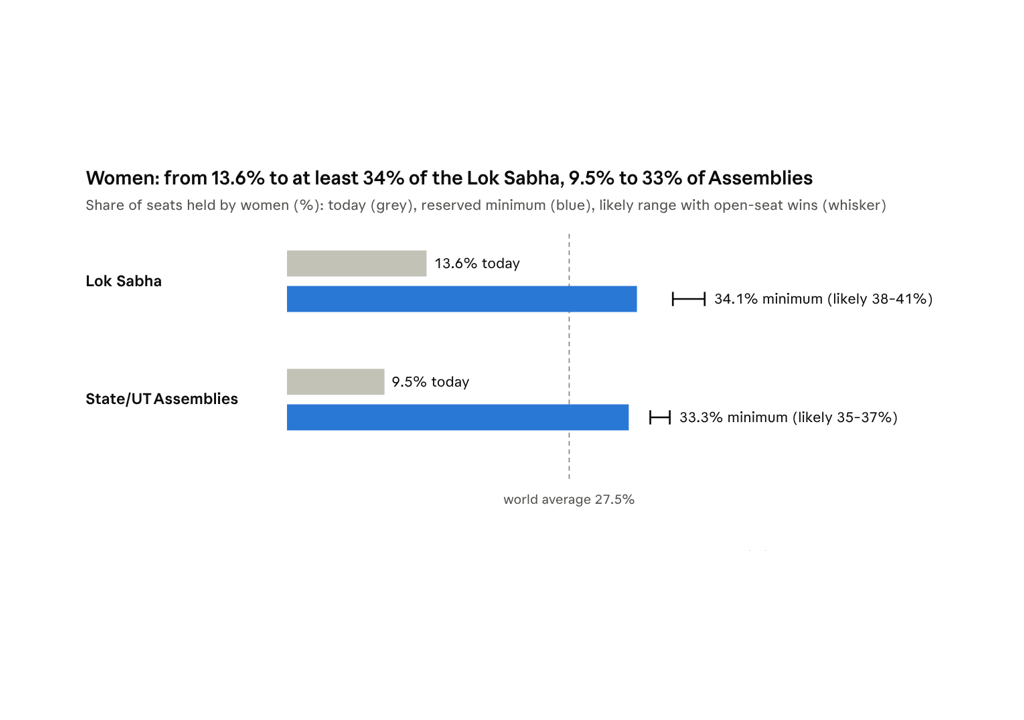
Today: ADR (March 2026). After: author’s calculation, one-third reserved plus assumed open-seat wins. World average: Inter-Parliamentary Union, 2026
The evidence from India’s own experiment with local government is encouraging. Since 1993, reserved seats have brought well over a million women into panchayats and municipalities; studies found that women leaders shifted spending towards drinking water and other public goods, and that reservation made voters more willing to elect women even after seats were de-reserved.
Research on State legislators suggests women representatives have delivered faster economic growth in their constituencies. A national quota of this scale would change who sets the agenda in Parliament and in every Assembly, and would create an immediate demand for women candidates that parties have resisted for decades.
The design questions are real, though. Reserved seats will rotate, so a woman who wins a reserved seat may face an open contest next time, and a male incumbent may suddenly find his seat reserved; the Bill leaves rotation to the Commission “as it may deem fit”, pending a Parliamentary law. There is still no sub-quota for women from Other Backwards Classes, the main demand of the Samajwadi Party and the RJD, and caste data from Census 2027 will not be used. And, as noted, the quota expires in 2041.
The opposition’s central argument is that none of this requires enlarging the House. Within 543 seats, 181 would be reserved for women from the next election. True — and that is precisely why the government prefers expansion: reserving a third of existing seats means a third of sitting MPs, overwhelmingly men, lose their constituencies. Adding seats buys the consent of incumbents. Whether a 50% expansion of every legislature in the country is a reasonable price for that consent is the real question before Parliament.
The government’s case rests on 2029.
For the new map and the women’s quota to apply to the next general election, the Commission must finish every State’s orders by about the end of 2028, so that the Election Commission can prepare rolls for 824 constituencies before polling in April–May 2029. That is roughly two years.
Justice Kuldip Singh’s Commission took about five, and it did not have to change a single State’s total or reserve a single seat for women. The Jammu and Kashmir Commission took two years for 90 seats.
The Bill sets no deadline; it asks the Commission only to “endeavour” to finish within whatever term the Centre notifies. If it slips, 2029 will be fought on the old 543-seat map, without the quota, and the government will have to explain why a delay justified rushing the law.
If the map is ready, 2029 will be the most disruptive election since 1977. Every boundary will move. A third of constituencies will be reserved for women.
Seat-sharing will be easier, with half as many seats to share again. Parties with centralised candidate selection and deep benches of women workers will adapt fastest. State elections will run on two maps for years: the seven States voting in 2027 will almost certainly use the old one; Tamil Nadu, Kerala, West Bengal and Assam will not see the new map until 2031.
None of the package’s flaws requires defeating it. They require amending it. Before the vote, Parliament should insist on five changes:
The southern States have won the argument they made in April: their share of Parliament will not be cut in 2029. That is a real achievement of federal bargaining. But the gain is narrower than it looks.
The inter-State question has been postponed to 2051, when it will be harder; the rules for drawing the map have been handed to a body the South has little say in; and the 2011 census may govern constituencies for another quarter-century.
The women of India deserve their seats now. They, and everyone else, also deserve a map drawn in a way that no one has reason to doubt.
Also Read:
‘Three targets still stand’: Yogendra Yadav warns of ‘Trojan horses’ in new Delimitation Bill
(Edited by R Rajesh Kumar.)



