

Published Nov 29, 2026 | 12:14 PM ⚊ Updated Nov 29, 2026 | 12:35 PM

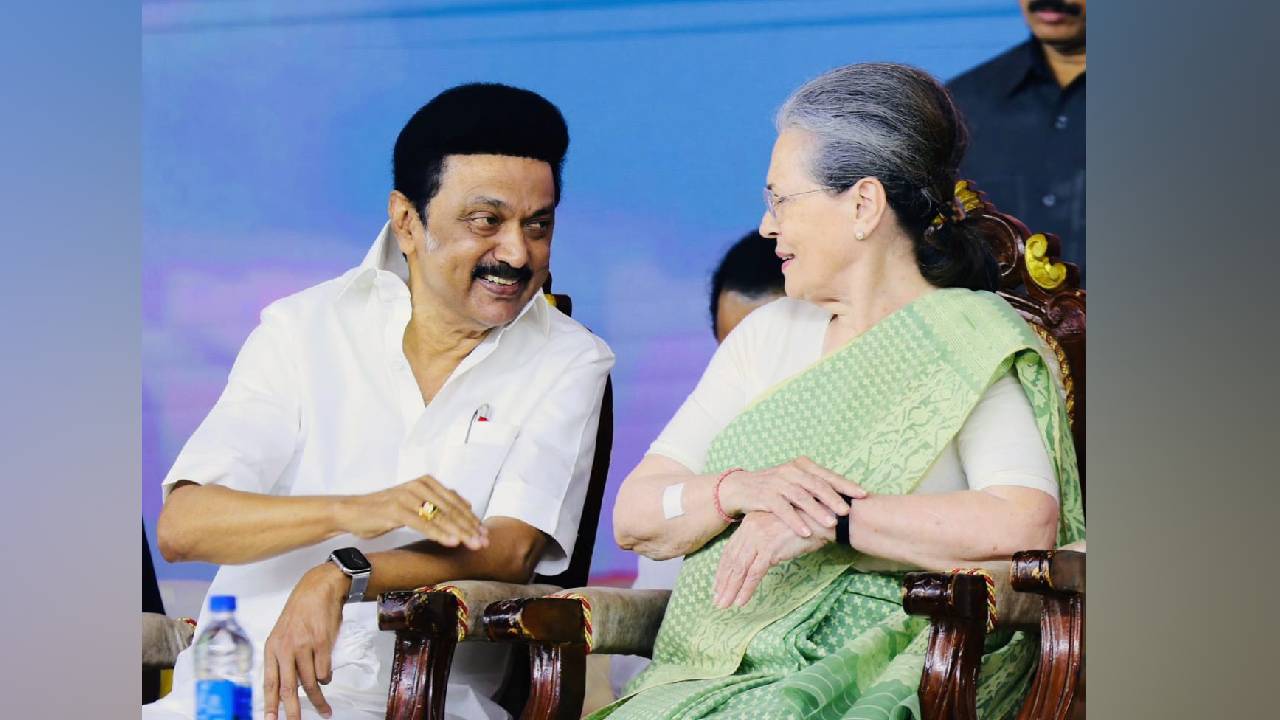
DMK chief M.K Stalin with Congress leader Sonia Gandhi.

In an attempt to persuade former ally Dravida Munnetra Kazhagam (DMK) to withdraw its support for the contentious delimitation Bill, INDIA bloc leaders, including Congress Parliamentary Party Chairperson Sonia Gandhi, are travelling to Chennai to meet party supremo M.K. Stalin.
The delegation, set to arrive in Chennai at 1:45 PM on Sunday, includes key leaders of the alliance, including the Leader of the Opposition in Lok Sabha Rahul Gandhi, AICC President Mallikarjun Kharge, former West Bengal Chief Minister and TMC supremo Mamata Banerjee and three Congress chief ministers: D.K. Shivakumar, V.D. Satheesan and Revanth Reddy.
In a post on X, Rahul Gandhi announced that the alliance leaders were travelling to Chennai to meet Stalin and request him to oppose the delimitation Bill set to be introduced during the special session of the Parliament beginning on November 30.
“An expansion to 850 seats will finish democracy in India. It will give BJP-RSS unlimited space to redraw India’s entire electoral map to their advantage. Brother Stalin has always stood like a rock against anti-Tamil forces. In the national interest, in Tamil Nadu’s interest and to protect the Constitution, we have to defeat this bill together,” Gandhi said.
Stalin, appearing firm on his position, responded to Gandhi in a post on X, “My sincere thanks to brother @RahulGandhi for acknowledging the DMK’s historic role in protecting the Constitution and the rights of the States. We have always made every decision keeping the interests of Tamil Nadu and our Tamil people as the foremost consideration.”
“We will not compromise on this path, and I’m confident that history will judge us as Kattabommans and not Ettappans,” he added.
The DMK, which had been on the forefront of the opposition protests against the delimitation exercise, on November 28 announced that it will support the new Bill, claiming that it promised Tamil Nadu a 7.21 per cent share of parliamentary representation, up from the existing 7.18 per cent. The party adopted a resolution supporting “fair delimitation” in a meeting of its MPs chaired by M. K. Stalin.
The party, however, claimed that its stance on the delimitation issue has not changed.
“Since the Bill allows a 50 per cent uniform increase in the number of seats for all states, the DMK has decided to support the Bill. We have always batted for fair delimitation. Our stance on this issue has not changed,” the party’s deputy general secretary and MP A Raja told reporters.
He rejected the view that the DMK had adopted a different position because it left the Congress-led alliance. He also disputed the allegation that the DMK had contradicted the Congress on the issue.
“Fair Delimitation was the position taken by the Congress as well. No political party had advocated anything other than this at that time. Our position has always been that delimitation must be carried out fairly,” he justified his party’s stand.
Addressing a press conference on the same day, Rahul Gandhi stressed that the issue was larger than individual State’s share of representation.
“There is a lot of talk about state share… that our state share should not be reduced. That is not the question here. The question here is giving the BJP the chance to reshape the foundations of Indian democracy,” he said.
The DMK has stayed away from the Congress-led alliance after a fallout with the party over joining the Tamilaga Vettri Kazhagam (TVK) government in Tamil Nadu after the Assembly elections. The Dravidian party had been among the strongest opposition voices against the delimitation exercise, with party chief M.K. Stalin leading massive protests in the state when the BJP-led government introduced the earlier Constitution (131st Amendment) Bill in Parliament in April this year.
The INDIA bloc has announced that it would oppose the repackaged delimitation Bill, with AICC President Mallikarjun Kharge describing it as a “major threat” to democracy. They have raised three key demands: the current strength of the Lok Sabha should be maintained, women’s reservation should be provided based on the current strength of the Lok Sabha, and the current allocation of seats among states in the Lok Sabha should be maintained for the next 25 years.
The Constitution (132nd Amendment) Bill, 2026 and the Delimitation (Second) Bill, 2026, set to be introduced by the BJP-led central government in the Parliament during the special session, propose a uniform 50 per cent increase in the number of Lok Sabha seats in all States and a 25-year extension of the freeze on each State’s proportional share of representation in the Lok Sabha, currently pegged to the 1971 Census.
(Edited by Fayisa CA)
Also Read: Explained: The southern challenge facing the Centre’s delimitation Bill



