
Published Sep 27, 2026 | 4:00 PM ⚊ Updated Sep 28, 2026 | 12:21 PM

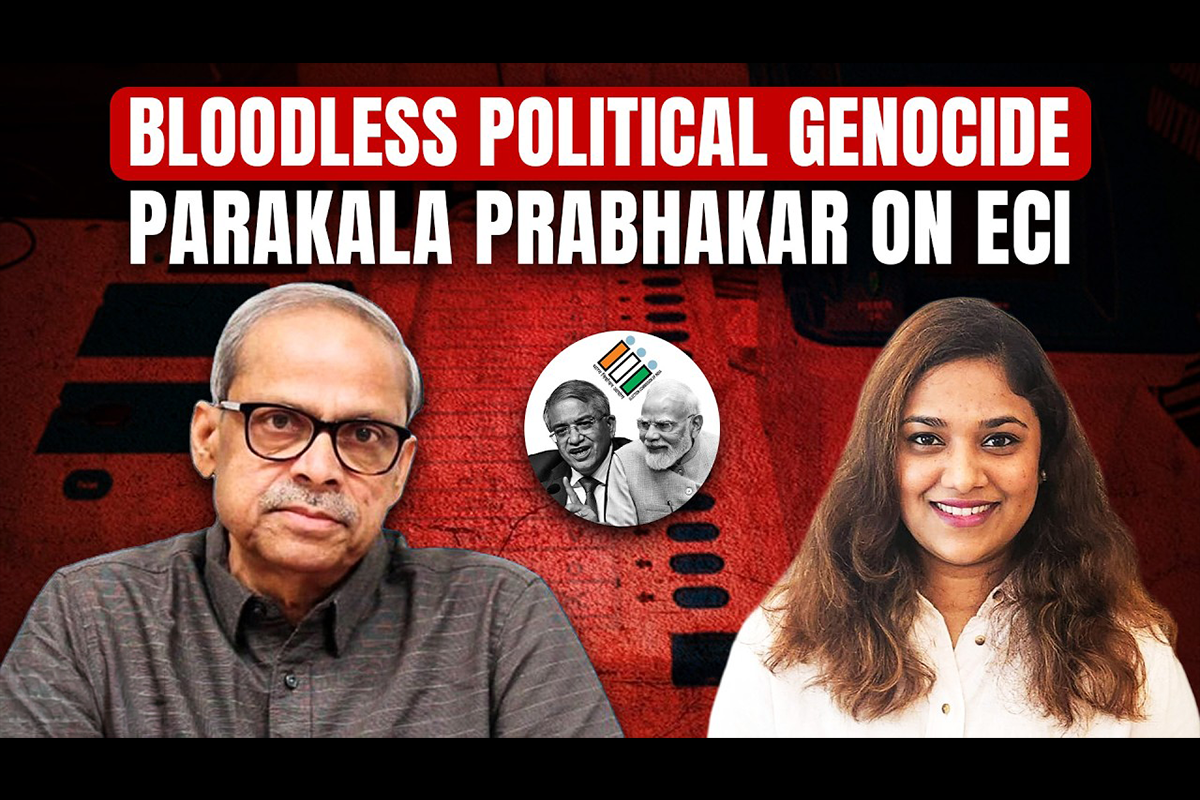

Synopsis: Since its inception in mid-2025, the Election Commission of India’s Special Intensive Revision (SIR) of electoral rolls has consistently raised concerns about widespread voter disenfranchisement. In recent months, a series of journalistic exposéshave not only affirmed those concerns but raised further questions about the poll body’s credibility. In a conversation with South First Editor Anusha Ravi Sood, economist Dr Parakala Prabhakar describes the contentious exercise as a “bloodless political genocide”, aimed at disenfranchising whole sections of society in service of the Hindu Rashtra project.
The deeply flawed Special Intensive Revision (SIR) of electoral rolls, undertaken by the Election Commission of India (ECI) since mid-2025, was already burdening citizens. Now, a series of journalistic exposés raise questions about the intent, integrity and functioning of the poll body.
In conversation with South First Editor Anusha Ravi Sood, renowned political economist and commentator Dr Parakala Prabhakar deems the SIR exercise a “bloodless political genocide”.
Dr Prabhakar agrees with Anusha’s long-held characterisation of SIR as a backdoor attempt at the controversial National Register of Citizens. He adds that the mass disenfranchisement of voters is part of a planned process towards the idea of “Hindu Rashtra”: an attempt to push “impure” elements out of society and, ultimately, exterminate their citizenship.
Edited excerpts follow.
Also Read: Why CEC Gyanesh Kumar should resign, and why the appointment process needs to change too
Anusha: The Election Commission of India, which is supposed to be the premier institution protecting everything that India stands for—a democracy, a people’s republic where people have the right to choose their elected representatives—today faces a credibility crisis.
Is this the first time since Independence that the ECI has faced such a huge credibility question? Is this question any longer debatable, or is it proven beyond doubt?
Dr Prabhakar: I think the ECI’s credibility is at its lowest point. Once this goes beyond urban, news-consuming public and slowly starts sinking into the country’s consciousness, it might even go into the negative.
In 2001, when the Election Commission of India was celebrating its Golden Jubilee, the then President of India, K.R. Narayanan, addressed a meeting of the Election Commission. He said that the credibility of the Election Commission of India was much higher than even the judiciary.
Today, just before and after the 2024 elections, CSDS and Lokniti conducted a survey. Forty to 50 percent of people said they had lost trust in the ECI. Some even said they believed that the Election Commission of India does the government’s bidding.
There are reasons for that. Look at the way the ECI is appointed, especially after the new law in 2023, which gave lifetime immunity not only to the CEC but also to all the election commissioners.
Interestingly, that law was passed when a large part of the Opposition was suspended, and it was passed by voice vote. The Chief Justice was taken out of the selection committee. One of the justices of the Supreme Court recently commented that the presence of the Leader of the Opposition is now only nominal, which you and I and many others were feeling, because the government has a 2-to-1 majority on the committee.
What kind of credibility would a Commission appointed in such a manner, with that kind of immunity, have? And then there is the conduct of the Commission since the appointment of the three commissioners. Look at the way the Model Code of Conduct was implemented. It was absolutely, openly in favour of the ruling party.
They condoned hate speeches; they allowed hate speeches. Look at the way the election schedule was drawn, the phasing of elections, and then you have polling, followed by the final figure only after several days.
Many of my colleagues and I were talking about the discrepancy between the initial percentage of polling and the final polling figures, and then the spurious injection of votes in the 2024 elections. Almost five crore votes were spuriously injected, because there is a huge gap between the initial, provisional figures and the final figures declared much later.
And then, in our calculation, almost 79 Lok Sabha seats changed hands across 15 states, and that completely affected who was in power.
With all this in the background, when the Election Commission’s credibility is already low—it’s not that this is the first time it has been low—now come the Indian Express’s Ritika Chopra revelations. I think this is a very decisive juncture for Indian democracy, Indian federalism, and the credibility and integrity of the institutions.
Also Read: Call for poll panel chief’s resignation: SIR row hits the streets; protesters detained in Delhi
Anusha: The Congress very recently put in the public domain the Leader of the Opposition’s dissent note when the appointment of Mr Gyanesh Kumar as the CEC was made. Also take into context this law that pretty much gives election commissioners greater immunity, not just when they are in office but even after they exit. It basically means you have no venue to hold them accountable.
Even if you are able to say, as the Indian Express investigative piece did, and provide evidence, put evidence on the table of not just rupture within the ECI but also majority rule—the rule of law that asks for a majority or consensus decision—being overruled. Here we have two election commissioners who have gone on record officially to say that this is not something we approved.
So, if you do not have a venue to hold anybody in the ECI accountable, where does the buck then stop? Can somebody say that the government of the day should not be held accountable for whatever is happening in the ECI, considering how much influence the government holds over institutions, including the ECI, given the way they have been appointed? Can somebody say you can’t hold the government responsible?
Dr Prabhakar: That’s a very interesting thing because, whenever people like me point out the irregularities you have just mentioned—polling patterns, polling numbers, MCC, etc.—it is not the ECI which answers you. Interestingly, it is always BJP spokespersons who come to the defence of the Election Commission of India. Even in this latest instance, that is the case.
What does it mean? I’ll tell you a small anecdote, something that happened in my own experience. When I was travelling to one of these meetings, somebody sitting next to me on the aircraft recognised me and said, “You speak so much about ECI, you’re unnecessarily wasting your breath and wasting your time.”
He said, “You see, the BJP has a Kisan Morcha to organise farmers, Mahila Morcha to organise women, they have Yuva Morcha to organise young people. They have Dalit Morcha to organise Dalits. They have an Election Morcha to organise elections, and that is the ECI.”
He said that, and it really shook me and shocked me. That is the level of credibility of the Election Commission. The BJP is not doing any service by deploying their spokespersons to defend the ECI.
What is wrong when we say, “Look, why don’t you show us the Form 17C? Why don’t you make it public?” No, the Election Commission doesn’t talk. But as a political party, the BJP also should ask for us. Instead, the BJP says that it is right that Form 17C is not given to you. Why?
And today there are questions about meetings, dissent notes, objections and documentation. If you don’t have enough documentation to support you, you won’t go public with a story like that. You’ll be skinned alive, especially in these circumstances. But they’ve done it, which means the story is very credible.
In fact, look at the kind of statement that the ECI had put out. Even to be very generous to the ECI, I would call it a joke. It doesn’t answer even a single point raised in the investigative report. Why the change in Form 6? Why the instance that the report quotes, where 97 people were found eligible, but the EROs in the state election office were not able to access the portal to include their names?
And who really raised objections in Bengal to delete the names? Sixteen lakh objections were raised in Bengal.
Coming out and saying that it’s a multi-member organisation and there could be discussions or differences of opinion, all that is fine.
But mind you, even if they were all unanimous decisions, the ECI does not have the authority to alter Form 6. It does not. It has to be done by the government with the approval of Parliament. You have to amend the law. You have to amend the rules. How can you do that? Whether one person did it, two people did it or the three together did it, we don’t know.
If you want to defend this, if you want to come clean, the Election Commission should say: these were the number of meetings that were held, these were the minutes of the meetings, and look at the signatures of all the election commissioners. They were all unanimous decisions. But, of course, there were different opinions expressed, but ultimately consensus prevailed, etc. You should bring them and put them in the public domain. We will all see.
And if it is really as you say—that they were consensus decisions—the law very clearly prescribes that, as far as possible, the Commission will have to arrive at decisions on the basis of consensus, failing which, a majority.
Right now, who is the majority in the Election Commission? If two election commissioners have said that they were not consulted, their opinions were not taken, they were not even aware of certain measures that the Election Commission of India was taking, where does it leave us?
Anusha: It is also important here to mention that when we say it is a body of three people, even if it is the Supreme Court and it is a Chief Justice bench of three judges, just because the Chief Justice is in disagreement with two other judges doesn’t mean the order will go with the CJI. The order will be, like you said, what the majority decides the outcome should be.
Something else that you pointed out about how the BJP is actually the one responding to any allegation against the ECI, which I also think is true of the ECI. If you recall, the first time the term “vote chori” became publicly popular was when the Leader of the Opposition, Mr Rahul Gandhi, used it when he wanted to demonstrate how, in Bengaluru, there was a blatant attempt to steal votes. “Vote chori” was a term that was coined. He was pretty much ridiculed then.
But I suppose now the Indian Express investigative piece has actually provided proof of how things did fall. At that point in time, the ECI’s tone and tenor in demanding proof of what Mr Gandhi was saying, or else asking him to apologise…
Dr Prabhakar: They demanded a sworn affidavit.
Also Read: The struggle to be counted: Informal workers among the worst affected by SIR process in Telangana
Anusha: They insisted that if you cannot prove it, then you must apologise. Never has there been a scenario where an entity like the Election Commission of India has used language or a tone like that before.
You spoke about the set of documents that the entire SIR process is demanding and the kind of hardships that citizens are being subjected to. Has the ECI lost its focus? Because the primary job of the ECI is to ensure that every eligible voter is counted on the voter list. Giving every adult their franchise is the primary job of the ECI. But here is a scenario where the ECI seems to be more focused on disenfranchising people. And most often than not, the worst affected are the vulnerable and the marginalised.
The ECI has also come up with this brilliant new idea of VIP voters. Since when did the concept of VIP voters creep into our democratic system? It is something I don’t understand. The first thing that popped into my head was George Orwell’s Animal Farm, where some animals are more equal than others.
Isn’t this an abdication of responsibility by the ECI, when not only is it disenfranchising the most vulnerable, the marginalised and those who simply do not have the kind of documents it demands—which could be for varied reasons—but is also choosing to treat some citizens over and above other citizens?
Because, at the end of it, the vote is pretty much the only thing in a country as varied as India that is equal to all, or is supposed to be equal to all. But has the ECI abdicated that responsibility?
Dr Prabhakar: Yes, of course. What I would say is that the ECI, whatever it is doing in the form of SIR, should not be looked at from the electoral point of view. We should also not look at it in terms of who wins or who loses, to whose advantage it will be or whose disadvantage.
Let us first look at this whole thing with a party- or winner-loser-agnostic mind. We don’t care which party takes advantage or suffers disadvantage, who wins or who loses. That is not necessary. Then what does this do? Let’s be very focused on this.
And that is the reason why I say SIR is not an electoral project. It is a much deeper project than handing over election victory to anyone.
What does it do? In the wake of SIR, India will have two types of people – one with franchise, another without franchise. The country is going to be split into two. Please understand this.
Now, what happens to those people who are disenfranchised? I will give you a thought experiment. Imagine 500 people living in a place and none of them have a franchise. Will any political party or leader go there? Will the government respond to what they say?
Even if you have votes and they don’t listen, that is a different thing. But if they do not have a vote, what those 500 people think of who is in office, how they are doing, and what their performance is won’t matter. Those in office don’t have to give them roads, electricity, schools, medical care. Nothing.
You are there. If you want to continue to live like a second-class citizen, you continue to live. Otherwise, go wherever you want to. Depending on who you are and what your religion is, they’ll also give you destinations.
So that is the kind of India that we see very shortly. We are already seeing it. Because by now there are 13 crore people already disenfranchised. Thirteen crore, for a country of our size, we feel is very small. But please don’t miss this point: 80 percent of the countries in the world have either 11 or 12 crore population. Thirteen crore is more than the population of Mexico.
Which means that you are taking country after country out of this body politic and throwing them out. You have made them a mistake. You have pushed them out of your political society.
And then comes: who are these people?
Also Read: Missing names, broken portal: Shivajinagar voters on ECI’s SIR experience
Initially, a lot of commentators, analysts and observers thought these were all shoddy bureaucratic exercises, which was the reason why a lot of people were being left out. But you see a pattern and a purpose. That’s what I’ve been arguing for. Now it is very clear. It’s being deliberately done.
The Election Commission suo motu, without the authorisation of the entire Commission, goes about and files for 16 lakh deletions in West Bengal. Who are these people? And they don’t admit 97 people from Goa even when the state and local officials said they were eligible. Which means that there is a purpose, there’s a plan.
If you look at the entire picture, you will find Muslim minorities, Christian minorities, Dalits, Adivasis. You will find, as you were saying, marginalised people who are daily wagers, who do not have a voice, who cannot forgo a day’s labour and wages to come and queue up outside a hearing centre. And among all these sections, women.
Now, some people might say, well, how do they know that these people don’t vote for the BJP? No, it’s not a question of knowing who votes for the BJP and who doesn’t. It’s not. It is much more than that, much deeper than that.
Because when you customise your political society with only certain people and throw a lot of people out, then what happens is, for a couple of election cycles, it might favour or benefit the BJP or the ruling party, or somebody or the other, and it might harm others. But eventually, what it does is that those people with franchise are going to be of a certain religion, a certain class, a certain language, mostly from a certain geographical area.
If that is the case, then all the political parties, if that is the political ground, will have to work in order to win over this particular constituency. Which means that all political parties eventually willingly become like the BJP, or even more so.
The second thing is that, eventually, this is a project in order to realise the “Hindu Rashtra”. You are disenfranchising, you are pushing the “impure” elements out of society. I term this as bloodless political genocide.
Earlier, in European or African experience—Nazi Germany or America’s Native Indians, lots of examples—the unwanted people were either pushed out or killed. Now, here in 21st-century India, you can neither push them out nor kill them. So what do you do? When you cannot kill a citizen, when you cannot exterminate a citizen, what can you do? You will exterminate the citizenship. And without franchise, citizenship is nothing.
Also Read: Interview: Beyond dispatched passport — R Rajagopal questions policy failing lakhs of citizens
Anusha: At the very beginning of the process, given the kind of documentation that the ECI demanded, my view and my argument was that SIR is simply the backdoor implementation of the NRC.
My argument was that because the Union government, led by Mr Modi as Prime Minister and Home Minister, could not come up with guidelines and a framework to implement the NRC, they have basically shouldered off the responsibility to the ECI and, under the garb of SIR, compelled citizens to prove their citizenship, which should be the other way around.
If I’m born in this country, the onus should be on the state. If they want to alienate me and say, “You do not belong to this country”, the burden of proof should not be on me. But here the burden of proof has been shifted to the voters in the most inconvenient manner possible.
I think my reading was much more surface-level. But you have given a far more nuanced explanation of the same scenario: how this entire exercise has been a circumvention of putting the burden of proof on citizens.
Dr Prabhakar: You hit the bullseye. That’s exactly what it is.
Anusha: And I think most people also do not understand that we are a country where a big chunk of the population still struggles to put food on the table every day. And here we are expecting them to have documentation from their Class 10 board exams, birth certificates, etc. It’s almost as if those who are formulating these policies and guidelines at the ECI have no understanding of the ground realities of this country and its people.
Dr Prabhakar: Today I saw a ground report in The Hindu from Bengaluru. A 79-year-old man was asked to show details about his grandparents. Seventy-nine years old. So this is a different kind of exercise. I think all of us should stop looking at this in electoral terms.
Anusha: I’m going to ask you a more political question around the same subject. Something that caught my attention was when the Leader of the Opposition, Mr Gandhi, was talking about how a lot of information about “vote chori” or the misgivings in the ECI was coming to the Congress from within the ECI – that is, officials of the ECI or those in the government were expressing their disappointment with the way things are functioning.
It quickly took me back to the UPA era, when a lot of political analysts would say the fall of the UPA was because the bureaucracy ultimately turned against the then government. Is a similar scenario shaping up right now?
For so many years, we have been fed this concept of “Teflon coating, no criticism sticks”, etc. But I would really like to understand, given how several things have been unravelling—whether it is the Gen Z protest, the way the government has been forced to roll back on a lot of its decisions, compelling its minister to resign, and now the Opposition claiming that officers themselves are giving them information—do you look at this as perhaps the bureaucracy also turning against the government? Is this a UPA scenario replaying?
Dr Prabhakar: I would look at it as ECI-gate. It is an ECI-gate, no less.
About the inside information, of course there are people who are very suffocated and who do not approve of or agree with what is happening. And they are aware that what is happening is really destroying the soul of India and completely destroying the Constitution. There are people.
But you see, what they have done by way of the kind of manipulations that have taken place during the elections from, say, 2019 onwards—some people say from 2017, 2018, 2019 and 2020, and all the elections till 2024, and even after 2024—is that, even before the rollout of SIR, elections were manipulated.
How they are manipulated? This is not the time to discuss that. But I have shown you in my piece. The calculation is that a vote was cast in Andhra Pradesh between 11.45 pm. and 2 am. in the morning. A vote was cast every three seconds. Imagine a fly going into the polling station and flying around and coming out: it takes more than three seconds. But for a vote?
The reason why I bring this up is that, on top of it, people turn against the government, the bureaucracy turns against it, but it does not reflect in the ballot box.
So they have probably understood or anticipated this kind of backlash and made sure that all the adverse opinion, the adverse view of the government—can you imagine, with the kind of runaway inflation in terms of food, education and medical costs; the kind of high youth unemployment, even general unemployment; the kind of high rural distress; and historically high household debt and historically low household savings—with this kind of economic crisis, you can show 7.8, 8.2 GDP, whatever you want to show.
But if the government is not able to come and say in public, “Look, I’ve created a crore of jobs,” they are talking about the upstream of GDP accounting, but not the downstream. What has it done?
Can you believe that, in that kind of economic situation, that kind of political situation, that kind of unrest among the people, that kind of distress among people, a government cannot return to power? If it returned, it is mainly because all your unease, all your dissatisfaction, all your displeasure is taken care of in such a way that it does not reflect in the EVM.
So the bureaucracy might start leaking things. But unless the Election Commission is disbanded and a new Election Commission with an entirely new framework and procedures in place for accountability, transparency, answerability, approachability, all the rest of that, we just can’t go forward.
Also Read: PM Modi, Amit Shah will be investigated; Gyanesh Kumar should turn approver: Rahul Gandhi
Anusha: How do you think things would have turned out differently had the Supreme Court been a little more proactive when the West Bengal SIR cases were filed? And what is the way forward? Cancelling or undoing everything that SIR has done so far – is that what we should be pushing for or looking forward to?
Dr Prabhakar: If the Supreme Court of India had decided to do what it was supposed to do and discharge its responsibilities, things would have definitely been different.
But the tragedy, of course – you and I have a lot of respect for the judiciary, especially the Supreme Court of India. But we have to, as free citizens of India, also say that Supreme Court justices from the bench did ask very, very searching questions during the SIR and after that in many cases.
But unfortunately, whatever answer the Election Commission had given, they took it at face value and accepted it. They did not say, “Is that true? Is it right?” That is a major difficulty with the SC. They are asking good questions, but nothing else actually comes out. As a judge from the bench, oral remarks are very good. But when it comes to the judgment, that’s disappointing.
The Election Commission should be made accountable, and not just for the little things. Since the EVM regime, what is the source code? That’s very important. They don’t reveal the source code. We can’t really check whether the EVM is reliable or not.
So when we do not know whether it is reliable or not, when we are not sure whether the vote that I intend is being recorded as intended, being counted as intended, being announced as intended – no. If you press the button, you do not know where it is going.
(Edited by Dese Gowda)



