

Published Aug 06, 2026 | 9:00 AM ⚊ Updated Aug 06, 2026 | 10:47 AM

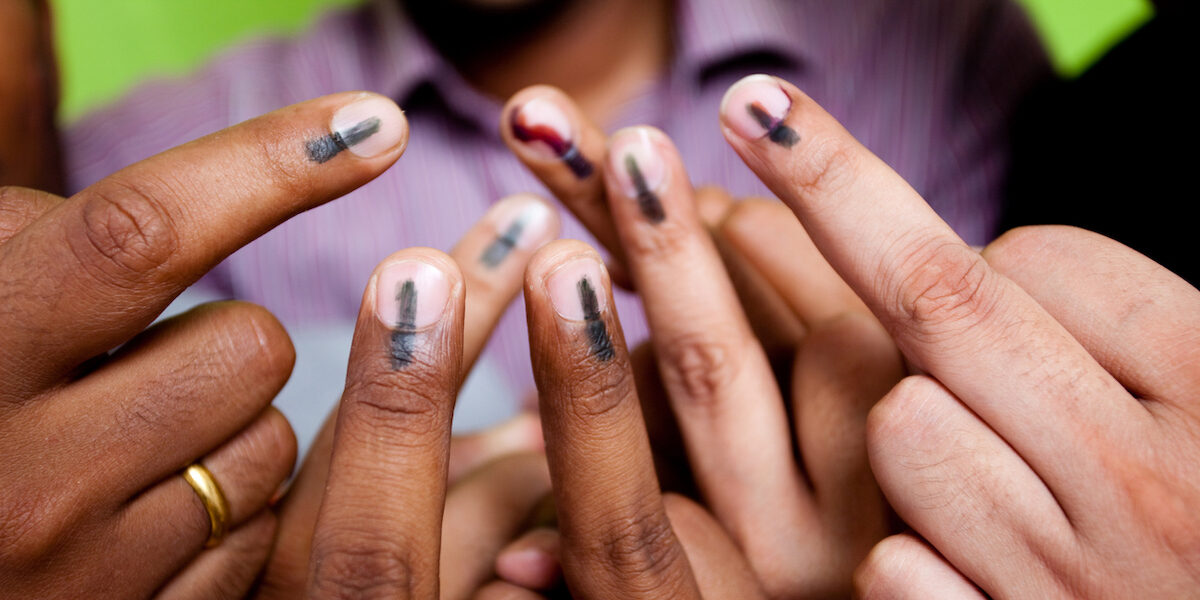
“One person, one vote” is the foundational principle of democracy. (iStock)

Synopsis: Thousands of informal and migrant workers in Telangana have struggled to navigate the Special Intensive Revision (SIR) of electoral rolls because of documentation requirements, limited awareness, digital barriers and problems with the enumeration process. While civil society groups, Booth Level Officers and cadres of political parties have stepped in to help many workers complete the enumeration, activists say unresolved issues could still leave many eligible voters off the final electoral rolls as the process draws to a close.
Ravi drives an autorickshaw out of Karkhana, a neighbourhood in Secunderabad, Telangana, picking up fares through ride-hailing apps to support his wife and two children. When the enumeration form for the ongoing Special Intensive Revision (SIR) of electoral rolls in the state reached him, he did not know what to do with it.
“I cannot read, and that’s why I couldn’t fill out the form myself. I went to the community hall and asked the people there for help,” said Ravi. He eventually submitted his form, but not before losing two days of work.
“It is a huge loss to me, but what else could I do? I had to go because a friend told me that filling out the form was more important,” he added.
Ravi’s experience is not an outlier. Across Hyderabad and Secunderabad, informal workers such as auto drivers, gig workers, domestic workers, sanitation workers and street vendors have all run into the same wall: a lack of relevant documentation, difficulties filling out the form, inadequate awareness and limited access.
As the door-to-door enumeration phase draws to a close on 10 August, many informal and migrant workers in the state remain at risk of falling off the electoral rolls altogether. Those who have managed to secure their place have often had to struggle to produce the required documents and complete the enumeration forms.
The Special Intensive Revision has remained contentious since it was rolled out early last year. Opposition parties have consistently alleged that it is an attempt to manipulate the electoral rolls ahead of Assembly elections and have demanded that it be rolled back, but the exercise has proceeded in three phases.
The initial rollout began in Bihar in mid-2025, where nearly 47 lakh names were struck off the rolls. In Phase 2, the SIR was carried out across nine States and Union Territories, including West Bengal, Tamil Nadu and Kerala, from November 2025. This marked the expansion of the exercise across the country.
From May 2026, a third phase covering 16 States and three Union Territories, including Telangana, began. That same month, the Supreme Court upheld the SIR as constitutionally valid and consistent with the Representation of the People Act.
In Telangana, Booth Level Officers began the door-to-door enumeration process for the state’s 3.38 crore electors on 25 June.
The stakes extend beyond the ballot. In West Bengal, where a Special Intensive Revision was carried out earlier this year, the state’s Food and Supplies Department ordered in June that ration cards linked to names deleted from the electoral rolls be marked inactive. The move threatened welfare benefits for lakhs of residents.
The Supreme Court later held that people excluded from the electoral rolls would still be entitled to certain welfare benefits. But the episode has left informal workers elsewhere wary that a clerical slip on the voter list could just as easily cost them their rations.
Sister Lissy Joseph, Chairperson of the National Workers Welfare Trust (NWWT), told South First that the biggest hurdle facing many informal workers was the lack of documentation. The NWWT has been working with domestic workers in the state, helping them organise under the Telangana Domestic Workers Union (TDWU).
Speaking about the communities she has worked with, Sr Lissy said, “Many are still living in subsidised state housing sanctioned to them over 20 years ago. For a few communities, this was their first experience of assimilating into society. Where can they get their parents’ voting information? A lot of them only started voting recently.”
Where discrepancies arise, the ECI recommends submitting one of 11 indicative documents, including a birth certificate, passport, matriculation certificate, residence certificate, caste certificate, forest rights certificate, or an identity card issued to a government employee or pensioner. For informal workers, many of whom possess none of these, that requirement alone can be disqualifying.
“A majority of the informal workers in the city are migrants from villages in Telangana and Andhra Pradesh who have lived here for a long time. A huge chunk are also from other states. It is not possible to ask all of them to keep these documents on hand,” said Sr Lissy.
She also pointed to people displaced by floods and those forced to move frequently for work, saying it was unfair to expect them to have the required documents readily available.
The documentation requirement has disproportionately affected women workers who migrated to the city after marriage, changed their last names, and/or do not possess their parents’ documents.
Manjula, a small-time vendor in Surya Nagar near Baghlingampally, said she could not furnish her parents’ voter information from 2002 because they had passed away long ago.
“I got married in 2002 and registered to vote much later in 2014. What proof can I submit from 2002 to link to my parents?” she asked.
Even where Booth Level Officers (BLOs) and other officials are willing to help fill out the form, they cannot resolve the errors flagged by the online portal in cases of mismatched information or missing documents.
Also Read: Telangana: Three school students booked for sexually assaulting junior
Beginning on 15 June, the door-to-door enumeration posed a host of challenges. Booth Level Officers (BLOs) were tasked with visiting voters’ homes to distribute the enumeration forms.
Many informal workers did not receive the forms because they were away at work during the day. Those who did receive them struggled to fill them out because of limited or no formal education. Many also complained that they were not given a copy of their submitted forms.
Activists demanded that the state government designate a fixed space in each community for BLOs to operate from. This change was eventually made, but only several days into the process.
Manju from the Gruha Karmika Union of Telangana State (GUTS) said that in some bastis, such as Meerpet, residents were given enumeration forms printed only in English. When they asked for help, she said, they were told to get their school-going children to fill out the forms.
Manju also pointed to a more basic inconsistency. Within the same household, one family member might receive an enumeration form while another received nothing at all, with no explanation from the BLO.
Komaraiah, a resident of Nacharam who works at a nearby factory, never received his SIR form. His wife, Lalitha, received hers only after their son repeatedly called the BLO.
“My husband has lived here in Nacharam for over 30 years. He worked for a decade as a watchman in the same locality. He has a voter ID (EPIC) card from 2003. In 2024, we got our votes in different constituencies. We have not been able to get in touch with the officer for his constituency,” Lalitha said.
Sr Lissy Joseph said limited awareness and poor accessibility had made the process even harder to navigate.
“They have prioritised awareness through social media, but not everyone has access to it. How can people find information about the SIR, the contacts of BLOs, and the necessary documents without access?” she asked.
People without access to digital tools are also struggling to verify the 2002 and latest 2025 electoral rolls online or to register as new voters. At Teachers Colony near Rail Nilayam, Srilatha, a 25-year-old disabled woman, said she had been turned away multiple times since last year by Mee Seva Centres and BLOs whenever she tried to register to vote.
“They ask me for my phone number. I do not have a mobile phone. I sell balloons for a living and sometimes do domestic work too,” said Srilatha. Without a contact number, she said, she has also been unable to apply for the PWD pension.
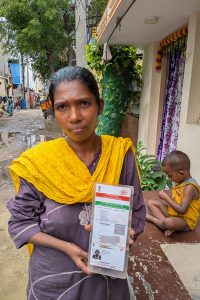
Srilatha displaying her Aadhaar at teachers Colony, near Rail Nilayam, Secunderabad
(Sreshta Ladegaam/ South First)
Srilatha has been estranged from her husband and lives with her mother.
“My mother has a voter ID (EPIC) card, but I am not able to get one for myself. I was born and brought up here. No official is helping me,” she said.
BLO Narsingh Rao told South First that registering new voters had become a persistent challenge.
“The portal is not working. Right now, it’s not even opening. We asked for help from Mee Seva; they also have no idea how to work around it,” he said.
Savitri, a 38-year-old domestic worker from Teachers Colony, said, “I have two sons, Joshua and Samson. They work with a sofa manufacturer. Both applied to register, but only one of them had his application accepted.”
“I grew up here. So did my kids. I don’t know how he cannot be a registered voter here when his whole family is,” she added.
Also Read: Hyderabad Cyber Crime DCP who booked case against Meta India chief shunted out
Government employees across Telangana were designated as Booth Level Officers (BLOs) and assigned SIR duties in addition to their regular work. While Municipal Corporation officials, RDOs and MROs/Tahsildars took on the role of Electoral Registration Officers, the labour-intensive work of physically distributing, collecting and digitising enumeration forms fell to more junior staff.
VROs, Anganwadi teachers, ASHA workers and, in some areas, SHG leaders and sanitation workers were all tasked with SIR duties.
Many voters complained that the BLOs assigned to guide them through the process were themselves inadequately briefed. Those who owned smartphones and could navigate the ECI’s portal filed their forms online and largely bypassed the chaos. Many informal workers, however, had no choice but to rely on a BLO who might be just as unprepared as they were.
The office of the Telangana Chief Electoral Officer (CEO) conducted training sessions for BLOs ahead of the enumeration drive. But by the time the exercise began, many were still unprepared for its scale and complexity. For many BLOs, the training covered only the basics and proved insufficient for the demands of the exercise.
GUTS coordinator Manju said that in several areas, BLOs were posted to localities far from where they normally worked. This affected their work because they were unfamiliar with the streets and the families living there. They were also severely understaffed relative to the population they were expected to cover, a gap that was particularly pronounced in a dense city like Hyderabad.
The targets set for BLOs added to the pressure. On 27 July, Dadigala Aruna, an Anganwadi teacher assigned BLO duties, died in Kuravi village in Mahbubabad district. Her colleagues alleged that the additional workload had taken a toll on her health and staged protests in the aftermath.
Such deaths are not unique to Telangana. BLO deaths linked to overwork during the SIR exercise have also been reported in West Bengal, Gujarat and Rajasthan, with families and colleagues in several cases blaming the pressure of digitising thousands of forms against tight deadlines.
The Telangana government later moved to ease the burden on Anganwadi teachers by reducing their centre hours to 10 am to 3 pm for the duration of the enumeration exercise.
Concerned activists, unions and civil society organisations have taken on the task of raising awareness about the SIR process, filling gaps that many felt the state itself should have addressed.
Sister Jenestus of the Montfort Social Institute told South First that the organisation had been working proactively with garbage collectors, domestic workers’ unions and other informal workers by conducting awareness sessions on the SIR.
“We worked in seven districts across Telangana. In Hyderabad, we visited settlements populated by informal workers, such as Warasiguda, Meerpet, and Parsigutta, among others, to raise awareness,” she said. They also engaged directly with BLOs, conveying the issues affecting residents.
Sr Jenestus said their efforts appeared to be paying off, with many of the localities they visited having completed the enumeration process.
Field workers from the National Workers Welfare Trust (NWWT) also covered several bastis in Secunderabad, building on their existing organising work with the Telangana Domestic Workers Union (TDWU). Its field coordinators and union members attended sessions at the NWWT office in Paigah Colony to learn about the SIR process.
A group of activists came together to form the Telangana Voter Rights Forum (TVRF), a non-partisan platform to protect citizens’ right to vote. The Forum submitted multiple representations to the office of Chief Minister Revanth Reddy, seeking greater public awareness and a smoother SIR process through a clear set of recommendations.
In the first week of July, the TVRF held a public consultation to document the issues informal workers were facing with the SIR. The consultation, followed by a panel discussion, culminated in a formal set of demands submitted to the state government and the Chief Electoral Officer.
These included a multilingual awareness campaign in Telugu, English and Urdu; the daily availability of BLOs at fixed public assistance points, with their contact details publicised and periodic grievance redressal; dedicated voter helplines and help desks through Gram Panchayats and urban local bodies; regular consultations between District Election Officers and civil society organisations; and a three-month extension of the SIR timeline.
The Forum also urged the state to simplify access to Permanent Residence Certificates, which the ECI accepts as valid proof, through Gram Panchayats, local bodies and Mee Seva centres, noting that many poor and informal-sector households lacked the other prescribed documents.
Some of these demands have since been partially met. The ECI has set up helplines and help desks to assist citizens, while awareness announcements were made over loudspeakers in several localities.
Most significantly, in the final weeks of the enumeration phase, the state government introduced the Telangana Family Register Certificate, issued through Mee Seva and local bodies, giving residents an alternative proof of identity accepted by the ECI.
Suneetha Achyuta, a senior researcher and activist, said that despite multiple representations, not all of the Forum’s recommendations had been acted upon. District Election Officers, she said, had so far not actively engaged with civil society organisations, despite repeated requests.
“We had asked for Permanent Residence Certificates but were told it would not be feasible due to the Mulki rules. But the Family Register Certificate should serve a similar purpose,” she said.
The end date of the enumeration process has been extended twice, but the requested three-month extension was not granted despite widespread demand.
“We are going to continue publicising our demands. We will conduct another public consultation soon,” said Suneetha.
Booth Level Agents (BLAs), the party-appointed volunteers who typically assist during elections, have found their role expanding beyond its usual bounds during this SIR cycle. Across the city, BLAs from several political parties have taken on tasks that would ordinarily fall to government employees.
They have been helping residents fill out enumeration forms, track down documents, retrieve electoral records and, in some cases, distribute the forms themselves.
In Manikeshwari Nagar, a settlement largely populated by construction and sanitation workers, BLAs representing the Congress have effectively replaced the state-appointed BLOs.
BLA Suresh helping residents at Congress Party Helpdesk in Manikeshwari Nagar
(Sreshta Ladegaam/ South First)
BLA Suresh said, “One of the BLOs for this area was unresponsive, so we set up two help desks here. We have been assisting residents in filling out the forms.”
Suresh said a large number of enumeration forms had initially gone undistributed, but his team had been coordinating with the authorities to ensure that no voters were struck off the rolls altogether.
The arrangement has drawn mixed reactions. While some activists have called for BLAs to be financially compensated for the additional work, others have voiced unease over political parties becoming central to a process that is meant to be administered by the state.
Also Read: ‘Not invincible’: Inside the Telangana High Court’s blistering order against HYDRAA
The enumeration phase will end on Monday, 10 August. The deadline was first extended from 24 July to 3 August, and then again to the current date. Although BLOs had reportedly distributed 100 percent of the forms across the state, only 77.66 percent had been digitised as of the status report published by the Telangana CEO on 4 August.
The four districts spanning the twin cities continue to lag significantly. In Hyderabad, only 57.51 percent of the forms had been digitised, followed by Medchal-Malkajgiri at 62.46 percent, Ranga Reddy at 64.30 percent and Sangareddy at 78.68 percent. These districts are home to large migrant populations and sizeable informal workforces.
The draft electoral rolls are due to be published on 17 August, after which claims and objections may be filed until 16 September. This stage will be critical, as many people who are unable to resolve outstanding issues during this period may find their names missing from the final electoral rolls, scheduled for publication on 19 October.



