

Published Oct 19, 2026 | 6:30 PM ⚊ Updated Oct 19, 2026 | 6:30 PM

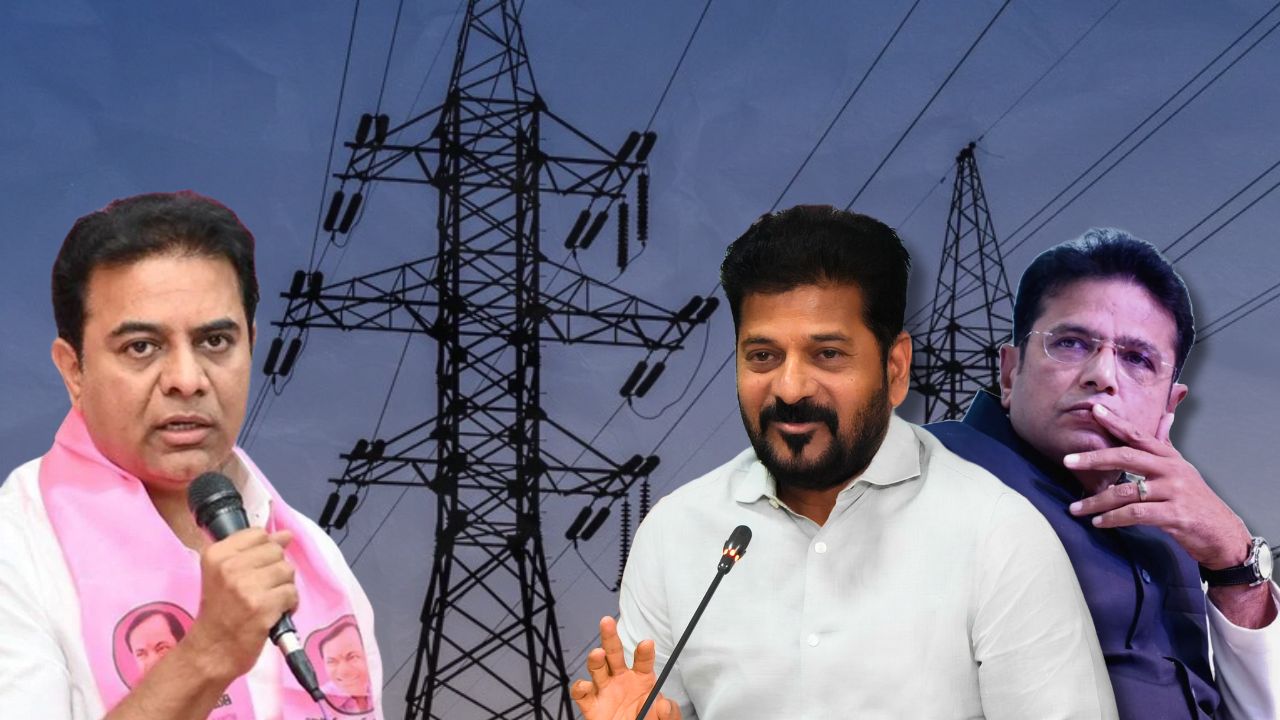
The state’s power crisis hit farmers the hardest, as they are already experiencing outages for long hours.

Synopsis: Telangana Chief Minister A Revanth Reddy has called El Niño a COVID-like disaster and warned senior officials they could be suspended over power cuts. A chief engineer at the Yadadri plant has been suspended, and five IAS officers have been deputed to camp there. While the BRS and the Congress spar over Singareni coal, old dues, and corruption, farmers and rural consumers may end up paying a hefty price.
Telangana Chief Minister A Revanth Reddy, at a review meeting with officials on the state’s response to El Niño, compared the situation to a disaster on the scale of Covid-19. Reacting to the ongoing power crisis in the state, the Chief Minister warned of serious consequences for Energy Department officials if power outages persisted.
The same day, the Telangana Power Generation Corporation Limited (TGGENCO) suspended a chief engineer of the Yadadri Thermal Power Station (YTPS), and the state designated five IAS officers to camp at the plant to monitor the situation.
While the opposition Bharat Rashtra Samithi said the government is hunting for scapegoats to cover its own failure to secure coal and prepare for a weak monsoon, the Congress administration has instead pointed to failures during the KCR regime in terms of arrangements for coal supply to YTPS and acquisition of new coal blocks for Singareni.
But behind the political sparring, pumps across the farms are running on unreliable power, just as standing crops need water most. If the situation continues to worsen, sources suggest that household supply will also be at serious risk.
Also Read: Telangana’s custard apple: The fruit that sustained Sita, now threatened by monkeys and El Niño
Telangana has received roughly 17 percent less rain than normal this monsoon, with drought-like conditions reported in several mandals across the state. Agriculture Minister Tummala Nageswar Rao said 315 mandals are experiencing drought-like conditions and urged the Union government to provide immediate assistance.
Higher temperatures have driven up electricity demand, while water scarcity has reduced hydel power output, leaving thermal stations to carry most of the load. On Thursday, 15 October, the state recorded a peak demand of 20,003 MW, 1,455 MW above the previous financial year’s peak of 18,548 MW. The state consumed 334.54 million units (MU) that day and 337.8 MU on 16 October, almost on a par with March 2026 consumption.
Between 1 and 15 October, average daily peak demand stood at 19,289 MW. In the Greater Hyderabad limits alone, demand reached 4,220 MW on 15 October, against 3,552 MW at last October’s peak. The Telangana Southern Power Distribution Company Limited (TGSPDCL) said it supplied a record 228.14 MU that day.
Jitesh V Patil, its Chairman and Managing Director, attributed part of the surge to falling groundwater, which has pushed farmers towards borewells and pumpsets, and appealed to consumers to use electricity judiciously.
Speaking to South First, K Eshwar Rao, state president of the Telangana State United Electricity Employees Union, said, “Hydroelectric power generation has gone down significantly at projects like Nagarjuna Sagar and Srisailam, due to low availability of water. The Yadadri Thermal plant with 4000 MW capacity is now operating at only 3200 MW, which is also not being met.”
Rao said the state is generating 8872 MW of power while the demand has crossed 20,000 MW.
“The demand has soared because of the change in the weather conditions, increased heat, and insufficient rainfall. On top of that, the power purchase agreement with Chhattisgarh has been largely unsuccessful. We are buying power from the power exchange at extremely high costs, mainly to ensure sufficient supply for agriculture and industry. Most demand in the state comes from the agriculture sector, with almost 29 Lakh pump sets across farmlands,” Rao said.
The state government has ordered uninterrupted supply for farming needs for the next 20 days to safeguard standing crops and has advised farmers to defer the second crop or cultivate alternative crops that consume less water instead of paddy.
The state Discoms have been directed to deploy their engineers and staff on the ground under the ‘Polam Baata’ programme, based on directions from Deputy Chief Minister and Minister for Energy Mallu Bhatti Vikramarka, to hear farmers’ power complaints first-hand. As part of a parallel drive called ‘Prajabata – Bastibata’ in Hyderabad, officials were instructed to meet consumers and carry out necessary development works to improve electricity supply.
At the sixth stakeholders’ meeting, held at the FTCCI in Hyderabad on 17 October, TGSPDCL’s Jitesh V Patil told industry representatives that it would prioritise their power-related problems. He said the organisation plans to take measures to ensure smooth supply and run operations aligned with industries’ requirements.
At the centre of the war of words between the Revanth Reddy administration and the opposition party over the power crisis is the Yadadri Thermal Power Station (YTPS) at Damaracherla in Nalgonda district.
The KCR government laid the foundation for the plant in 2015, and it became operational in 2023. The power station has been under scrutiny ever since the Congress government took charge. A 2023 white paper on the state’s energy sector estimated that the plant’s cost rose significantly from Rs 6.27 crore per MW in initial estimates to Rs 8.64 crore per MW in the latest reports. It also flagged high transport costs of shipping coal all the way from Singareni.
In the Assembly debate on the paper, Chief Minister Revanth Reddy had announced a judicial inquiry into Yadadri and the Bhadradri plant, along with the Chhattisgarh power purchase agreement. The probe has since moved from a single-judge commission to the Central Bureau of Investigation (CBI).
The ruling party has continued its attack on the plant and, amid the ongoing crisis, once again drew on its original claims from the white paper. It also held the former KCR administration accountable for signing a Memorandum of Understanding (MoU) with Metal Scrap Trade Corporation Limited (MSTC) to import G9-grade coal for the plant, as the plant needs the specific variety for its operation.
According to the Chief Minister, the state is now forced to buy millions of tons of coal for the plant because of decisions made by the previous administration.
The BRS party’s working president, KT Rama Rao (KTR), however, accused the government of hiding behind claims of a coal shortage while failing to clear what it owes Singareni Collieries Company Limited (SCCL). He alleged that the state owed SCCL about Rs 60,000 crore, and that 40 lakh tonnes of coal had gone missing across the company’s operations.
The BRS also accused the government of behind-the-scenes corruption and claimed that the Chief Minister’s brother-in-law, Sudhini Srujan Reddy, was controlling Singareni. In a fresh set of accusations, KTR alleged that the state government was running a scam through its plan to import coal from Australia at high prices, even though Singareni coal costs a fraction of that. He said the government first let SCCL slide into crisis and is now citing it to justify imports, outside power purchases, and an eventual privatisation plan.
Minister D Sridhar Babu rejected the missing-coal allegation, saying SCCL tracks every tonne through SAP/ERP integration, GPS-tracked vehicles, geo-fencing, electronic weighbridges and anti-theft teams. He also dismissed the privatisation claims, saying Singareni will instead expand into critical minerals, thermal and solar power.
The Congress said the BRS government had promised YTPS 14 million tonnes of G-9 a year based on mines that never materialised, and that the plant was shoddily built for commissions. It also blamed the BRS for keeping Singareni out of coal block auctions, losing Koyagudem-3 and Sattupalli-3, and claimed they secured Naini block clearances within two years.
Tensions intensified at the Yadadri plant on 14 October when TGGENCO suspended B Suresh, Chief Engineer (in-charge) of YTPS (Construction) Stage-I, with immediate effect, pending a departmental inquiry.
The memo, signed by TGGENCO CMD Dr S Harish, accuses Suresh of gross negligence towards duty and supervisory lapses in planning, monitoring and executing prioritised works to improve generation. It says the lapses came to light during a review meeting on 14 October and treats them as gross misconduct under the APSEB (Revised) Conduct Regulations adopted by TGGENCO.
The CMD, the Director (Thermal and Projects), and the Executive Director (Thermal) reportedly reviewed generation regularly at the 5×800 MW station for two months, while the Special Chief Secretary (Energy) monitored it for 15 days.
The action came the same day the Chief Minister warned energy officials of suspension over frequent power cuts. Reddy also asked why Yadadri was not running at full capacity despite coal linkages from the Naini and Mahanadi mines.
The state government also issued a memo deputing five IAS officers to camp at the plant on a rotating basis until 30 October. Chevvuru Hari Kiran, Commissioner, Prohibition & Excise; Venkatesh Dhotre, Special Secretary, Education Department; Rahul Raj P S, Special Commissioner for Cooperation and Registrar of Cooperative Societies; Zendage Hanumant Kondiba, CEO, Arogyasri Health Care Trust; and Killu Sivakumar Naidu, Commissioner, R&R and LA, I&CAD, were the officers designated for the job.
They have been directed to monitor the functioning of all coal streams; the status of the designed coal flow; the grade of coal received; operations and feeding; power generation at the four functional units; and to identify any lapses.
Special Chief Secretary (Energy) Navin Mittal and TGGENCO CMD S Harish have since toured the plant and reviewed the issues along with TGGENCO and BHEL engineers. Sharing details of the review, YTPS said it produced more than 2,109 MW from four units for the first time, still significantly lower than its capacity. Officials also said Unit 5 is due to be synchronised soon and BHEL promised corrective measures on priority.
Also Read: Telangana sets three-month deadline for Rohith Vemula Bill draft
The state’s power crisis hit farmers the hardest, as they are already experiencing outages for long hours. Many told South First that they are now taking loans to rent and run generators, on top of existing debt.
Farmer groups say the trouble lies as much in the quality and timing of supply as in its duration. T Sagar, state secretary of the All India Kisan Sabha (AIKS), said, “Farmers are getting seven to eight hours of supply but at night. It is neither continuous nor consistent. We have seen several cases of low voltage power causing motors to burn out, and farmers have to pay for repairs.”
He said they are not demanding 24 hours of supply, and added, “Hydel may be down, and they are generating power via thermal stations and are buying to meet demand. But there are also irregularities in managing the available power. The cuts are more frequent than before, and in some cases even more than in April and May. In ten years, this is the most extreme situation we have seen, especially in October.”
He blamed lapses in administration and management and said there is also suspicion that supply to farmers is being cut and diverted to industry instead.
“The damage is already visible, and in many places, recently sown crops have dried up. Even where there is water in the borewells, crops are drying up because there is no current.” He estimated that three to four lakh acres of agricultural land has been affected.
“Small farmers are hit hardest, and tenant farmers most of all, as they do not get bank loans. From every angle, the burden is the highest on them. They are borrowing from external sources to cope with the crisis. All of this points to an unfortunate outcome. There could be a possible increase in farmer suicides,” he added.
He also warned about the advice to skip paddy this Yasangi. “They are telling farmers to grow other vegetables and pulses, but consumers will lose out because of that. Rice prices will keep rising.”
“Instead of suspending one or two people now, there should be continuous monitoring by a dedicated team. Farmers want the government to commit to a fixed schedule for quality electricity supply,” Sagar told South First.
Officials from TGGENCO and the Discoms have maintained that household supply is not at risk and that the current outages are unplanned.
K Eshwar Rao said the next 10 days are critical, and added, “If the temperatures don’t go down, we don’t get the final spell of Monsoon, and the State fails to purchase sufficient power, there is definitely a high risk of disruption in supply for domestic purposes.”
Rao said the Energy Department is in a critical condition financially, and buying power at high costs may not be viable for long. He added that rural areas of Telangana will be the most affected when household supply is disrupted, as the government tends to prioritise uninterrupted supply for urban regions.
The government hopes that the separate Discom for farmers, the Telangana Rythu Power Distribution Company Limited (TGRPDCL), expected to start operations on 1 November, could play a crucial role in softening the blow, he added.
(Edited by Dese Gowda)



