

Published Oct 19, 2026 | 1:35 PM ⚊ Updated Oct 19, 2026 | 2:04 PM

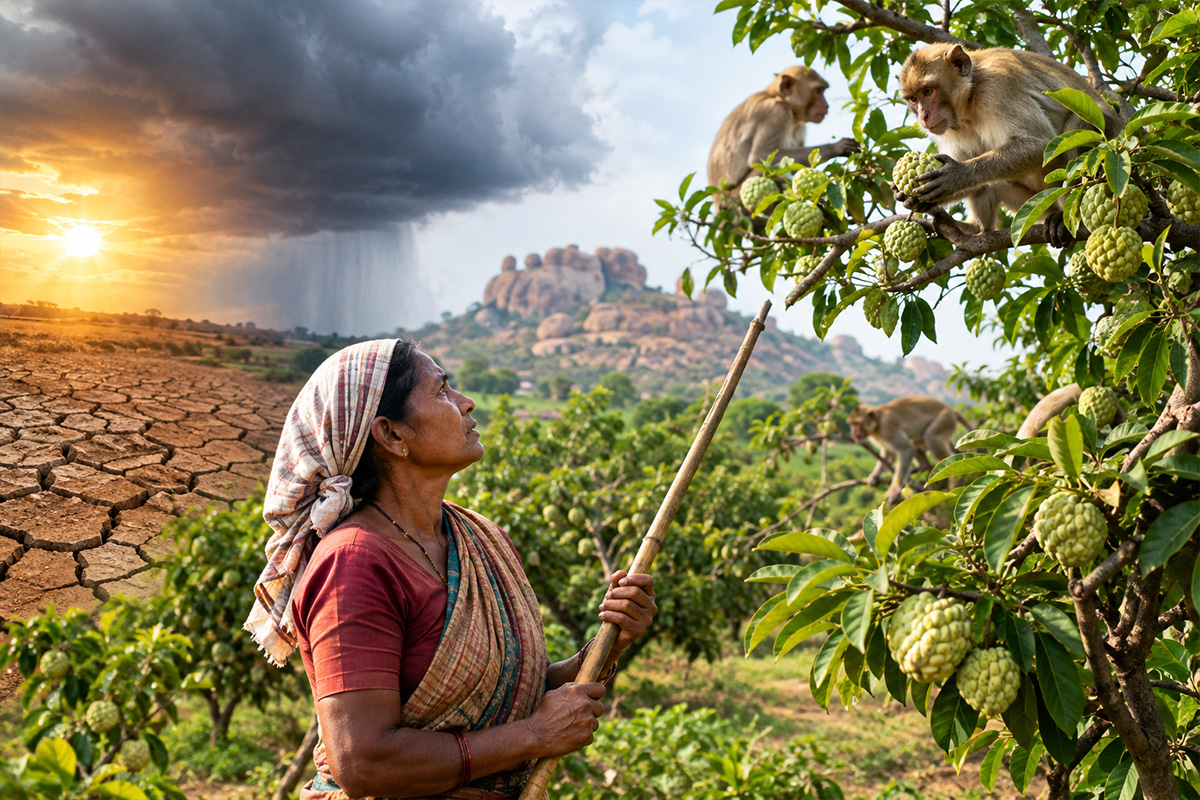
The fruit faces threats from two very different forces: the climatic uncertainty associated with El Niño, growing monkey menace. (AI-generated image)

The custard apple fruit has been celebrated in one of India’s great epics, Ramayana, as the fruit that sustained Sita during her exile in Ravana’s Lanka.
The humble seasonal fruit is cherished for its sweetness and grown across the rocky landscapes of Telangana. One of the varieties grown in the state, the Balanagar Custard Apple, is aiming for a GI tag. But this hugely popular fruit, 13.31 thousand metric tonnes of which was estimated to have been produced in the 2025-26 season, is now facing a double assault.
These days, the fruit faces threats from two very different forces: the climatic uncertainty associated with El Niño and the growing menace of monkeys that raid orchards before farmers can harvest their produce. For cultivators who depend on this short-lived season for supplementary income, the combination is turning a natural bounty into an increasingly uncertain livelihood.
In Telangana’s dryland regions, particularly across parts of the erstwhile Mahabubnagar, Nalgonda, Rangareddy and other rocky tracts, custard apple trees are more than a source of fruit. They are an example of how rural communities have adapted to difficult growing conditions.
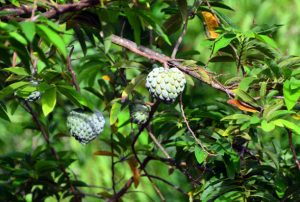
Custard apple trees can survive on relatively little water, grow on marginal lands and yield a marketable crop without intensive investment. (iStock)
The trees can survive on relatively little water, grow on marginal lands and yield a marketable crop without the intensive investment demanded by many commercial horticultural crops. For small and marginal farmers, forest-fringe communities and seasonal gatherers, the fruit offers an important source of income when other agricultural opportunities are limited.
Yet this apparent resilience has its limits. A tree that survives drought does not necessarily produce a healthy, remunerative harvest under prolonged heat, erratic rainfall and changing seasonal conditions.
El Niño, the periodic warming of the central and eastern equatorial Pacific Ocean, can influence India’s monsoon circulation and increase the risk of below-normal rainfall in some years. It does not automatically cause drought in Telangana, nor does every El Niño produce the same local weather pattern. Nevertheless, when elevated temperatures coincide with weak rainfall, the consequences for dryland horticulture can be severe.
Custard apple trees are adapted to semi-arid conditions, but fruit development still depends on the timing of rainfall, soil moisture, flowering and pollination.
Prolonged heat and moisture stress can weaken flowering, affect fruit setting and reduce fruit size and quality. Irregular rainfall can further complicate the growing cycle. A delayed or uneven harvest can also expose farmers to greater losses when fruit is ready, but buyers are unavailable at the right time.
The danger, therefore, is not simply that there may be fewer fruits. It is that the fruits reaching the market may fetch lower prices, while the cost of protecting, collecting and transporting them continues to rise.
But climate is only half the story. The other half has a face, a tail and an astonishing ability to destroy a farmer’s expectations in minutes: the monkey.
Across agricultural and forest-fringe areas in Telangana, monkey raids have become a serious concern for cultivators. As natural habitats shrink, food sources fluctuate, and human settlements expand into wildlife corridors, encounters between people and monkeys have become more frequent in many places.
Custard apple orchards offer an easy attraction. Monkeys can climb trees, break branches, pluck immature fruits and damage several fruits for every one they consume. A farmer who has waited months for the crop may return to find the orchard stripped or damaged before harvest.
The economic consequences are particularly harsh because custard apple cultivation often operates outside the protection enjoyed by organised commercial agriculture. Many orchards are scattered across rocky land, with limited fencing, inadequate access roads and little infrastructure for surveillance. Hiring people to guard the trees is expensive, especially when the expected income from the harvest is modest.
Electric fencing may be unsuitable or dangerous for wildlife, while improvised deterrents offer inconsistent results. Farmers are left paying the price for a problem they cannot solve individually.
When heat stress, uncertain rainfall and monkey raids strike together, the losses multiply. Climate stress can reduce the quantity and quality of fruit available for sale. Monkey damage can destroy what remains. Farmers consequently face a double jeopardy: nature reduces the harvest, and wildlife diminishes the marketable surplus.
The irony is striking. Custard apple is precisely the kind of fruit that deserves greater attention in a state seeking to strengthen dryland agriculture.
It can provide income from lands where conventional crops are difficult to sustain. Its cultivation can diversify rural livelihoods, support local markets and create opportunities for processing it into pulp, ice cream, beverages and other value-added products. Yet a potentially valuable resource remains vulnerable because the institutional support around it is inadequate.
Telangana needs a coordinated response rather than seasonal expressions of concern.
First, agricultural universities and horticulture departments should document the impact of heat, rainfall variability and moisture stress on custard apple flowering, fruit setting and yield. Advisories must be tailored to local growing conditions, with practical guidance on soil-moisture conservation, mulching, water harvesting and the protection of young trees. Reliable local observations are essential; attributing every crop loss to El Niño without examining actual weather and orchard conditions would obscure the remedies farmers need.
Second, the Forest Department, horticulture authorities and local bodies must jointly develop humane, scientifically evaluated methods of reducing monkey raids. Community-based monitoring, suitable physical barriers, non-harmful deterrents and restoration of natural food sources where feasible deserve consideration. Farmers should not be expected to shoulder the burden of wildlife management alone. Compensation mechanisms, where justified, must be accessible, transparent and based on prompt assessment of crop damage.
Third, the state should explore whether crop insurance or a targeted risk-sharing scheme can cover eligible losses in minor horticultural crops and forest-fringe livelihoods. Farmer groups could also organise collective harvesting, grading, transport and marketing. Local processing units would help convert seasonal abundance into products with a longer shelf life, reducing dependence on distress sales during a narrow harvesting window.
Ultimately, Telangana must recognise custard apple not merely as a wild fruit appearing in roadside markets, but as an economic resource for communities inhabiting difficult landscapes. Protecting this livelihood requires climate preparedness, wildlife management and better market access to work together.
The coming seasons may bring further climatic uncertainty, but the scale of the damage need not be left entirely to chance. A fruit that thrives where many crops struggle should not become a symbol of rural helplessness. If the state can mobilise institutions to promote high-value agriculture, it must also help protect the humble custard apple and the people whose earnings depend on it.
El Niño may be beyond the control of farmers, and monkeys cannot simply be wished away. But a policy failure to protect a vulnerable livelihood is neither a climatic inevitability nor a wildlife problem. It is a choice—and one Telangana must urgently reconsider.
Also Read:
‘Dear farmers, asking you for water too’: CM predicts tough 9-10 months for El Niño-hit Telangana
Cloudy outlook: Telangana’s rice bowl faces a season of reckoning
Telangana confronts severe drought conditions with power and water shortages under El Niño impact
(Edited by R Rajesh Kumar.)



