

Published Oct 28, 2026 | 1:20 PM ⚊ Updated Oct 28, 2026 | 1:20 PM

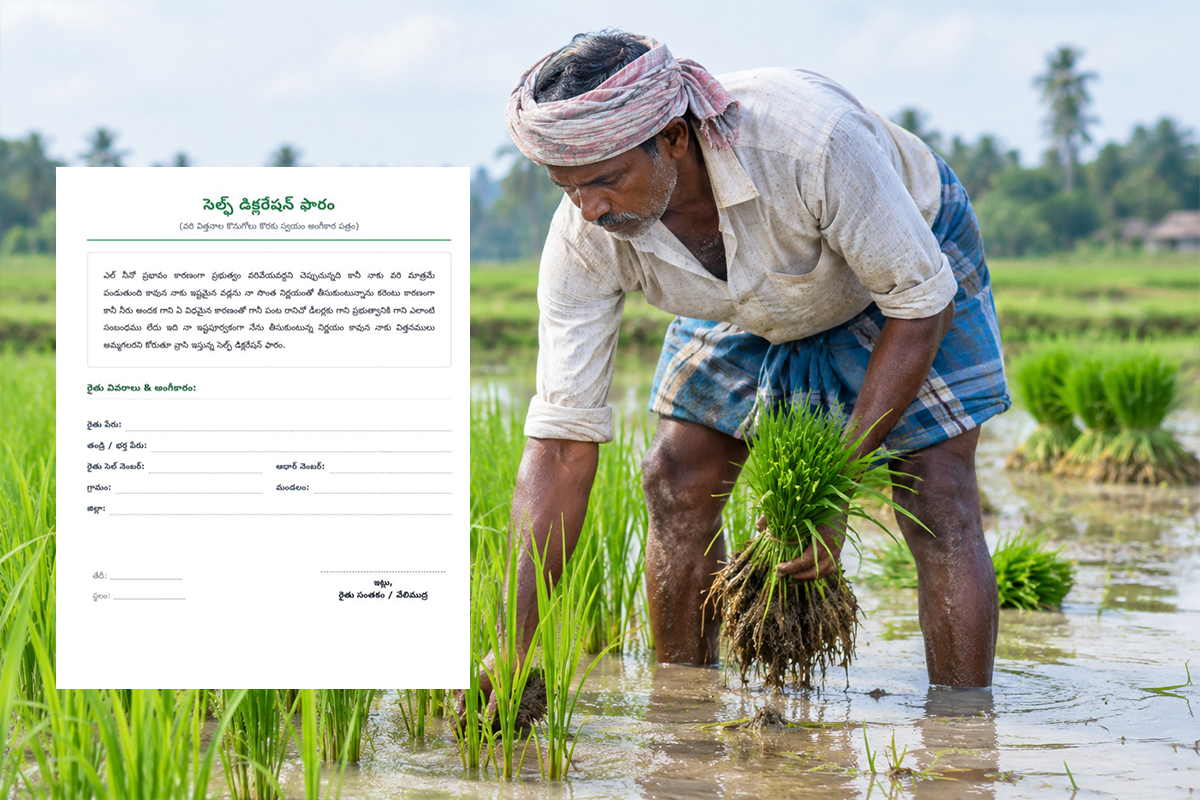

Hyderabad/Karimnagar: Telangana’s drought-hit paddy farmers are battling a new headache.
The state government might have urged them to avoid paddy cultivation during the current Rabi season and consider less water-intensive crops. But with paddy fetching them attractive prices, many are reluctant to abandon the crop.
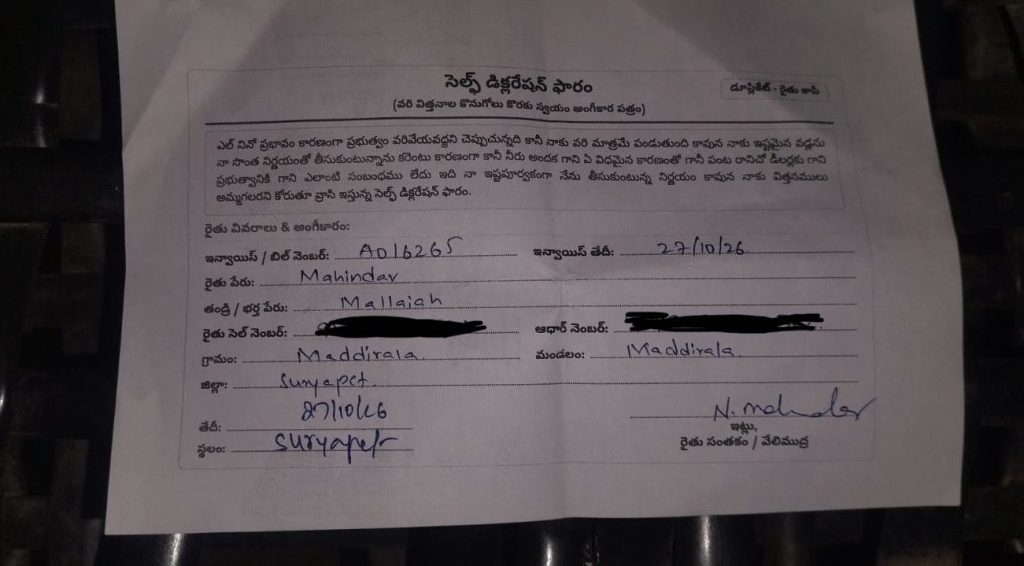
Now, in a fresh challenge for them, fertiliser dealers have reportedly begun asking farmers to sign self-declaration forms stating that they will bear the responsibility if their crops suffer due to a lack of irrigation water or electricity.
The form’s language is telling.
“Due to the impact of El Niño, the government has advised against cultivating paddy. However, since I can only grow paddy, I have decided — of my own accord — to proceed with its cultivation. I acknowledge that neither the dealers nor the government shall be held responsible if the crop fails for any reason, including issues related to electricity supply or a lack of water. This is a decision I am making entirely of my own free will; therefore, I request that you sell the seeds to me,” it states.
This has triggered a debate on whether farmers are being made to shoulder the risks of cultivation.
The controversy has also fuelled allegations that the Congress government is behind the move and is trying to insure itself against having to pay compensation in the event of a crop failure.
Dealers and a representative of the state-level association, though, have clarified that no official government instructions to collect such declarations had been sent to them.
To understand how the forms reached farmers and why some dealers are insisting on them, South First spoke to farmers, fertiliser dealers and association representatives.
The issue came to light after Maru Muralidhar Reddy, a farmer from Vellulla village in Metpalli, approached the local Mandal Parishad Development Officer (MPDO) with a representation questioning the self-declaration forms. He asked why farmers were being asked to sign such declarations and why the government was not taking responsibility.
“I saw the self-declaration form on social media and wondered whether it was genuine. So, I went to the Metpalli MPDO and asked about it. He told me that his office had nothing to do with it. I received the form on WhatsApp from Joga Krishna Fertilisers,” Muralidhar Reddy said.
South First then reached out to Krishna, the owner of Joga Krishna Fertilisers. He confirmed that the form had reached him through the dealers’ WhatsApp groups and that he had forwarded it to others.
“What Muralidhar said is true. We received the message in the dealers’ WhatsApp groups. I shared the form with others only because it had circulated in those groups. We did not create it ourselves,” Krishna said.
Srinivas, a dealer from Jagtial, also said he had forwarded the form after receiving it in a WhatsApp group for dealers.
“We forwarded it because it appeared in our association group. The government has not issued any official instructions asking us to collect self-declarations from farmers. However, given the prevailing drought concerns, many people assumed that the form might be genuine and forwarded it,” Srinivas said.
Peddi Lakshminarayana, president of the Karimnagar District Fertiliser Dealers Association, said the proposal was driven by concerns about dealers being held responsible if crops failed.
If paddy crops fail, farmers could blame the quality of seeds or fertilisers.
“The concern is that if crops dry up because of a lack of water, farmers may accuse dealers of selling defective seeds or poor-quality fertilisers. We could then face problems, including possible cases from the Agriculture Department. Given our past experiences, some dealers want to avoid that risk by obtaining declarations from farmers,” Lakshminarayana said.
Asked whether seeking such declarations was appropriate, his answer was simple.
“If the government believes farmers should not cultivate certain crops, it should ensure that the relevant seeds are not available in the market. As long as seeds are available, farmers will buy them and cultivate their crops. The idea behind the declaration is to prevent dealers from being made scapegoats if crops dry up due to a lack of water,” he said.
Nagolla Venkanna, president of the Telangana Fertilisers, Pesticides and Seeds Association, said collecting self-declarations was neither an official decision of the state-level association nor a practice mandated by the government.
Venkanna said some dealers may have considered collecting the declarations out of fear that they could face allegations if crops failed after seeds were sold to farmers who chose to cultivate paddy despite government advisories.
However, Venkanna made it clear that the practice was not an official association policy and that the government had not instructed dealers to collect such forms. He also said he considered the practice of obtaining these declarations inappropriate.
Venkanna pointed out that Telangana is widely known as the “Seed Bowl of India”, supplying seeds to farmers across the country. He said any decision to discourage cultivation must also take into account the implications for seed production.
“It is not easy to distinguish farmers who cultivate crops for seed production from those who grow crops for their own requirements. If the government advises farmers not to cultivate crops because of El Niño concerns, it must also consider where the seeds for the next Kharif season will come from,” Venkanna said.
He also alleged that, to his knowledge, the Agriculture Department had not held a meeting with the Seedmen Association to discuss how to address the situation. He questioned whether there was a comprehensive plan to deal with the potential challenges.
Is a major seed company behind the self-declaration forms?
Under the prevailing seed regulations, licensed dealers must comply with applicable legal requirements while selling seeds, including issuing bills.
If seed-quality defects are established, the relevant authorities are responsible for taking action in accordance with the rules. However, signing a self-declaration does not automatically exempt dealers from their legal responsibilities.
Farmers argue that asking them to sign declarations disclaiming responsibility for crop losses is unfair. They are demanding that the Agriculture Department take immediate action against dealers who insist on obtaining such declarations.
The key question is whether a few dealers are using these forms as a precaution against potential disputes or whether the practice is spreading across the state.
While South First has been told on the record that some dealers have introduced these self-declarations to avoid blame if crops fail, some dealers, speaking off the record, have claimed that a prominent Indian seed and fertiliser company was behind the move.
Also Read:
Rice and paddy crisis in Telangana: Artificial scarcity before the real shortage
Telangana’s looming water crisis: Responsibility and response
Prepare before we panic: Every dam in Telangana needs a water protocol
(Edited by R Rajesh Kumar.)



