

Published Oct 20, 2026 | 1:49 PM ⚊ Updated Oct 20, 2026 | 1:49 PM

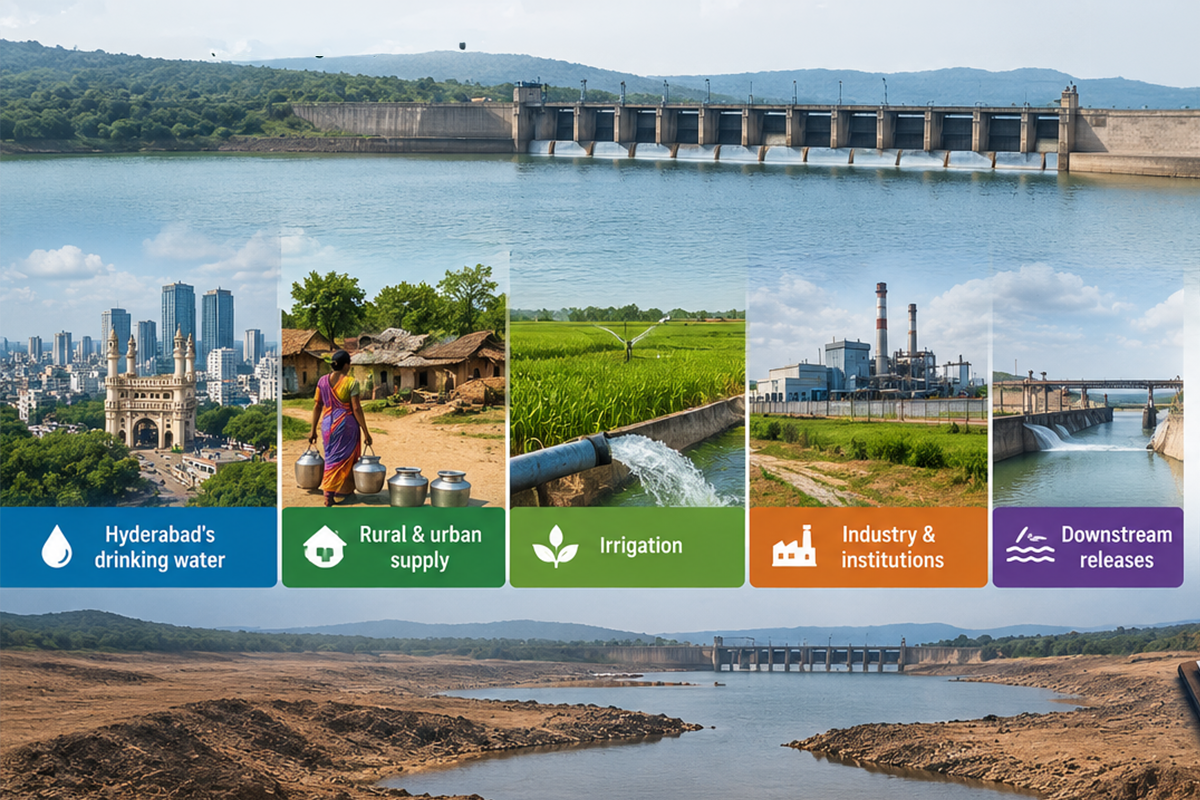
Image used for representational purpose only. (AI generated image)

Telangana has woken up to a water crisis. Government leaders are issuing statements of warning and appeals. What these statements do not show is what the Government plans to do, with the hard months still ahead.
The Chief Minister predicts that the “next 9-10 months will be very difficult”. He has requested farmers to avoid planting paddy this year, telling them, “You have given us food whenever we have needed and asked for it. Now we are asking you for water as well.”
The Chief Secretary also says El Niño’s impact is very severe and expected to peak by February 2027. Live storage in the Krishna basin’s major and medium projects has fallen to about half of last year’s level, and groundwater is declining. Farmers could face shortages in the Yasangi season, even with additional power. Each month is likely to be harder than the last.
In a crisis, governance matters. At this moment, rules matter as much as rain.
How a State shares scarce water in such months depends on the rules it has prepared. For most reservoirs in Telangana, no such rules exist in a form the public can read. We should write them now, dam by dam, before shortage becomes a public mood of panic that no rule can calm.
In India, shortages of commodities bring hoarding and profiteering. Water shortages can be far more traumatic, and can test the social fabric.
Singur now serves almost everyone.
It was built as a multi-purpose project, with drinking water for Hyderabad among its uses, and other uses were added over time without public discussion or consultation. Under Mission Bhagiratha, it supplies 2,395 rural habitations and 18 urban bodies in four districts. It also irrigates about 40,000 acres, has several industrial and institutional allocations, and feeds releases downstream to Ghanpur Anicut and Nizam Sagar.
Every claim on it is a volume. The Water Board has 6.96 TMC a year, Mission Bhagiratha 5.70 TMC, irrigation 2.00 TMC, and an industrial zone near Zaheerabad was allocated 1.42 TMC in 2018, conditionally.
We found no plan or document that says how these volumes change, singly or in proportion, when the water falls. The general policy of putting drinking water first does not settle the matter. The water sits in one pool, and the claimants within drinking water compete with each other.
On the orders we have seen, the committed volumes add up to about 16 TMC a year. On 17 October 2026 the reservoir held 3.42 TMC, with supply expected to last until 9 November, or to 10 December with emergency pumping.
The levels do not agree. A 2017 order says the reservoir must be kept above 520.5 m to protect Mission Bhagiratha’s water. A 2009 order treats 516 m as the level from which irrigation can lift water. The dam-safety panel is reported to have found levels kept above a 517.8 m design limit for years.
Storage is now below 515 m. We could not find anyone reconciling these figures in public.
It is also unclear how much of the current low storage is deliberate, since the reservoir was reportedly emptied for safety repairs, how much reflects low inflow, and how much, if any, is siltation.
The Central Water Commission found a loss of only about 1.3 per cent of live capacity in 30 years, so siltation looks an unlikely cause.
The operational rules cannot be found. The 1990 order that the Government itself cites as laying down Singur’s operational rules is not in the public domain, as far as we could find.
Releases for farmers downstream have been authorised one order at a time, “as per rules” that are not stated. The Irrigation Department’s own 2023 manual says every dam needs a rule framework and a recorded reason for every drawdown. We have seen neither for Singur.
Measurement is missing too. No public register lists every draw on the reservoir. A 2020 Central Water Commission study recorded that no hydrographic survey had been done on a project built in 1989.
A Mission Bhagiratha engineer said in July 2026 that drinking water cannot be drawn once storage falls below about 3 TMC. That is a vital number, and it reached the public through a press quote.
Singur has also become a revenue source, at least on paper. Government orders from 2015 to 2018 say industry pays water rates. Using the 2015 rates, we estimate an upper bound of about Rs 12 crore a year from the allocations we know of. Nobody has published what is billed, what is collected, or whether any of it reaches the Irrigation Department, which owns the dam.
Cuts are being announced without a rule or a visible order. Irrigation was cut first, by custom, below 16 TMC, a figure that appears to match the 2017 level. Industry and institutions are now reported to be facing cuts of 20 to 50 per cent.
For the city, the Government has a plan for 60 MGD more. For the towns and villages around Singur, the plan is borewells and other alternative sources.
Conflict over water is the real risk.
Each of these choices may be defensible. None can be traced to a rule, and people do not accept sacrifices they cannot trace.
Farmers will set themselves against the city, villages against towns, and industry against both. Within each category it will be harder still: Hyderabad against Kamareddy, one farmer against another, one factory against its neighbour.
Guarantees written as volumes make this worse. Without a protocol, Singur’s guarantee to every kind of user is in doubt. When water is short, every guarantee competes with every other, and the loudest or best connected wins. That is not governance. It is a queue with no numbers.
Singur is not unique.
Other reservoirs in Telangana also serve more than one major use, and they run on the same volumes, custom and discretion. The framework that left Singur without a protocol applies to them equally. The 2023 manual, like the Central Water Commission template it follows, tells engineers how to run a dam safely. It does not say how scarce water is shared.
Prepare, do not panic
Panic helps nobody. It means tankers, hurried borewells, distress sales and street protests, and it spends money and trust together. The best preparation is a water protocol for every major storage: a written rule, published in advance, that says at each storage level who gets how much, in what order, with what notice and with what relief.
It starts with measurement. A register of every draw, metered and reported daily, including groundwater pumped near the dam, so that allocation rests on use and not on assumption. A monthly water balance would show what is unexplained.
Then comes monitoring. A daily public dashboard should show storage, usable storage and days of supply at the current draw, with quality readings at the drinking-water intake.
Next come principles.
Drinking water comes first, with a stated rule for sharing it between city and village, measured in litres delivered per head. Non-essential and industrial use is cut first, in proportion. Farmers are protected: standing crops first, support when a cut is unavoidable. Decisions are taken early, on forecast days of supply, and reversed in the same order when storage recovers.
A water budget completes the picture. For each reservoir, allocations against measured use, and a matching account of revenue and expenditure: who pays, where the money goes and what upkeep costs.
It must connect to the rest of the system. Farm power schedules, crop advisories before sowing, groundwater rules and conservation targets all depend on the same figures. The Chief Secretary has said that saving 20 per cent of water across Greater Hyderabad would save about 80 MGD a day. Targets by area, checked against meters, would turn such a statement into a plan.
Innovation helps. Telemetry at intakes, open data, independent audits and user-group water budgets are all within reach.
Consultation is not optional. Farmers, including tenants and labour, residents of cities and villages, and industry should see the draft, question it and see their comments answered. People will follow a rule they helped write, even in a bad month.
Start now. Begin with reservoirs that serve more than one major use. Publish the current status and the order of cuts in force now. Release a draft within weeks and adopt it before summer. Singur can go first, because the evidence is already there.
None of this is exotic. It is ordinary preparation by a State that expects a hard season. The Government has the data, its own manual says dams need operating rules, and the Chief Secretary has been to the dam. What is missing is the written, consulted rule. Prepare now, or panic later.
Also Read:
‘Just to keep the crop alive’: Telangana farmers forced to rent generators amid power cuts
How India’s changing climate may push your body towards diabetes through metabolic disruption
(Edited by R Rajesh Kumar.)



