

Published Oct 24, 2026 | 9:35 AM ⚊ Updated Oct 24, 2026 | 9:35 AM

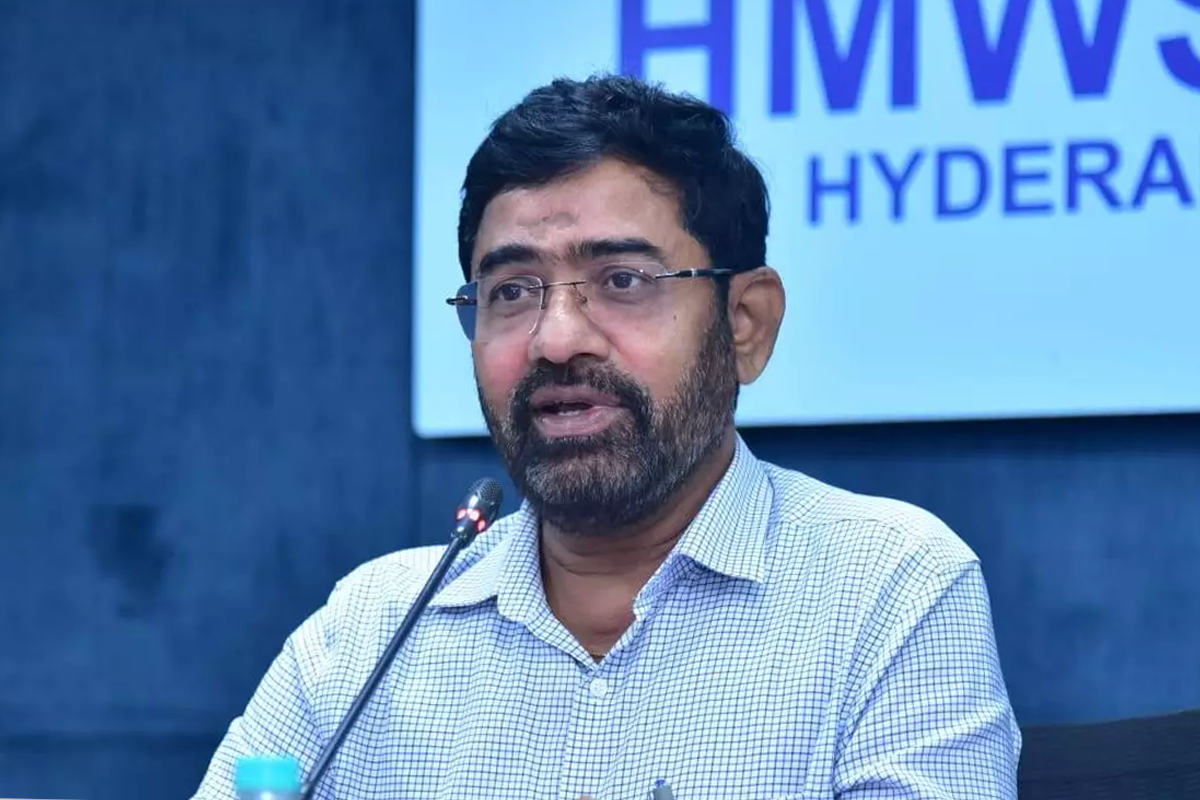
Hyderabad Metropolitan Water Supply and Sewerage Board Managing Director Ashok Reddy speaks during a press conference in Hyderabad. (File photo)

The Hyderabad Metropolitan Water Supply and Sewerage Board has issued a notice to the people of Hyderabad stating that all the reservoirs supplying drinking water to the city are nearing depletion and may run completely dry by the end of November.
It warned that the supply of drinking water to households could be drastically reduced or even stopped altogether. The notice also urged people to conserve every drop of water, offering suggestions on the measures they should adopt to save water.
This is not merely a grave situation confronting Hyderabad alone. It reflects the condition of the entire state and, perhaps, the country as a whole. Since one-third of Telangana’s population lives in Hyderabad, there is a tendency to view the city’s problems as the problems of the state itself. But the problems confronting the rest of the state are even more serious than those facing Hyderabad.
In the very first sentence of its notice, the Water Board attributed the situation to “the ongoing impact of El Niño and the impending drought.”
It’s not just the Water Board. The Chief Minister said “the next 9-10 months will be very difficult” and that “we will have less water because of this unprecedented El Niño situation”. The chief secretary too believes El Niño’s impact is very severe and will peak by February 2027.
Despite all these dire warnings, nobody knows precisely how much of Telangana’s situation can be attributed to El Niño. Yet, in the name of mitigating its effects, the state government has recently made a great deal of noise and continues to do so. It has appointed nodal officers.
Whether the Water Board and the government acknowledge it or not, everyone knows that the state did not receive the rainfall it should have during this year’s monsoon, that winter — which has already arrived on the calendar — has not actually set in, and that the scorching heat continues as though it were perpetually summer.
Those who follow the news closely know that the floods which usually occur at least once, and sometimes two or three times, in the Godavari and Krishna rivers during July and August did not materialise this year. There was not even enough water to brush against the riverbanks and flow past them. All told, Telangana has not had a proper season this year.
Failure of the rains, drought, and the resulting shortage of water for crops, livestock and people are nothing new to Telangana. They have occurred in the past as well. But we need to reflect on the difference between how society responded then and how it responds now. Neither society nor the government seems to grasp that a major calamity is approaching!
First, we need to understand the severity of the drought in Telangana. The southwest monsoon normally reaches the state in the first week of June, marking the beginning of the rainy season, which continues until around the middle of September.
Thereafter, under the influence of the retreating monsoon and the northeast monsoon, some rain also falls during October and November. Rainfall is generally heavier in July and August, when rivers, streams and rivulets flow. Tanks, ponds and reservoirs fill up. Agricultural operations proceed at full pace, and reservoirs that meet people’s drinking-water needs throughout the year are replenished.
This year, however, the southwest monsoon is said to have failed to behave as it normally should because of the El Niño effect. Rainfall in June was 12 per cent below normal. The situation improved somewhat in July, but the rainfall deficit in August was a substantial 38 per cent.
The Meteorological Department says that rainfall during the southwest monsoon season as a whole was 17 per cent below normal. Whatever the official figures may indicate, the fact that Hyderabad’s reservoirs are at risk of running dry by the end of November makes it clear that the shortage is severe.
Reports indicate that drought conditions prevail in 315 of the 539 rural mandals in the state’s 612 mandals. In other words, more than half of rural Telangana can be said to be already in the grip of drought or on the verge of being so.
Crops that have been sown in the hope that a few showers would suffice will not get the water they need. Farmers will have to draw more heavily on groundwater, requiring more electricity.
Whatever they do, crops may fail. The debt burden on farmers will grow. A situation may arise in which even fodder for livestock becomes unavailable.
Crop failures will push up foodgrain prices, burdening urban residents as well. As reservoirs dry up and groundwater is depleted, drinking water too will become scarce.
All this can be blamed on nature. Alternatively, El Niño — a phenomenon ordinary people may not readily understand — can be offered as an excuse. The burden can even be placed on an unseen God or Varuna, the deity of rain. But when calamities of this kind occur, the responsibility to support the people rests with the government, which runs on the taxes paid by the people while enjoying all the privileges of office.
In fact, the government has a responsibility to take precautions before such calamities occur, build systems capable of recognising an impending disaster, and provide assistance, support and relief to affected people once it strikes. In a modern representative democracy, these are among the government’s most basic duties. It is the responsibility of society, civil society and the media to keep prodding the government relentlessly to fulfil them.
But our topsy-turvy society has entered an unfortunate phase in which nobody knows — or remembers — their responsibilities. Whenever a problem arises, the sole preoccupation of individuals, organisations and even institutions entrusted with public responsibility has become finding someone else to blame and devising ways to evade accountability.
Being irresponsible is one thing. Being irresponsible while pretending, and persuading others to believe, that one is shouldering enormous responsibilities is quite another. So is making a great show of activity and spending extravagantly on pomp and publicity out of all proportion to the actual work done. This is an art our governments have mastered on a grand scale.
The government’s handling of the drought engulfing Telangana and the water crisis expected to engulf Hyderabad within a few weeks follows precisely this pattern. The elaborate arrangements made for the immersion of polluting Ganesh idols and Durga idols, and for the security of those at the helm of government, have no parallel in the arrangements visible for dealing with the impending drought and water shortage that threaten to cause immense hardship to Telangana’s three-and-a-half crore people.
It would, however, be inaccurate to say that nothing is visible at all. Countless meetings have been held over the past two months. Directives have been issued. The Chief Minister, his Cabinet colleagues and senior officials have made solemn pronouncements.
Relief packages worth thousands of crores of rupees have been announced. But it is not known how much of this fanfare has translated into reality.
There have been no reports indicating that even 10 or 25 per cent of the announced allocations have actually been released. Nor is it known how well the various government departments have prepared themselves to withstand the calamity that has already begun and is yet to unfold in full. We do not know what efforts those in positions of authority are making to prepare their subordinate staff for the task.
What lies ahead is no ordinary undertaking. Numerous measures must be implemented on time, systematically and according to plan.
Existing crops must be protected. Plans for the coming rabi season must be safeguarded from disruption. Farmers facing an agricultural crisis must receive assistance.
Crop-insurance arrangements must be devised for crops that are lost. If the government intends to advise farmers against sowing crops because of the water shortage, or to declare a crop holiday, it must consider compensation for the resulting losses. Alternative arrangements must be made to overcome water shortages in both urban and rural areas.
Reports say the state government began recognising the problem in the first week of July itself. It reportedly instructed district administrations to submit assessments of rainfall, groundwater levels, water availability in reservoirs and cropping patterns in their respective districts. When the State Legislative Assembly met on September 18, it reviewed the situation and adopted a unanimous resolution.
Through that resolution, the Assembly urged the Union government to send an assessment team, provide a special assistance package of ₹20,000 crore, release disaster-relief funds, provide compensation for crop losses, and extend assistance for drinking water, fodder and groundwater replenishment. It also sought an additional 50 days of employment under the rural employment guarantee scheme, over and above the 125 days currently provided. A month has passed, but there has been no news of whether the Union government has responded to these requests.
Reports said that, at a special meeting held on October 10 and 11, the Chief Minister instructed officials to prepare an action plan covering drinking water, irrigation, agriculture and electricity through June 2027. Reports on October 15 and 16 said the Chief Minister had issued a stern warning to farmers not to sow rabi crops and to reserve the available water exclusively for drinking-water needs and other essential purposes. News reports also stated that reservoir storage, which stood at 462 TMC at the same time last year, had now fallen to 200 TMC—less than half the previous year’s level.
On October 16, reports announced an assistance package of ₹1,986 crore under various heads, including crop losses, seed subsidies, incentives for shifting to alternative crops, water-conserving agricultural practices, and compensation for foregoing paddy cultivation during the rabi season. But there is no information on whether these funds have been sanctioned or released, how many farmers have received assistance, or what the applicable procedures and conditions are.
The government must move beyond the grand spectacle of announcements and work with far greater commitment and focus to prevent — or at least mitigate — the crisis engulfing farmers, agriculture, rural communities, irrigation and drinking-water supplies.
In this context, several questions must be asked.
Will farmers receive compensation for crops currently standing in the fields but drying up because of the water shortage? If so, when?
Will compensation be paid to farmers who voluntarily forgo cultivation, irrespective of whether their crops have already suffered damage?
When agriculture itself is in crisis, what is the government doing to secure the livelihoods of landless agricultural labourers who depend on farm work? Leaving aside the request to the Union government for additional employment days, does the state government have any plans within its own jurisdiction to provide additional days of work?
And finally, what measures will be taken to resolve the drinking-water crisis?
Also Read:
Vinayaga! Who will remove these obstacles?
(Edited by R Rajesh Kumar.)



