

Published May 20, 2026 | 9:50 AM ⚊ Updated May 20, 2026 | 9:50 AM

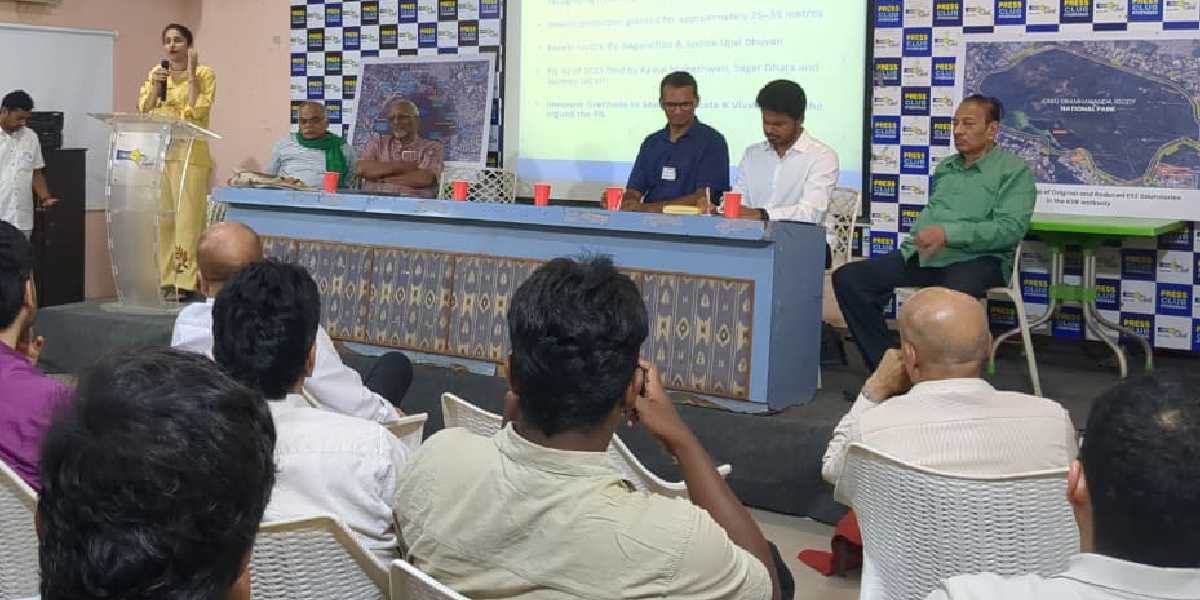
The meeting was held at the Hyderabad Press Club.

Synopsis: Save KBR campaigners came together on Tuesday and deliberated on the current status of the park’s protective perimeter, fault lines, and the way forward.
A day after the Supreme Court ordered a stay on the felling of trees around the Kasu Brahmananda Reddy National Park, citizens, activists and environmentalists on Tuesday, 19 May, gathered at the Hyderabad Press Club to demand accountability and put pressure on the Telangana government.
The press meet brought together residents, who led the Save KBR campaign, prominent voices including environmentalist Narasimha Donthi, environmental engineer Sagar Dhara, former Resident Editor of The Times of India Kingshuk Nag, activist Lubna Sarwath, and Kaajal Maheshwari, whose petition had led to the Supreme Court’s intervention.
On Monday, 18 May, a Bench of Justice BV Nagarathna and Justice Ujjal Bhuyan issued an interim stay on tree felling within 25 to 35 metres of the park boundary, while hearing a petition filed by Maheshwari.
Senior Advocate K Vivek Reddy argued for the petitioner. The next hearing is on 27 July.
The petition challenged the reduction of the Eco-Sensitive Zone (ESZ) around KBR National Park to a width ranging from just three metres to 29.8 metres on certain stretches. It argued that such a narrow buffer defeats the purpose of an ESZ as a protective shield for a national park.
The petitioner further alleged that the State falsely represented that a public hearing had been conducted before the notification was finalised.
Also Read: Supreme Court stays tree felling around KBR National Park
Maheshwari, a lead campaigner of the Save KBR movement, explained the status of the park’s protective perimeter.
“It is not the suggested 10 km or even 1 km buffer zone instructed by the Supreme Court. Not even the already limited 25 to 35 metres that was originally proposed. In some places, a mere three metres is left as the buffer zone. Further, the park is being suffocated by seven flyovers and underpasses. So instead of giving our beloved forest a protective buffer zone, we are replacing that protection with concrete, traffic, heat, noise, light and pollution. Gradually, this will suffocate its fragile ecosystem,” she said.
Also Read: KBR National Park and the architecture of regulatory evasion
Sustainability researcher and environmentalist Major Sandeep Khurana (Retd) pointed to the need for a public hearing, a critical legal fault line in the entire process.
“The public hearing is not merely a procedural formality or a checkbox exercise, but a substantive statutory requirement mandated by the ministry to meaningfully address large-scale public objections,” he said.
He added that if such a hearing was not conducted and the court was misled, it could render the foundation of the ESZ notification legally untenable.
Nag, a long-standing supporter of the campaign, said he had challenged the earlier SRDP project before the High Court in 2016. He raised concerns about how the H-CITI project has been structured.
“The current state government is fully aware of the legal challenges involved, yet H-CITI appears to be a single integrated project involving multiple flyovers and underpasses that has allegedly been fragmented into separate components, most likely to be executed by the same contractor. This raises serious concerns that the exercise is intended to bypass comprehensive Environmental Impact Assessment scrutiny,” he said.
Also Read: Midnight arrests and a Supreme Court rebuke
Donthi, an environmentalist, public policy campaigner and conservation advocate, pointed to a pattern of the government proceeding despite judicial directions.
“Despite clear judicial directions, the Government of Telangana and the GHMC allegedly proceeded with tree felling and excavation activities in violation of the stay order dated 11 August 2021. The eco-sensitive zone process around Kasu Brahmananda Reddy National Park remains incomplete, yet irreversible ecological damage is being attempted without due legal or environmental safeguards,” he said.
He also noted that rather than granting interim relief, the High Court adjourned the matter repeatedly before the case reached the Supreme Court.
Dhara, an environmental engineer and a former IIT-Bombay professor, challenged the government’s justification for the project.
“Contrary to official claims, the H-CITI project does not reduce carbon emissions. It risks intensifying the climate crisis by inducing greater vehicular traffic and by destroying a vital urban green lung that regulates temperature and air quality. Kasu Brahmananda Reddy National Park is not merely a biodiversity hotspot, but a critical public commons that protects Hyderabad from escalating heat and pollution. The Supreme Court’s intervention highlights the urgent need to preserve ecological buffers and uphold the principles of environmental justice,” he said.
The H-CITI project, a ₹5,942 crore initiative by the Greater Hyderabad Municipal Corporation and Hyderabad Metropolitan Development Authority, proposes seven steel flyovers and seven underpasses across major junctions encircling the park in Banjara Hills and Jubilee Hills.
By 16 May, nearly 2,000 mature trees had been felled across key stretches surrounding the park.
The Save KBR campaign, launched on 26 April 2026, formed human chains involving residents outside the park gates. On 13 May, Banjara Hills police detained five volunteer leaders in a midnight operation. FIRs were filed against 10 to 15 activists for allegedly obstructing government work.
(Edited by Majnu Babu).



