

Published May 19, 2026 | 4:36 PM ⚊ Updated May 19, 2026 | 4:36 PM

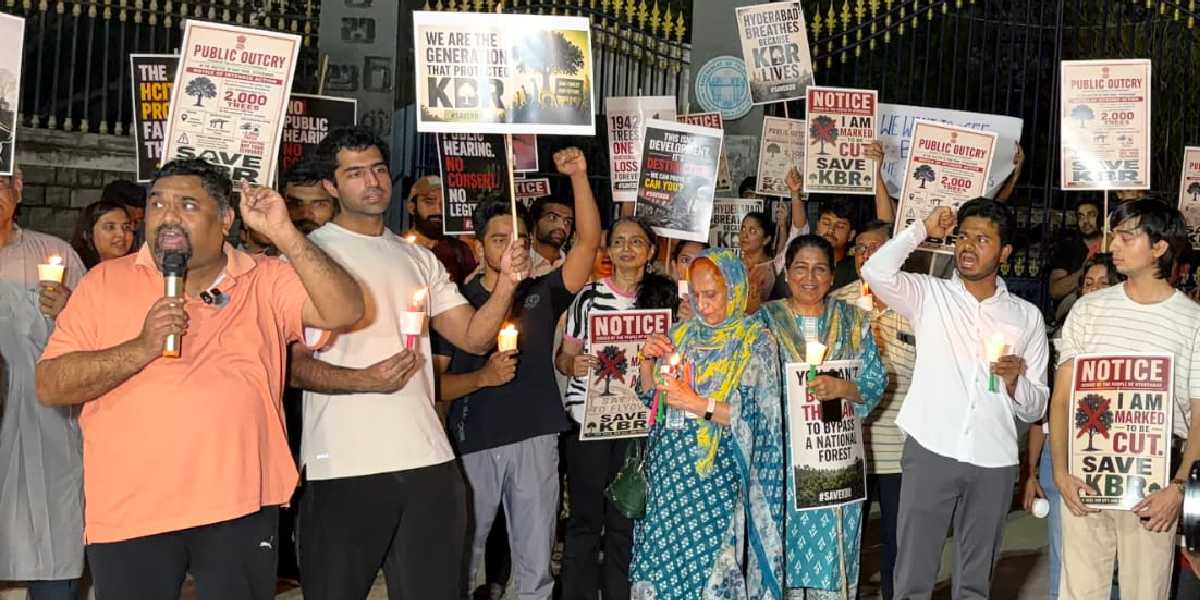

Synopsis: The Supreme Court has stopped tree felling around Hyderabad’s KBR National Park after residents and activists challenged a road project that could cut down thousands of trees. Protesters said the Telangana government reduced the park’s eco-sensitive buffer zone to make way for flyovers and underpasses, while the state said the project would reduce traffic congestion. Environmentalists warned that losing tree cover around KBR would increase heat, air pollution and groundwater loss in the city.
At 3 am on Wednesday, 13 May, Hyderabad police detained five people outside KBR National Park in the city’s posh Banjara Hills neighbourhood.
Their crime, as the state saw it, was standing between chainsaws and the thousands of trees inside the park.
State authorities were set to fell as many as 2,000 trees to make way for a ₹1,090-crore flyover and underpass project.
On 18 May, the Supreme Court of India issued an immediate stay order halting all tree felling within the eco-sensitive zone around Kasu Brahmananda Reddy (KBR) National Park in Hyderabad.
A bench of Justice BV Nagarathna and Justice Ujjal Bhuyan passed the interim direction while hearing a petition filed by Kaajal Maheshwari, who challenged the Telangana High Court’s earlier refusal to grant interim relief.
The court ordered that no trees be felled within 25 to 35 metres of the park boundary. It also questioned why the buffer zone had been reduced so sharply, putting the state government on notice. The court scheduled the next hearing for 27 July.
The park spans 353 acres and was declared a Protected Forest in 1994. It contains deciduous forests, rocky outcrops and open clearings. More than 120 bird species live there, including the Indian peafowl, kingfishers, parakeets and seasonal migratory birds.
For many residents, the park is one of the few places that offers respite from Hyderabad’s heat and congestion.
“One of the biggest reasons I connected with this neighbourhood was because of how calm, breathable and walkable the surroundings near KBR felt compared to most parts of Hyderabad,” a Banjara Hills resident told South First.
Also Read: Signal, warning or invitation? Decoding Modi’s “mere se jud jao” message to Revanth
The H-CITI (Hyderabad City Innovative and Transformative Infrastructure) project is a ₹5,942-crore plan to build seven steel flyovers and seven underpasses across major junctions around the park in Banjara Hills and Jubilee Hills.
A collaboration between the Greater Hyderabad Municipal Corporation (GHMC) and the Hyderabad Metropolitan Development Authority (HMDA), the project aims to ease chronic traffic gridlock at six key junctions, including Jubilee Hills Check Post, Film Nagar and the Indo-American Cancer Hospital stretch on Road No. 10.
In the darkness of the night, thousands of trees are being cut to make way for flyovers that will choke KBR Park — Hyderabad’s last green lung. 🌳
No cumulative EIA. No public hearing. Disregard for the Eco-Sensitive Zone. Even the High Court stay order is being ignored.
This… pic.twitter.com/M9NGbQn7Tv
— SaveKBR (@CitizensForHyd) May 18, 2026
But the project comes at a steep ecological cost. By 16 May, allegedly more than 1,000 mature trees had been felled or severely cut at Jubilee Hills Check Post, Mugdha Junction and the Indo-American Cancer Hospital stretch.
The original design required the felling or translocation of roughly 1,300 to 1,500 mature trees along the park’s outer walkway and surrounding medians.
GHMC officials maintain that they are operating under a Zero Park Intrusion policy, under which no trees inside the park are affected and all flyovers and underpasses remain within existing road medians.
The government has said none of the affected trees are more than 10 to 12 years old.
Residents and activists dispute that claim.
“What worries me about the H-CITI project is that it feels less like solving traffic and more like rearranging traffic with multiple flyovers and underpasses surrounding KBR from different sides. Visually and environmentally, it completely changes the character of the area,” Hasif, a resident, told South First.
Further, the petition before the Supreme Court alleges that the state reduced the eco-sensitive zone (ESZ) from the originally proposed 25 to 35 metres to as little as 3 metres in some stretches around the park without scientific or ecological grounds, in order to avoid land acquisition costs for the infrastructure project.
The petition also raises questions about the absence of an environmental impact assessment and the failure of the Wildlife Authority to study how the project would affect the park’s fauna.
It further contends that although more than 19,000 people signed a petition opposing the dilution, their objections were not meaningfully addressed.
The petition also alleges that the state falsely claimed a public hearing had been conducted before the October 2020 Ministry of Environment notification, which fixed the ESZ at widths ranging from just 3 metres to 29.8 metres.
Eco-sensitive zones act as ecological shock absorbers, protecting national parks from disruptive external activity.
Activists say a 3-metre buffer around an urban forest is, in practice, no buffer at all.
Also Read: Telangana treated one lakh cancer patients in five years; six in ten were women
This is not the first attempt by a Telangana government to use land around the national park for development projects. Similar proposals have faced opposition since 2016.
In February this year, the state government granted WALTA Act tree-felling permissions to contractors, clearing the way for heavy machinery.
By April, the Telangana High Court had declined to issue a stay. Instead, it asked petitioners to research what activities were legally permissible within the buffer zone, a response that outraged environmentalists and residents alike.
On 26 April, hundreds of residents and environmental activists gathered outside the park’s main gates, formed human chains and formally launched the Save KBR movement.
Between 10 and 12 May, excavation machinery began operating through the night to avoid daytime traffic disruptions. That prompted round-the-clock citizen vigils.
Police began a crackdown soon after.
Police alleged that protesters obstructed work and threatened contractors. Protesters denied the allegations.
The demonstrations drew comparisons to the Chipko movement of the 1970s, during which villagers in the Himalayan region hugged trees to stop commercial felling.
Vijay Mallangi, activist and representative of the Save KBR campaign, told South First: “We were taken away by the police only for resisting tree cutting and peacefully standing at the tree cutting site and holding our hands somewhat in the form of a Chipko movement. We also repeatedly stated that there is a stay order that is not being respected.”
Also Read: Supreme Court stays tree felling in eco-sensitive zone around Hyderabad’s KBR National Park
Dr Narasimha Reddy Donthi, researcher and environmental justice activist, told South First that old-growth canopies such as those in KBR Park perform a wide range of irreplaceable ecological functions.
He pointed to rising air pollution, noise and vibration as vehicle numbers around KBR increase, with dust, carbon emissions, diesel fumes, nitrous oxide and sulphur oxide accumulating across the corridor.
“These emissions will cause the death of the green lung space, which is vital. Once it is lost, the surroundings are badly impacted because this is where a lot of the water is absorbed. The KBR park absorbs a lot of water and also replenishes the groundwater,” he said.
“It is a micro sink for carbon emissions, and also maintains the microclimate. So when the KBR park gets degraded, all these functions will be lost, and the urban heat island will increase.”
The loss of green cover could put Hyderabad on the same trajectory as Delhi, where shrinking tree cover has driven extreme heat and worsening air quality.
At the same time, Mallangi said that while the six new traffic points may reduce congestion locally, they would simply shift the problem elsewhere. Instead of waiting at multiple junctions, commuters would queue at a single, larger bottleneck.
Dr Donthi said new roads do not simply absorb existing traffic. Instead, they encourage greater car use and create more traffic. Drivers who previously avoided congested routes or peak hours enter the network once a flyover makes travel seem faster and more convenient.
Activists have instead called for greater investment in public transport, including metro expansion into Gachibowli, Kondapur and the Financial District, alongside better bus services.
“We want the metro to be expanded as it is stopping right now in a high-tech city and is not going beyond the actual working area, which is the Financial District, Gachibowli, Kondapur,” Mallangi told South First.
“All these choke points are now filled with flyovers and underpasses. As citizens, we are demanding that no more capital expenditure be spent on projects which will be redundant in three years and which will be completely filled with traffic and invite more traffic.”



