


Published Apr 29, 2026 | 3:00 PM ⚊ Updated Apr 29, 2026 | 3:00 PM

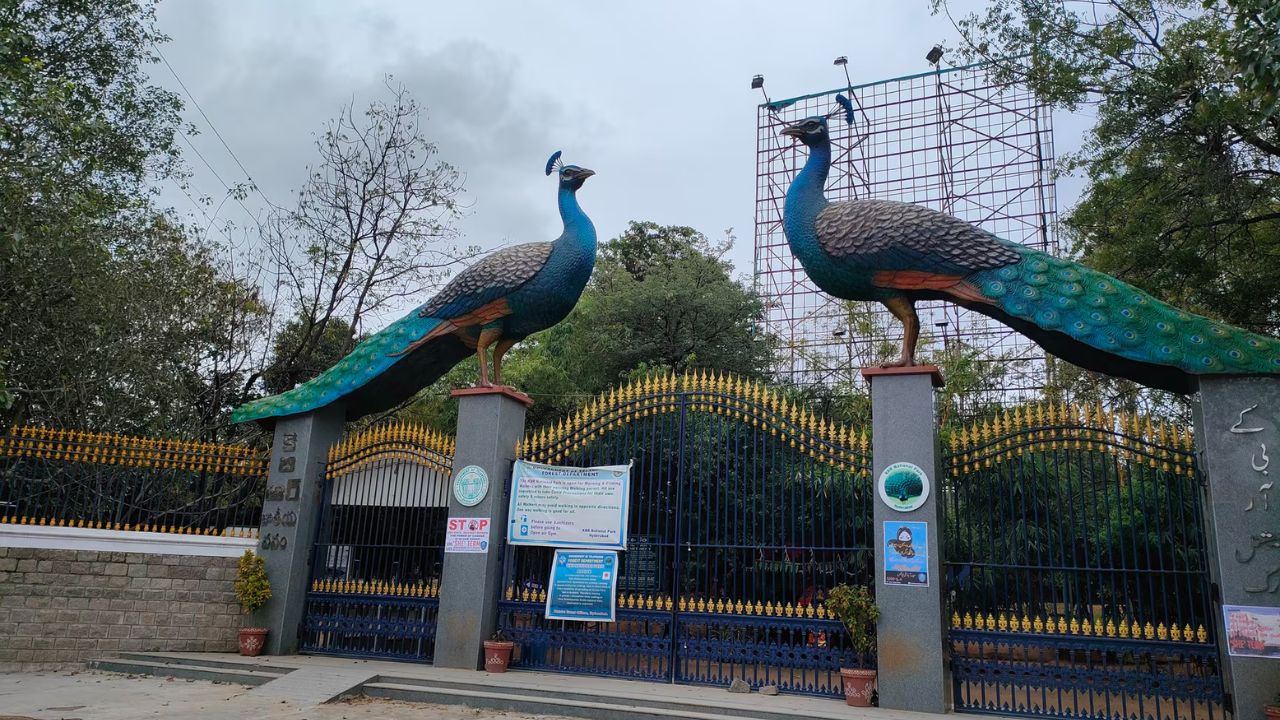
Entrance of KBR National Park in Hyderabad.

Synopsis: Hyderabad’s Kasu Brahmananda Reddy (KBR) National Park is now subject to seven concurrent grade-separator works, which together encircle it on every side. Each has been independently cleared. Each acquisition recites the requisite statutory formula. Yet the cumulative effect is the structural encirclement of a National Park — accomplished in the language of full legal compliance.
Hyderabad’s Kasu Brahmananda Reddy (KBR) National Park occupies a unique constitutional position. Notified in 1998 under the Wildlife (Protection) Act, it is one of only two National Parks inside Indian metropolitan cities — the other being Sanjay Gandhi Park, Mumbai. Sitting on a granite ridge between Banjara Hills, Jubilee Hills and Film Nagar, it holds the city’s last large stand of mature canopy and measurably cools its surrounding micro-basin. Its Eco-Sensitive Zone (ESZ), notified through Statutory Order (SO) 3425(E) in October 2020, is in places only three metres wide.
The park is now subject to seven concurrent grade-separator works — the H-CITI projects — which together encircle it on every side. Split into two EPC (Engineering, Procurement, and Construction) packages, neither of them individually crosses the Environmental Impact Assessment (EIA) threshold under the 2006 Notification.
Each has been independently cleared. Each acquisition recites the requisite statutory formula. Yet the cumulative effect is the structural encirclement of a National Park — accomplished in the language of full legal compliance.
That paradox is not an aberration. It is the consequence of an environmental-law architecture that assesses projects atomistically, defines protected areas administratively, and treats programmatic ring fencing of an ecosystem as a matter that does not arise.
Also Read: Telangana accelerates Hyderabad Metro Phase-I takeover from L&T
The architecture of brazen evasion is not a single bypass but a chain of narrow exemptions — each individually defensible, cumulatively destructive.
• EIA Notification 2006 sees a project, never a programme. Schedule-I organises activities into discrete categories with project-by-project thresholds. H-CITI’s urban grade-separators fall below the highway length threshold and outside the area-development trigger. The Notification contains no aggregation rule for concurrent below-threshold works sharing a tender date, an issuing authority and an impact catchment. The Supreme Court has recognised in dicta that cumulative impact must inform clearance decisions, but no binding test operationalises aggregation at the threshold stage.
• ESZ is treated as an administrative boundary, not an ecological buffer. Edge-effect literature places ecologically functional buffers at 50–100 metres. The Supreme Court in TN Godavarman (June 2022) directed a one-kilometre default ESZ, unless there is a contrary scientific basis. However, that order has been carved away by site-specific exceptions. H-CITI works are largely outside the gazetted ESZ line, and a court reading the file will correctly see that the line has been respected.
• The Forest (Conservation) Act does not classify the canopy as forest. The 1,942 mature trees approved for felling stand on roads classified as urban approach roads — not “forest land” under the FCA. The peri-park canopy is functionally part of KBR’s ecosystem, providing edge buffer, aquifer recharge and faunal connectivity, yet is regulatorily invisible. Compensatory plantation at 1:10 in saplings produces equivalent canopy only after 20 years, and at an unconnected location.
• Section 10A acquisitions exit the Social Impact Assessment regime entirely. Government Order (GO) Rt. Nos. 125 and 126 of March 2025 invoked Section 10A of the Right to Fair Compensation and Transparency in Land Acquisition, Rehabilitation and Resettlement Act, 2013 (RFCTLARR) to acquire 332 properties spanning 65,876 square yards — dispensing with Social Impact Assessment, food-security review and public hearing. A project below EIA threshold acquires land under an SIA-exempt clause; the entire pre-decisional assessment edifice is, by design, never reached.
• Cumulative impact is recognised in dicta but absent in the test. No Indian judgement has translated the acknowledged principle into an operative test requiring a competent authority to aggregate sub-threshold concurrent projects within a defined radius of a protected area.
• The “linear project” fiction has not been retired for urban protected-area peripheries. Seven concurrent urban grade-separators circling a 400-acre National Park are not seven linear projects but one circumferential ring. The typology, drafted for rural highways in 2006, misdescribes the geometry and becomes a loophole.
• ESZ as buffer-in-fact has not displaced ESZ as boundary-in-law. Courts have treated the gazetted boundary as conclusive. A doctrine of functional sufficiency — requiring the state to demonstrate, on hydrological and canopy-connectivity evidence, that a notified buffer is ecologically adequate before major works proceed — has not been articulated.
•Administrative packaging is permitted to defeat the statutory purpose. H-CITI was split into Package I and II — same tender date, same issuing authority, same consultant, same construction window. There is no Indian doctrine testing whether a notional contract split constitutes programmatic unity for assessment purposes.
• United States (NEPA). 40 CFR § 1508.25 requires the lead agency to consider “connected”, “cumulative” and “similar” actions in a single document. The Kleppe doctrine has been used routinely to require programmatic Environmental Impact Statements for road networks and infrastructure corridors. India has neither the regulation nor the doctrine.
• European Union (SEA Directive). Directive 2001/42/EC requires environmental assessment of “plans and programmes”, including transport and urban planning, expressly distinct from project-level EIA. The Court of Justice of the European Union (CJEU) has read the term expansively to capture frameworks that constrain subsequent project decisions. India has no plan-level or programme-level assessment instrument.
•South Africa (NEMA). Section 24 of NEMA authorises integrated assessment where activities are clustered. The Constitutional Court confirmed in Fuel Retailers (2007) that the precautionary principle and integrated assessment are constitutional obligations — not merely statutory directions. The structural feature absent in India — a constitutional duty to assess clustered activity — is operative there.
Also Read: Two more lakes set to reopen as Hyderabad steps up water body restoration
• A doctrine of cumulative encirclement. Where the combined footprint of concurrent works within a defined radius of a notified protected area exceeds any EIA Schedule-I threshold, the cluster shall be treated as a single programme for clearance — extending the precautionary principle from Vellore Citizens and the cumulative-impact dicta from Hanuman Aroskar.
• Retirement of the “linear project” fiction. Para 7(ii) of the 2006 Notification should be construed not to apply to circumferential urban infrastructure touching a National Park boundary. Where the category fiction produces an absurd result, it must be avoided as a matter of statutory construction.
• Functional sufficiency of the Eco-Sensitive Zone. The gazetted ESZ should be a rebuttable presumption, not a conclusive boundary. Where works are proposed within a defined distance of the park, the state carries the burden of demonstrating ecological adequacy — a doctrine implicit in the TN Godavarman 2022 order that now needs positive articulation.
• Programmatic unity over administrative packaging. Works sharing a tender date, issuing authority, consultant, construction window and contiguous impact catchment shall be treated as a single project for EIA threshold computation. An administrative split whose effect is to defeat statutory thresholds is to be disregarded as colourable — the substance-over-form principle from McDowell v. CTO supplies the template.
The KBR record is not a study in regulatory failure. Every regulator in the chain has done what its enabling statute required. No EIA threshold was crossed. No ESZ boundary was violated. No forestry clearance was needed. The Tree Protection Committee acted within its jurisdiction. The acquiring authority invoked an exemption that the state legislature itself enacted.
The cumulative result is the structural encirclement of one of India’s two metropolitan National Parks — accomplished in the language of full compliance.
When the construction window closes in 2027, what will remain is a 360-degree concrete ring around a 400-acre forest, eight underground sumps permanently exporting peri-park monsoon recharge into the city’s sewer network, and a canopy reduced by 1,942 mature trees.
The ecosystem will not collapse immediately. It will collapse, in slow motion, over the fifty-year design life of the structures, during which no judicial review will be able to undo what was lawfully built.
Articles 21, 48A and 51A(g) of the Constitution, read with the public-trust doctrine of MC Mehta v. Kamal Nath (1997), do not contemplate this outcome. KBR is the test of whether that doctrine reaches the architecture of regulatory evasion as well as its individual applications. The reform is, at this point, not academic. It is urgent. And on existing precedent, it is available.
(Major Sandeep Khurana (Veteran) is an environmentalist and sustainability researcher. Dr Donthi Narasimha Reddy is a policy researcher and public commentator based in Hyderabad. Views are personal.)



