

Published Sep 30, 2026 | 11:15 AM ⚊ Updated Sep 30, 2026 | 11:18 AM

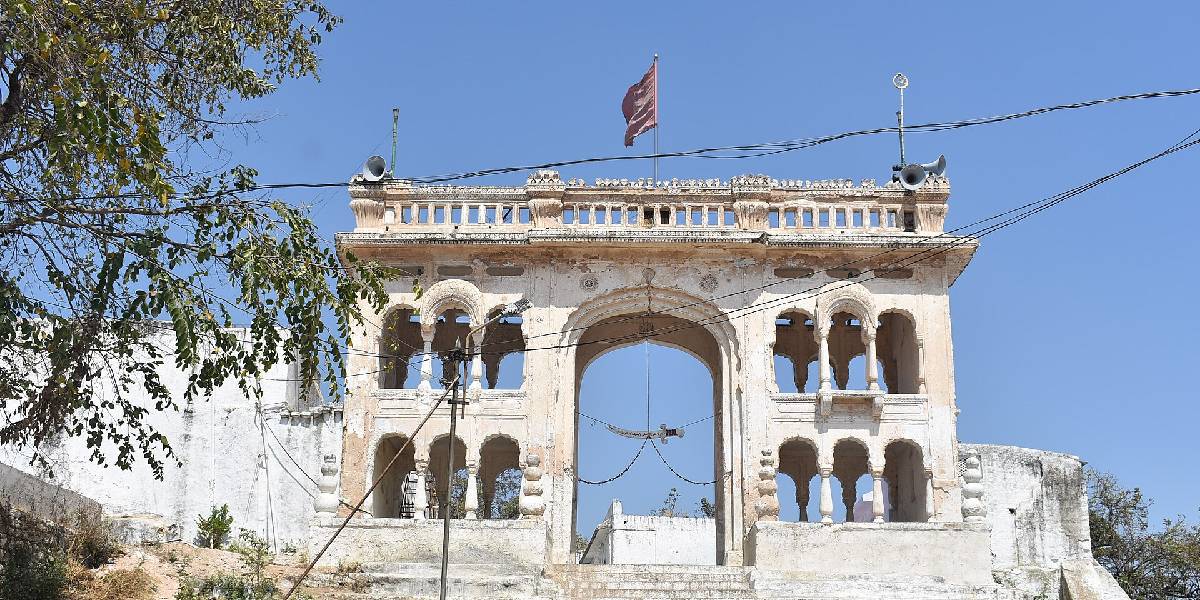
Imam Ali shrine atop the Moula Ali Hill Credit: Wikimedia Commons

Synopsis: While SIR coverage so far has focused mainly on Hyderabad’s core constituencies, other neighbourhoods far from the city centre are facing similar issues. SIR hearings from Moula Ali, a diverse suburb of Secunderabad City, reveal voter difficulties with anomalies, mapping issues, missing documents, language barriers, and more, while data shows abnormally high deletion and anomaly percentages.
The Deputy Commissioner’s office for the Moula Ali Circle is full of booth-level officers with stacks of documents in hand, some waiting for the supervisor to digitise them and others frantically calling constituents who received notices and asking them to visit the office with relevant papers.
DC Balakrishna Prasad says the office staff is overworked with the SIR process and has hired more computer operators to handle regular municipal work.
“It has come down now, but for the past few weeks, we had almost 200 to 250 hearings per day,” he added.
People line up at the office from the morning, with Special Intensive Revision (SIR) notices served to them due to various anomalies like name mismatch, no mapping with 2002 rolls, discrepancies in the ages of parents and grandparents, and more.
BLO B Laxmi, assigned to Polling Station 247, told South First that more than half of the booth constituents received notices. Out of the 919 voters whose names appeared in the latest draft rolls, 466 received notices.
“Almost everyone got a notice here. Even my fellow BLOs and I got notices. We are trying our best to get it resolved,” Laxmi said.
Alongside the anomalies, deletions are also excessive, noted BLO Shafiuddin. He told South First that 632 voters were deleted from polling station number 246 that he was assigned to, while only 828 appear in the draft rolls, amounting to almost 43.2% deletions.
An analysis of the hearing process and data from the Circle exposes the many flaws in the ongoing SIR exercise in Telangana already flagged by several activists and civil society groups.
Also Read: ‘SIR is a bloodless political genocide to exterminate citizenship’: Dr Parakala Prabhakar
Moula Ali, a suburb of Secunderabad City, is now a Circle under Malkajgiri Zone of the newly constituted Malkajgiri Municipal Corporation. The area is one of the more diverse localities in the greater Hyderabad region and boasts significant Muslim and Hindu populations, alongside a notable Christian presence. It is home to the prominent Sufi shrine dedicated to Imam Ali, atop the Moula Ali hill.
It falls under the Malkajgiri Assembly constituency, currently represented by Marri Rajasekhar Reddy of Bharat Rashtra Samiti (BRS). It comes under the larger Malkajgiri Lok Sabha Constituency, represented by Bharatiya Janata Party (BJP) ‘s Etela Rajender.
Located away from central Hyderabad, the area has received little wider attention despite recording unusually high percentages of notices and voter deletions during the ongoing SIR process.
The Malkajgiri Assembly constituency, which also includes multicultural neighbourhoods such as Sainikpuri, Safilguda and Neredmet, ranks eighth among constituencies with the highest number of voter deletions in the state, with 192,957 voters deleted from the draft rolls.
At the Moula Ali circle office, people flock to get their documents verified by the BLOs.
Mohammed Amir, a long-time resident of the locality, is among them. Amir and his wife, Salma Begum, were served notices due to different “discrepancies.”
Amir got the notice because there was a mismatch in his father’s name when compared to the 2002 rolls.
Salma received the notice because the age gap between her and her sibling was less than nine months. Under the ECI rules, two people cannot be mapped to the same parent in such cases.
When Amir asks what documents he should submit, one of the BLOs tells him to find his father’s name on the 2002 list. For his wife, they ask him to get her graduation or Class 10 certificate, but Salma had not finished her class 10th and holds no educational certificates.
The BLO then goes on to list all the documents he could and says, “PAN card, bank passbook, gas bill, ration card, electricity bill, birth certificate, bring everything you can. We don’t know for sure what the system will accept. But you have a higher chance with a bank passbook.”
Syed Jalaluddin Zafar, a social activist with the organisation, Youth Welfare Telangana, told South First that the BLOs were collecting documents without any guarantee that the anomalies would be resolved.
“I have been working with my team on the ground. We have noticed in several constituencies that the BLOs are asking people to get all the documents possible. Why are they collecting PAN Card details? It’s not even in the list of documents prescribed by the ECI,” said Zafar.
Another major problem with this type of document collection is that, after submitting the required documents, voters have no way of knowing whether they have been accepted or rejected, or whether additional proof is required.
“The documents are digitised, and all that the voter can see is that their record is updated. There is no mention of the submitted proofs being satisfactory. How can a person find out if their documents have been accepted or they have been excluded from the voter list?” asks Zafar.
This hangs the future of voting rights for many in ambiguity, Zafar added.
Also Read: After 1,000 days in office, Revanth bets on ‘visible impact’ taking on KCR’s infra legacy
Similar to Amir, Mohammed Aziz (41), a resident of Moula Ali’s Hanuman Nagar, received a notice because of the “discrepancy” in his father’s name compared to the 2002 rolls. Aziz’s old voter ID names his father as ‘Rasheed’ while his father’s other identification cards show ‘Mohammed Rasheed’. During the hearing, Aziz produced a family register certificate obtained from the Tahsildar’s office in August 2026.
The Telangana government had introduced an electronic family register based on the food security card (ration card) data, and started issuing family register certificates (FRC) in July 2026. The move followed several appeals from activists, rights groups, and politicians, including Asaduddin Owaisi, who called for a Permanent Residence Certificate (PRC) similar to Karnataka amid the ongoing SIR of voter rolls.
But the Election Commission called the FRC legally unacceptable. The ECI noted that the FRCs issued before July 2026 contained rigorous checks from local revenue officials and that the latest ones were similar to ration cards.
Adding that it holds discretionary power to set evidentiary standards for voter verification, the ECI cited the Supreme Court’s observation that ration cards do not constitute conclusive proof of citizenship. The Chief Electoral Officer of Telangana had since directed the state election officials to reject FRC as proof for SIR.
The BLOs rejected Aziz’s FRC and asked him to come back with more documents, including his Aadhaar card, assuring that the anomaly would be cleared.
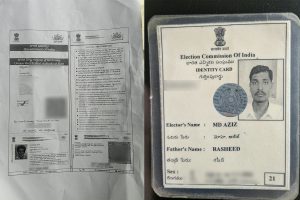
Mohammed Aziz’s voter ID and his father, Mohammed Rasheed’s Aadhaar card
When the FRC was first announced, the state government, including ministers, had publicly appealed to voters to quickly avail it, and explicitly cited its use for the SIR process. But the government has since failed to publicise that the certificates are no longer valid proof for voter verification.
Aziz told South First that he was unaware that FRC was no longer valid.
Voters in the Moula Ali Circle have received notices in Telugu, as English language notices were mandated only for the Hyderabad district.
Syed Muntazar Mehdi, a 65-year-old resident of Moula Ali, attended the hearing at the circle office as both he and his wife received notices over discrepancies in their names in the latest rolls in comparison to the 2002 voter list. When requested to show his notice, Mehdi shared a notice in Telugu which has a woman’s name on it. It belonged to his wife, Kausar Fatima.
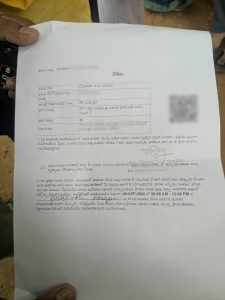
Kausar Fatima, who cannot read the language, received a notice in Telugu.
“I am sorry I cannot read this; neither can my wife. I am not even aware why I got a notice. I voted in 2004, and even in the elections before,” said Mr Mehdi when corrected.
“My name was written in Telugu in the 2002 list; maybe that’s why it’s not matching my documents. Now they are making the same mistake again by giving forms and notices in Telugu,” he added.
The language issue was first raised when the enumeration forms were being distributed, but the Telangana CEO agreed to issue English forms only for the Hyderabad district. The Moula Ali and the larger Malkajgiri constituency fall under the Medchal-Malkajgiri district.
Also Read: Ethics committee or electoral mandate? The Kaushik Reddy test
At 26.84%, the Malkajgiri Assembly constituency has one of the highest anomaly rates in the state, alongside 39.73% of voters marked under the no mapping category. This amounts to over 2.13 lakh out of 3.2 lakh voters receiving notices, which is almost 66.56%.
The abnormally high discrepancy rate is spread across the constituency. At the Moula Ali circle level, an analysis of all the polling stations shows 59.5% of the voters in the latest rolls receiving notices.
The ASDD data is even more striking, as no polling station shows voters marked as absent or duplicate. Almost every voter included in the ASDD list across polling stations in the circle is marked as having permanently shifted, while only a few are marked as dead. A total of 21,093 people face deletion from the rolls in the circle, accounting for nearly 39.2% of the voters on the 2025 roll who are absent from the current draft roll.
At a microscopic level, several polling stations had more than half of the voters placed in the ASDD list, and for one polling station, the number of deleted voters is higher than the number of voters in the draft rolls.
Activists working on voter rights noticed similar patterns across the State. Irfan Khan, a social activist associated with the Telangana Voter Rights Forum (TVRF), said, “If a person was not present at home when the BLOs visited, they were placed in ASDD. In some cases, people have filled the enumeration forms but are still facing deletion.”
People who believe they are being unfairly deleted are being asked to submit Form 6 to register as new voters.
“Why should a person who voted before submit a Form 6? Through this, they are being made to sign a declaration that says they are applying as a first-time voter. Right beneath that, it says any false declaration is a punishable offence. If it is a punishable offence, why are you actively making someone sign a false declaration?” asked Irfan Khan.
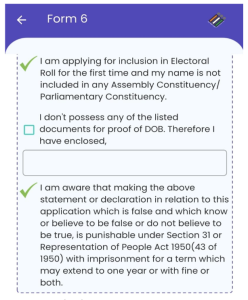
Form 6 Declaration
He demanded that ECI should notify a separate process for the deleted voters to be added back into the rolls.
Syed Jalaluddin Zafar said that there were inconsistencies in how voters in the same family fared in the SIR process.
“How can one person in a family be present in the rolls and another from the same family be untraceable? There is no clear pattern to these deletions. In some cases, even if the BLO has managed to digitise, the votes are still being deleted. We were about to take action against a BLO, but after recent news reports, we have realised that it is a procedure that is taking place from top-down,” he claimed.
TVRF had earlier written to the Telangana CEO, requesting that every voter be provided with clear reasons for receiving a notice. The forum also sought to make the documents submitted and the status of each case accessible to voters, with updates published every day. However, none of these demands has been implemented so far, as panic grips people across the state over whether their names will appear on the final electoral rolls at a time when over 47 lakh voters are staring at the possibility of being left out.
Meanwhile, the opposition parties have called for the resignation of Chief Election Commissioner Gyanesh Kumar over large-scale voter deletions through SIR, after reports suggesting the decisions were taken without the knowledge or despite objections raised by two Election Commissioners, Sukhbir Singh Sandhu and Vivek Joshi.
Leader of the Opposition Rahul Gandhi has alleged a conspiracy to “steal votes and destroy democracy,” naming Prime Minister Narendra Modi and Home Minister Amit Shah along with the CEC as key conspirators.
The Cockroach Janata Party (CJP) has announced a nationwide agitation starting from Mumbai on 2 October demanding the CEC’s resignation. One of the key demands raised by the CJP is to halt the SIR process and initiate an inquiry into the conduct of the exercise.
Even as the political turmoil over the SIR process intensifies, people on the ground continue to grapple with notices and uncertainty over losing their basic rights.
(Edited by Fayisa CA)



