

Published Sep 08, 2026 | 5:06 PM ⚊ Updated Sep 08, 2026 | 5:06 PM

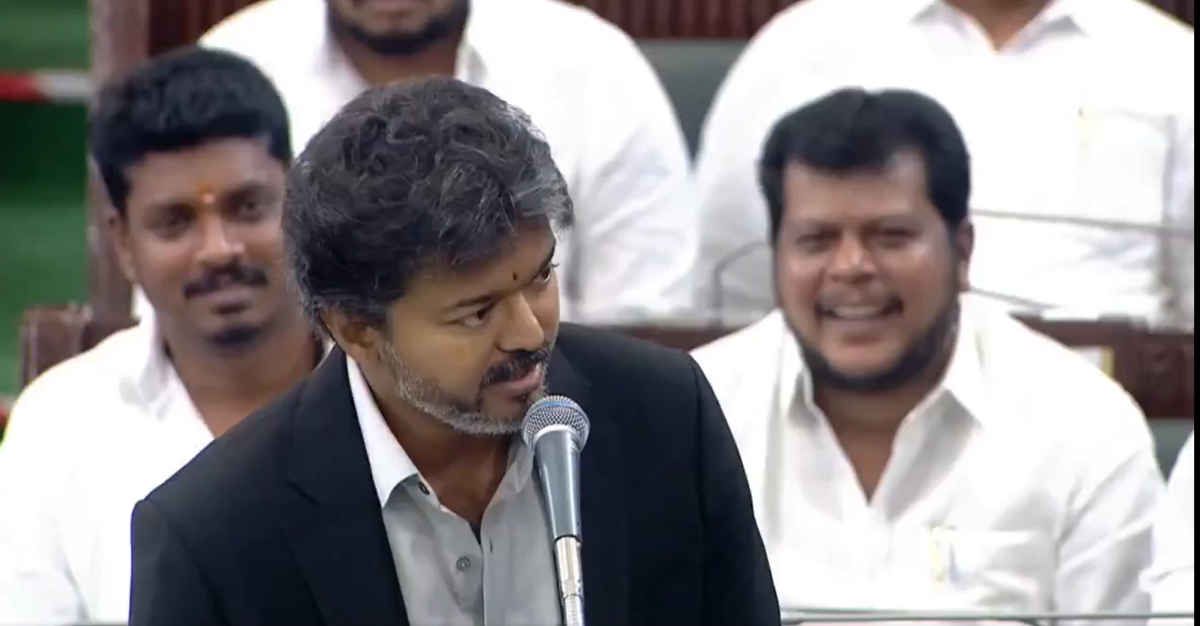
TN CM Vijay in Assembly. (Screengrab)

Synopsis: On Monday, 7 September, Tamil Nadu Chief Minister C Joseph Vijay delivered a charged reply in the Assembly debate on demands for police and Fire and rescue services, outlining his government’s measures on law and order, drugs, women’s safety, and policing. But the reply also devoted substantial space to attacking the previous DMK regime and revisiting political and historical controversies, raising questions over how directly he addressed the specific issues and incidents raised against his own government.
Tamil Nadu Chief Minister C Joseph Vijay delivered a charged, rhetoric-heavy reply to the debate on the Police and Fire and Rescue Services demands in the Tamil Nadu Assembly on Monday, 7 September. His speech — peppered with political and historical references — swung between his government’s record and allegations against the previous DMK dispensation.
But beneath the forceful presentation — the DMK termed it “cinema style” — was a more basic question: Did he adequately respond to specific questions on law and order, custodial deaths, the conduct of police, drugs, women’s safety and the functioning of the police machinery?
On several current law-and-order questions, Vijay responded with broad assurances, descriptions of government measures or explanations of the causes of crime. On some specific incidents, he did not explain each one. When he trained guns at the previous DMK dispensation, however, his response became considerably more detailed, citing individual cases, names, dates, court observations and allegations of political interference.
Under his government, however, such details were conspicuously missing.
This missing link later became the focus of criticism from the DMK and Vijay’s allies, the CPI and CPI(M). But their reactions formed only one part of the story. The larger issue emerging from the speech was whether the Chief Minister’s most forceful portions of the speech were also those that directly answered the questions raised in the House.
Also Read: Uproar over CM Vijay’s ED, corruption remarks
Opposition Leader Udhayanidhi Stalin’s intervention largely focused on police functioning and the government’s record on law and order. He raised questions about custodial deaths, murders, honour killings, police conduct during protests, selective registration of cases, the functioning of the Home and Intelligence wings, drug control, women’s safety and vacancies in the police force.
On custodial deaths, Vijay responded primarily by describing the procedures that his government would follow. He referred to post-mortem examinations, magisterial inquiries, medical examinations, CCTV surveillance, transparent investigations and accountability. He added that no gullible police officer would be protected.
But the response did not provide a detailed account of individual custodial-death cases raised by the Opposition, nor give figures of such deaths, the number of inquiries completed, total prosecuted police officers and the outcomes.
Vijay took a different approach when he discussed crime more generally. Rather than responding primarily through crime trends or case-disposal data, he spoke about the social and local causes of crime, including family and property disputes, previous enmity, revenge, drug use, caste identity, competition over land and power, opposition to inter-caste marriages, local rivalries and economic dominance.
The distinction mattered because Udhayanidhi’s questions focused on the government’s current law-and-order record. At the same time, Vijay’s responses often shifted to explaining why individual crimes occurred and his government’s plan to prevent them from recurring.
Vijay also spoke about cybercrime, describing online fraud, fake investment schemes, OTP and banking fraud, fraudulent job offers and social-media scams as emerging challenges. He said police mechanisms alone were insufficient and called for coordination among the police, banks, telecommunications companies, educational institutions and the public.
Again, the emphasis was largely on the government’s approach rather than measurable outcomes such as the number of cases charge-sheeted, convictions secured or money recovered for victims.
Also Read: Udhayanidhi hits back at Vijay’s speech, accuses Speaker of bias
Some of Udhayanidhi’s most specific questions concerned particular incidents involving the police.
The Opposition Leader asked why permission was denied for a NEET-related protest at Marina, reasons for denying permission for a memorial event for NEET victim S Anitha at Besant Nagar, why police officers without name badges allegedly assaulted students and entered a university campus.
Udhayanidhi also asked who ordered a circular asking colleges to keep students away from Congress and Left protests, and why police personnel gathered at Periyar Thidal to prevent a two-wheeler rally that later required court intervention.
Vijay’s reply was like an incoherent movie script that left more loopholes. He did not explain those incidents individually.
Instead, he offered a broader assurance that the police would function without political interference and that the law would apply equally to everyone, irrespective of political affiliation.
Also Read: Call for ban that started with Anitha‘s suicide
Udhayanidhi also questioned whether the Home and Intelligence wings were functioning effectively.
Vijay spoke generally about strengthening policing, adding technology muscle, improving preventive policing and ensuring that police action was not politically influenced.
But he did not provide a detailed assessment of the Intelligence wing’s performance, its role in preventing the incidents raised by the Opposition or whether there had been any institutional failures.
The answer therefore remained largely at the level of policy intent rather than an assessment of the specific institutional concern raised.
Another issue Udhayanidhi raised was selective policing. He questioned why cases had been registered against Opposition leaders, young people posting content online and journalists, while BJP leaders who had criticised Vijay were allegedly not facing comparable action.
Vijay responded by reiterating that the law would apply equally to everyone and cited instances in which TVK functionaries themselves had faced police action.
Also Read: Vijay’s government asks colleges to stop students from protesting
Udhayanidhi also raised specific concerns over the spread of drugs and the safety of women and children.
On drugs, he questioned the government’s crackdown on the supply network and the availability of narcotics to young people, particularly whether the measures being taken were actually succeeding in curbing the menace.
Vijay addressed the issue, outlining the government’s anti-drug enforcement measures and citing cases registered, arrests and quantities of the contraband seized. He said the government’s aim was not merely to arrest individual offenders but to dismantle the wider drug network. He argued that the problem could not be eliminated within a short period.
On women’s and children’s safety, Udhayanidhi questioned the government’s response to crimes against them and the effectiveness of preventive policing. Vijay spoke about factors behind such crimes, including family and social vulnerabilities, gender inequality, misuse of the internet, family disputes, social pressure and drug culture.
He also listed measures including a dedicated women-and-children safety force, new posts, vehicles, awareness programmes and action in cases involving women and children.
Vijay addressed both subjects, but largely by outlining enforcement measures, activity figures and government initiatives. The response was less direct on the Opposition’s underlying questions about the effectiveness of those measures and whether they had produced measurable improvements in drug control and the safety of women and children.
Also Read: ‘I have doubts whether the TVK will oppose NEET like the DMK’
The tone and character of the reply changed considerably when Vijay discussed the previous DMK government.
A substantial section of the speech focused on allegations of political interference in policing and delayed FIR registration under the previous administration.
Vijay cited individual cases involving DMK functionaries and referred to court observations on delays in registering complaints. He used those cases to argue that political influence had previously affected police functioning.
He also contrasted this with his own government, citing cases in which TVK functionaries had faced police action.
The difference in detail was striking. On several questions concerning the current government, Vijay offered broad policy positions. When discussing the previous DMK government, he relied more heavily on individual cases, names, dates and court observations.
The reply then moved beyond the immediate question of policing and into a much broader political indictment of the DMK, including allegations of corruption and misuse of power.
Also Read: Shock and outrage over sexual assault, brutal murder of Coimbatore girl
Vijay’s reply then moved beyond law and order to delve into allegations of corruption against the previous DMK government.
The Chief Minister referred to documents he attributed to the Enforcement Directorate and alleged that money had been collected in the name of party funds in connection with government contracts.
He spoke about alleged irregularities involving the Municipal Administration and Water Supply Department and referred to issues concerning TASMAC and former minister V Senthil Balaji.
He named former Chief Minister MK Stalin, Udhayanidhi, and other DMK leaders in the allegations.
The DMK objected to the allegations and sought an opportunity to respond. When the Speaker did not allow Udhayanidhi to respond immediately to the Chief Minister’s allegations, DMK legislators protested and staged a walkout.
One of the biggest departures from the police grant came when Vijay invoked the Sarkaria Commission and referred to former Union minister and senior DMK leader Murasoli Maran.
The Sarkaria Commission belonged to a much earlier chapter of Tamil Nadu’s political history. It was constituted to examine allegations of corruption and misuse of office involving the DMK government headed by M Karunanidhi. The commission subsequently became a major political reference point in the rivalry surrounding the DMK and its opponents.
By bringing the commission into a 2026 debate on policing, Vijay was attempting to place his present allegations against the DMK within that longer political history.
The DMK’s objection was not simply to the historical reference itself. It argued that the Assembly was debating the government’s present demands for police and fire services, and that the Chief Minister’s time should have been used to respond to the contemporary law-and-order issues raised by legislators.
Vijay also referred to Murasoli Maran, a prominent DMK national leader and former Union minister.
EV Velu objected to the manner in which Maran was referred to and argued that the Chief Minister had used words that diminished his stature. Velu pointed to Maran’s recognition in public life, including a commemorative postage stamp issued in his honour.
Velu also referred to Vijay’s earlier association with films produced by the Maran family, using that history to question the tone of the Chief Minister’s present remarks.
One of the most controversial portions of the speech came when Vijay referred to Stalin’s detention during the Emergency under MISA — the Maintenance of Internal Security Act.
MISA was a major preventive-detention law used during the Emergency between 1975 and 1977, when opposition politicians and activists were detained across the country.
Stalin, then a young DMK leader, was detained during the Emergency. The DMK has long treated his detention and the alleged abuse in custody as part of the party’s political history and its resistance to the Emergency.
Vijay referred to this episode while attacking the DMK.
The controversy intensified because, while discussing Stalin’s MISA experience, Vijay used a physical gesture that critics interpreted as mimicking the injury to Stalin’s jaw.
The gesture quickly became one of the speech’s most politically contentious moments.
CPI(M) state secretary P Shanmugam criticised Vijay over what he described as a personal attack and objected to the use of Stalin’s physical suffering as political material.
Velu also objected to the reference, arguing that MISA represented a period of democratic struggle and that Vijay’s presentation belittled the sacrifices associated with it.
The incident also created a contrast within Vijay’s own speech.
The Chief Minister had spoken about the need for political restraint and had criticised abusive political discourse. He had also invoked former Chief Minister J Jayalalithaa’s humiliation in the Assembly as an example of how political debate should not descend into personal degradation.
The Opposition subsequently pointed to the MISA gesture as evidence of a contradiction between that appeal for restraint and the manner in which Vijay presented Stalin’s political past.
Udhayanidhi’s criticism after the speech centred on what he saw as a basic failure to stay on topic.
He argued that Vijay should have explained the present government’s law-and-order record. He answered the issues raised by the Opposition instead of using the opportunity to attack the DMK.
He described the speech as resembling a memorised film script and criticised the use of acting, punch-dialogue delivery style and gestures inside the Assembly.
The DMK returned to the issue on Tuesday, 8 September, with senior leaders KN Nehru and Velu strongly criticising the Chief Minister’s speech.
Nehru accused Vijay of speaking for nearly an hour in a “cinema style” to humiliate the DMK and alleged that the speech contained false statements.
He said the Opposition had already requested the Speaker to remove such statements from the Assembly records and questioned why the request had not been accepted.
Nehru’s central complaint was that the Chief Minister spent substantial time discussing MISA and other historical and political issues instead of staying focused on the grant.
Velu focused particularly on the Chief Minister’s references to the Enforcement Directorate.
He invoked Rule 92 of the Assembly rules and argued that matters pending before courts should not be discussed in the House. He also objected to Vijay reading from an affidavit connected with a court matter.
Velu said the Opposition had expected the Chief Minister to speak about the law-and-order situation and respond to the murders and other crimes raised during the debate.
Instead, he argued, the Chief Minister had spent a substantial portion of his reply discussing the DMK, the Enforcement Directorate, the Sarkaria Commission and MISA.
Velu also objected to Vijay’s remarks concerning Maran and argued that the former Union minister’s stature had been diminished in the Chief Minister’s presentation.
The DMK said it had sought to remove the disputed remarks from the Assembly records. The Speaker did not accept the demand, leading to further protests and the removal of DMK legislators from the House.
The Left parties’ criticism
The criticism did not stop with the DMK. CPI(M)’s Shanmugam questioned the very structure of Vijay’s reply, asking whether the Chief Minister had actually answered the issues raised during the debate.
He said a demand-for-grants debate was not simply another political platform. The minister’s responsibility was to respond to legislators’ concerns regarding the department and explain the government’s policies, expenditure and performance.
The CPI similarly argued that political allegations against the Opposition and the previous government had overshadowed the debate.
Their criticism reinforced the central issue, but did not replace it: the more useful test of Vijay’s reply is to compare his response with the questions.
(Edited by Majnu Babu).



