

Published Jul 28, 2026 | 5:41 PM ⚊ Updated Jul 28, 2026 | 5:41 PM

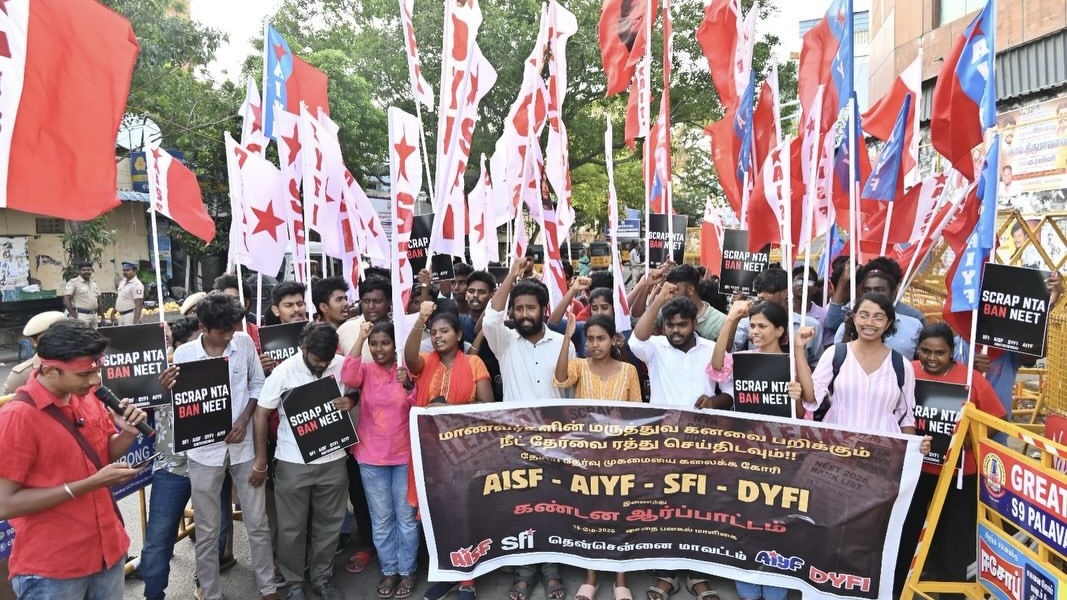
For weeks, political parties, student organisations and civil society groups in the State continued to raise a different demand: "Ban NEET."

Synopsis: Tamil Nadu’s opposition to NEET differs from the rest of India because it seeks the examination’s abolition rather than reform, arguing that it disadvantages students from State Board schools, rural areas and poorer families while weakening the States’ role in medical admissions. Two expert committees appointed by the Tamil Nadu government concluded that NEET has strengthened the coaching industry, widened educational inequalities, failed to show that it produces better doctors and represents excessive centralisation of education.
The nationwide protests led by the Cockroach Janata Party (CJP) demanding reforms to India’s education system, particularly concerning the National Eligibility-cum-Entrance Test (NEET), have become one of the most significant youth-led agitations in recent Indian history.
The movement gathered enough momentum to force the resignation of the Union Education Minister, an outcome few would have predicted when the protests began.
While the youth in much of India rallied around the demand for a ‘fairer’ NEET, Tamil Nadu stood apart.
For weeks, political parties, student organisations and civil society groups in the State continued to raise a different demand: “Ban NEET.”
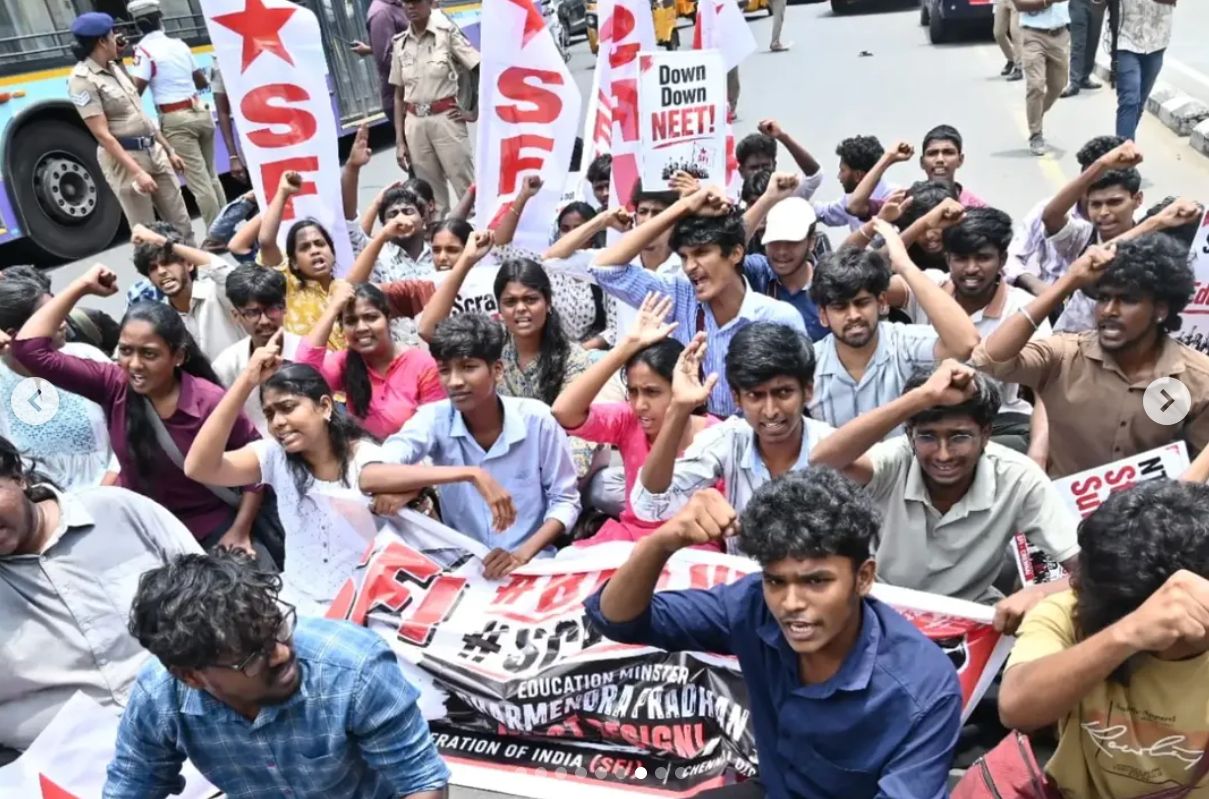
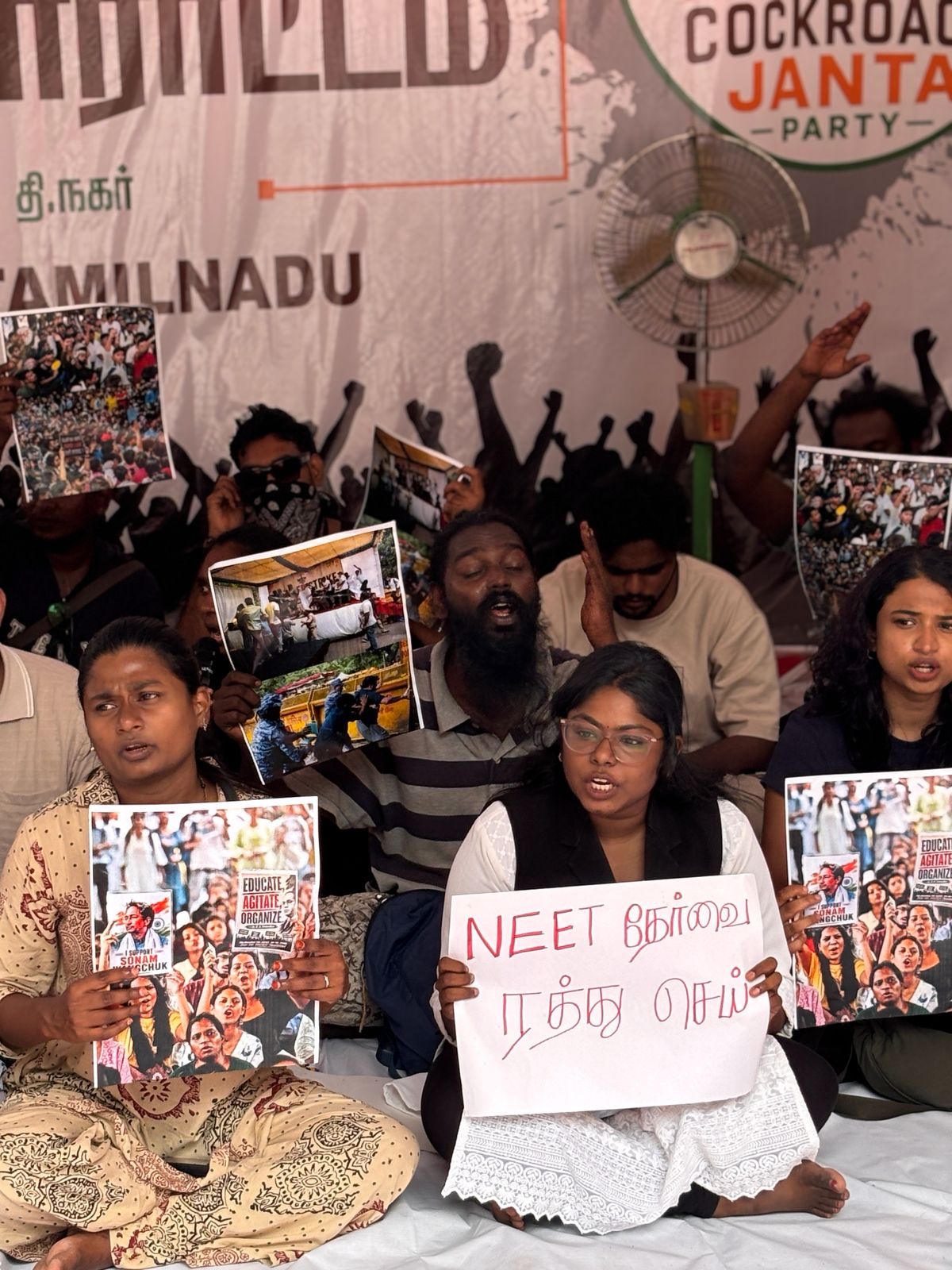
The Tamil Nadu unit of the CJP, too, joined the campaign demanding the complete abolition of the examination.
After concluding its recent phase of protests, the organisation also announced the formation of a committee to coordinate a sustained movement seeking the scrapping of NEET.
Why does Tamil Nadu continue to seek the abolition of NEET when much of India is asking only for reforms?
Why has the State remained steadfast in its opposition, from S Anitha, the first student to lose her life after unsuccessfully challenging NEET before the Supreme Court, to the present day?
Also Read: NEET leakage: Are authorities endorsing systemic failure?
On 24 July 2026, Lok Sabha MP Maddila Gurumoorthy asked the Union Government whether it had reviewed or conducted any study on the impact of NEET-based admissions on students from rural areas, regional-language backgrounds and economically weaker sections. He also sought the findings of such a review, if any.
Under Tamil Nadu’s admission policy that existed before NEET, medical admissions were based solely on Class 12 marks.
In its reply, the Union Ministry of Health and Family Welfare did not state whether any such study had been conducted. Nor did it provide any findings on NEET’s impact on rural or regional-language students. Instead, it reiterated that NEET is the common entrance examination under the National Medical Commission Act, 2019, noted that it is conducted in 13 languages and highlighted the increase in MBBS seats across the country.
Tamil Nadu, however, had already attempted to answer those questions.
Over the past five years, the State government has commissioned two major expert committees to examine why NEET should be abolished.
The first was the Justice AK Rajan Committee, constituted in 2021 to study the impact of NEET on medical admissions in Tamil Nadu. The committee was specifically tasked with examining whether NEET had adversely affected students from rural areas, government schools, Tamil-medium schools and economically weaker sections, whether it was an equitable method of selecting future doctors, and how the mushrooming coaching industry had altered the education system.
The second was the Justice Kurian Joseph Committee on Centre-State Relations, which examined NEET not merely as an entrance examination but as a constitutional and federal question. Its report argued that the centralisation of medical admissions had diminished the States’ powers over education and devoted an entire chapter to explaining why high-stakes national entrance examinations should be reconsidered.
Together, these reports present perhaps the most comprehensive institutional critique of NEET produced in India. One asks whether NEET has transformed who gets to become a doctor. The other asks who should have the power to decide how future doctors are selected.
Nearly a decade after Anitha’s death, they also help explain why, while much of India demands Fair NEET, Tamil Nadu continues to insist on a NEET ban.
Any discussion on NEET in Tamil Nadu inevitably returns to one name: S Anitha.
Born in Kuzhumur village in Ariyalur district, Anitha was the daughter of a daily-wage labourer. A government school student who studied under the Tamil Nadu State Board syllabus, she scored 1,176 out of 1,200 in her Higher Secondary examinations, including near-perfect marks in science subjects.
Under Tamil Nadu’s admission policy that existed before NEET, where medical admissions were based solely on Class 12 marks, she stood a realistic chance of securing a government medical college seat.
Instead, she found herself competing in a national entrance examination for which thousands of State Board students had neither the syllabus nor the coaching ecosystem that many CBSE students enjoyed.
Rather than quietly accepting the outcome, Anitha became one of the petitioners challenging NEET before the Supreme Court. She argued that a single national entrance examination placed students from State Boards, rural backgrounds and economically weaker families at a structural disadvantage.
On 1 September 2017, days before the admission process began, Anitha died by suicide.
Under Tamil Nadu’s admission policy that existed before NEET, medical admissions were based solely on Class 12 marks.
Her death transformed NEET from an education policy debate into one centred on social justice. Nearly every major anti-NEET campaign in Tamil Nadu since then has invoked Anitha, not simply because she was a victim of the system, but because she represented the question the State continues to ask: Does NEET measure merit, or does it reward privilege?
The Dravida Munnetra Kazhagam (DMK), then in the Opposition, promised to abolish NEET if voted to power. After assuming office in 2021, instead of relying solely on political arguments, the government chose to commission an independent expert committee to examine the evidence.
Also Read: The NTA has failed India’s students once too often. Is it time to pull the plug?
On 10 June 2021, the Tamil Nadu government constituted a High-Level Committee headed by retired Madras High Court judge Justice AK Rajan. Unlike previous political debates over NEET, the committee was given a specific mandate: determine whether NEET-based admissions had adversely affected students from rural and urban poor families, government schools, Tamil-medium institutions and other disadvantaged communities, assess whether NEET was an equitable method of selecting medical students, and study the impact of the mushrooming coaching industry.
The committee also undertook one of the largest public consultations ever conducted on an education policy in Tamil Nadu.
It received more than 86,000 representations from students, parents, teachers, doctors, educational institutions, political parties and members of the public. Of these, over 65,000 opposed NEET, while around 19,000 supported it.
But public opinion alone did not shape the committee’s conclusions.
The report examined admission data, judicial precedents, educational research and international admission practices before arriving at a conclusion that directly challenged one of the central arguments made in favour of NEET: that a common entrance examination creates a level playing field.
Instead, the committee argued that India does not have a common educational system, making the idea of a “common” entrance examination inherently problematic.
It noted that while NEET is presented as a standardised test, there is no common national syllabus followed by all school boards. The examination, it argued, largely reflects the CBSE curriculum, placing State Board students at a disadvantage.
Admission data from Tamil Nadu showed that the share of CBSE students securing MBBS seats increased sharply after the introduction of NEET, even though CBSE students constitute only a small proportion of the State’s school population.
For instance, in government medical colleges, the share of CBSE students rose from virtually zero in the pre-NEET period to 26.83 percent of admissions in 2020-21. During the same period, the share of Tamil Nadu State Board (HSC) students fell from over 70 percent before NEET to 43.13 percent.
In self-financing medical colleges too, CBSE students’ share increased from just 0.07 percent in 2015-16 to 12.01 percent in 2020-21. The committee argued that these trends reflected a structural advantage for students from the CBSE stream under the NEET regime rather than a genuinely level playing field.
The committee therefore rejected the claim that NEET creates a genuinely level playing field.
Perhaps the strongest criticism made by the committee concerns the rise of the coaching industry.
According to the report, a true aptitude test should not require months or years of specialised coaching. If expensive coaching substantially improves a student’s chances of success, the examination ceases to measure innate ability and instead begins to measure access to resources.
The committee found exactly that.
Since NEET became mandatory, coaching centres have expanded into a multi-crore industry. Students increasingly spend one or two years after Class 12 preparing exclusively for NEET, often postponing higher education altogether.
By 2020-21, more than 70 percent of students admitted to MBBS courses in Tamil Nadu were repeat candidates, compared to just over 12 percent during the first year of NEET.
The report estimated that many repeaters spend several lakhs of rupees on coaching, an investment beyond the reach of most low-income families. This, it argued, fundamentally alters the nature of medical admissions.
Instead of rewarding sustained academic performance over 12 years of schooling, NEET increasingly rewards those who can afford coaching, take gap years and repeatedly attempt the examination.
The committee described this as a shift from “learning” to “coaching”.
It warned that schools themselves were beginning to prioritise NEET preparation over broader education, reducing students to “marks-scoring machines” while neglecting qualities such as communication, reasoning, empathy and social awareness, qualities essential for future doctors.
The committee also attempted to quantify the scale of the coaching industry that has emerged around NEET. Based on fee structures collected from coaching institutes, it found that a one-month crash course costs between ₹10,000 and ₹38,000, while one-year programmes range from ₹30,000 to ₹1.5 lakh. Long-term coaching spanning up to four years costs between ₹2.5 lakh and ₹4.5 lakh.
Using these figures and the proportion of repeat candidates admitted to MBBS courses, the committee estimated that the average coaching expenditure per student was ₹95,033. It further estimated that an average coaching centre earned about ₹13.95 crore annually, and that the more than 400 coaching institutes operating in Tamil Nadu together generated an estimated ₹5,750 crore business exclusively from NEET coaching, noting that the actual figure could be even higher.
The committee contrasted these figures with the economic reality of most State Board students. It observed that more than 95 percent of students from the Tamil Nadu State Board (TNSBSE) could not afford coaching if these fees were compared with their parents’ average annual income.
For students like S Anitha, the daughter of a daily-wage labourer from Ariyalur who studied in a Tamil-medium government school, the cost of years of specialised coaching was simply beyond reach.
The committee argued that coaching-dependent entrance examinations like NEET therefore favour those who “have” over those who “have not” and those who can “access” coaching over those who cannot, thereby rewarding financial capacity as much as academic ability. It concluded that while coaching may improve test-taking skills, it cannot replace the reasoning, analytical ability and psychosocial skills that are developed through years of schooling and are essential for medical education.
Also Read: Horse trading or strategy? Inside the TVK’s play for AIADMK leaders
One of the principal justifications offered for NEET is that it identifies the most meritorious students and, consequently, helps produce better doctors. The Justice AK Rajan Committee examined this claim by comparing the academic performance of students admitted before and after the introduction of NEET.
The committee first challenged the widely held assumption that NEET marks are a better measure of merit than Higher Secondary (HSC) marks. It argued that if school education is designed to assess a student’s knowledge and abilities over several years, then there is little basis to dismiss those assessments in favour of a single three-hour multiple-choice examination. According to the report, the claim that NEET alone measures merit has “no scientific validity”, as no academic study has demonstrated that NEET is a superior indicator of a student’s ability or future performance.
To test this, the committee compared students admitted to MBBS courses before and after NEET. It found that students admitted during the pre-NEET era had significantly higher Higher Secondary marks than those admitted after NEET. In government medical colleges, the average Higher Secondary score of students admitted before NEET was 98.16 percent, compared with 89.05 percent among students admitted after NEET, a difference of about nine percentage points. Even more strikingly, the average NEET score of post-NEET admitted students translated to only 49.65 percent, leading the committee to argue that NEET had not attracted academically stronger students. It also noted that many students who failed to secure medical seats after NEET had Higher Secondary averages of around 80 percent, substantially higher than the average NEET score of students who eventually gained admission.
The committee then asked an even more important question: Did NEET improve students’ performance in medical college?
According to the report, the answer was no.
Analysing MBBS examination results before and after NEET, the committee found only a marginal improvement in first-year pass percentages and a marginal decline in second-year results. Overall, it concluded that there was no significant improvement in academic performance after the introduction of NEET. If NEET had indeed succeeded in selecting academically superior students, the report argued, this should have been reflected in consistently better performance during medical education. The available evidence, however, did not support that conclusion. Consequently, the committee concluded that NEET could not be regarded as a reliable predictor of success in medical studies.
For the committee, this undermined one of the strongest arguments advanced in favour of the examination. If NEET neither demonstrably selects more academically capable students nor leads to improved performance in medical college, then replacing 12 years of continuous school assessment with a single entrance examination becomes difficult to justify. In its view, the evidence suggested that NEET had become better at identifying students who excel at test-taking than students who would necessarily become better doctors.
One of the most striking aspects of the Justice AK Rajan Committee report is that it does not confine itself to Tamil Nadu. Instead, it asks a broader question: How do other countries select future doctors?
Supporters of NEET have often argued that a common entrance examination is essential to maintain uniform standards. The committee tested that claim by examining medical admission systems in countries such as the United Kingdom, the United States, Canada, Australia and China.
Its conclusion was that India’s NEET model is, in many respects, an exception rather than the rule.
In countries like the United Kingdom, admission to medical schools is based on multiple criteria. Standardised tests such as UCAT or BMAT are only one component of the selection process. School grades, interviews, personal statements, work experience and other indicators of aptitude are also taken into account.
Similarly, in the United States and Canada, examinations such as the MCAT are not used as the sole criterion for admission. Universities consider undergraduate academic performance, recommendation letters, extracurricular activities, interviews and research experience alongside test scores.
Australia follows a comparable model. While applicants may take the GAMSAT, universities combine entrance test scores with previous academic performance and institutional assessments before offering admission.
Drawing from these examples, the committee argued that most developed countries do not reduce admission to a single high-stakes examination. Instead, they evaluate students through multiple indicators accumulated over years of education.
The report also observed that where entrance examinations are used internationally, they generally assess reasoning ability, communication skills and aptitude rather than merely testing mastery of a prescribed syllabus. NEET, by contrast, was described as largely duplicating the content already examined through school board examinations while ignoring broader qualities expected of future medical professionals.
The committee therefore concluded that NEET had moved beyond accepted international practices by making a single examination the exclusive basis for admission.
Also Read: Keeladi excavation unearths rare furnace, reinforcing evidence of early Tamil iron production
The Justice AK Rajan Committee noted a sharp increase in the number of students who studied outside Tamil Nadu but secured MBBS seats under the State quota after NEET was introduced.
Before NEET, an average of 32 such students were admitted to government medical colleges each year. After NEET, this number increased to 220, while admissions in self-financing colleges rose from 14 to 78.
The committee observed that this nearly seven-fold increase warranted closer scrutiny, especially as several domicile-related cases were pending before the Madras High Court.
If the Justice AK Rajan Committee asked whether NEET is educationally equitable, the Justice Kurian Joseph Committee asked a different question: Should the Union Government have the power to decide how every State selects its medical students?
Constituted to examine Centre-State relations, the committee devoted an entire chapter to high-stakes national entrance examinations, arguing that NEET represented one of the clearest examples of the increasing centralisation of education in India.
According to the committee, there is an important distinction between entrance examinations such as JEE, CUET and CLAT, and the NEET regime.
JEE, CUET and CLAT primarily govern admissions to Central institutions or institutions that voluntarily participate in those admission systems. States continue to exercise considerable control over admissions to their own universities.
NEET, however, operates differently.
It applies uniformly to government and private medical colleges across the country, effectively overriding State-specific admission systems and leaving States with virtually no discretion in deciding how students are selected for institutions that they establish, fund and administer.
The committee described this as the most extensive intervention by the Union into the federal educational space.
It also expressed concern that NEET could become a template for extending centralised entrance examinations to engineering, arts, science and other disciplines, gradually replacing diverse State-level admission systems with a single national model.
Also Read: Educationalist Gajendra Babu urges MPs to oppose Bill adopting Vande Mataram as National Song
One of the central arguments advanced by the Justice Kurian Joseph Committee is that uniform standards do not necessarily require uniform examinations.
To support its argument, the committee examined admission systems in several federal countries. It found that Australia, Germany and Canada do not have a single national entrance examination for university admissions, with States or provinces retaining primary control over education.
Even in the United States, widely used tests such as the SAT and ACT are optional for many universities and are administered by private organisations, while admission decisions remain with individual institutions. The committee argued that these examples show uniform standards can be achieved through coordination and mutual recognition, without centralising admissions under a single national examination.
The committee also examined the psychological consequences of high-pressure entrance examinations.
It noted that countries relying heavily on single national examinations, such as China’s Gaokao and South Korea’s Suneung, have long struggled with intense academic pressure, a thriving coaching industry and concerns over students’ mental health.
The report warned that India was increasingly moving towards this model.
Citing national studies, it observed that examination-related anxiety has become a significant public health concern. It referred to the NCERT’s Manodarpan survey, which found examinations and results to be among the leading causes of anxiety among students.
It also cited National Crime Records Bureau data showing thousands of student suicides annually, with coaching hubs such as Kota becoming symbols of the enormous pressure associated with competitive examinations.
The committee argued that the objective of education should be to nurture learning rather than create a “do-or-die” examination culture in which a single day’s performance determines a student’s future.
Perhaps the sharpest criticism in the Justice Kurian Joseph Committee report is reserved for the National Testing Agency (NTA).
Established in 2018, the NTA conducts NEET, JEE, CUET, UGC-NET and several other national examinations.
The committee argued that despite exercising enormous authority over millions of students, the NTA lacks the statutory foundation and institutional accountability expected of such a powerful body.
It noted that the agency functions as a society rather than as a statutory authority, has no State representation in its governing structure and relies heavily on deputation staff, contract employees and outsourced services for conducting high-stakes examinations.
According to the committee, this institutional design creates a “single-point failure” risk, concentrating enormous responsibility in one agency while diffusing accountability across multiple contractors.
The report said these weaknesses became evident during the controversies surrounding NEET-UG, the cancellation of UGC-NET, delays in CUET and the observations of the Parliamentary Standing Committee on Education, which criticised deficiencies in the functioning of the NTA.
The committee argued that even if these examinations were conducted flawlessly, high-stakes national entrance examinations remained educationally and constitutionally problematic. Administrative failures, it said, only strengthened the case for reconsidering the existing model.
Consequently, the committee made two far-reaching recommendations.
First, it argued that States should regain exclusive authority over admissions to institutions that they establish, fund and administer, rather than being compelled to follow a centrally imposed admission regime.
Second, it recommended that the National Testing Agency be disbanded, with responsibility for national examinations returning to the specialised agencies that conducted them before the NTA was created.



