

Published May 27, 2026 | 8:00 AM ⚊ Updated May 27, 2026 | 8:21 AM

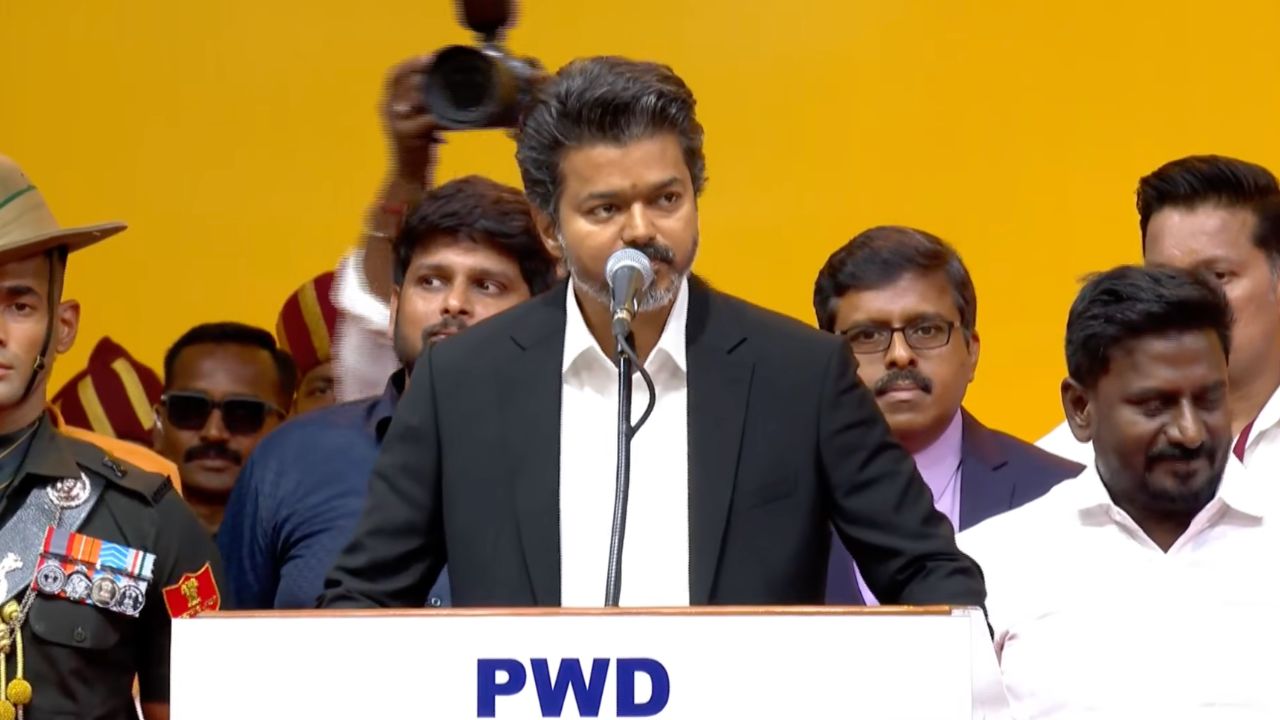
Vijay seen taking oath as the Chief Minister of Tamil Nadu on 10 May 2026. (File Image)

Synopsis: Tamil Nadu experienced an electoral breakthrough when the nascent party TVK won the majority after the Assembly elections, and actor-turned-politician Vijay was chosen as the chief minister. However, it was not a miracle, but a careful plan crafted over the course of 50 years. Though his father, SA Chandrasekar, was not part of his political mission in recent years, he laid the groundwork for Vijay to flourish.
Tamil Nadu just experienced an electoral breakthrough. But was it really a miracle? Not at all. It was a staged event 50 years in the making. Actor-turned-politician C Joseph Vijay and his party did not just appear out of thin air. They are the end product of a long game. A game that traded grassroots democracy for identity politics and unquestioning fan loyalty.
To find the roots of this victory, we must look back to the 1980s. Vijay’s father, director SA Chandrasekhar, laid the groundwork. He kept naming the lead characters in his films Vijay.
And in a strange twist of fate, Dravidian leader, former chief minister M Karunanidhi, even wrote the script for a film, Sattam Oru Vilaiyattu (The Law is a Game, 1987), featuring Vijayakanth with a screen name Joseph Vijay.
The name was etched into the cultural memory of Tamil Nadu long before the man himself thought about politics.
Cinema and politics have always informed each other in Tamil Nadu. While the first phase of Dravidian cinema was instrumental in promoting the Dravidian dream of social justice, it also, in the process, rolled out the red carpet for the charismatic saviour, MG Ramachandran (MGR).
In the second phase, the messenger became the message, and the icon grew larger than the ideology. Dravidian cinema became a maker and breaker of its own ideology.
And Vijay, to some extent, used this historical playbook. It was during the time of Vijay’s birth that his father observed MGR leaving the DMK and tasted electoral success by drawing on his parent party’s ideological base and pitting his individual charisma against it.
Since then, his father has been crafting his cinematic entry, stardom, and political entry. Though Chandrasekar was not part of his political mission in recent years, he laid the groundwork for Vijay to flourish.
Also Read: Congress’ risky but necessary radical shift in approach
Public Relations (PR) strategy in cinema and politics was brutally effective: Name an enemy, relentlessly attack them, and watch as opponents listlessly attempt to counter the calculated onslaught, only to fail miserably.
His PR strategy was always about pitching a one-on-one combat with the most powerful rival, whether it was cinema or politics, hence the DMK vs Tamilaga Vettri Kazhagam (TVK) narrative. While it triggers the fan bases of the others, in reality, Vijay’s image is being built as the strong other in this process.
This political empire was not built on cinematic masterpieces. For instance, the film Sura (2010), a commercial disaster, carried him into the houses of the fisherfolk in Tamil Nadu.
After two commercially successful and critically acclaimed films like Thuppakki (2012) and Kaththi (2014), he made a fantasy film, Puli (2015). Even his hardcore fans were less impressed. However, Puli became his entry ticket into Tamil Nadu’s GenZ world, where, with their internet presence and steadfast spirit, they have scripted his victory.
We are watching a clear shift from ideology to pure image. Contemporary commercial cinema operates as a goosebumps generator, delivering vibe-worthy high moments rather than a coherent whole. Vijay’s political narrative gave this exact product to a youth demographic hungry for quick fixes and instant gratification. And his government will probably try to hit those same high adrenaline beats.
This dynamic has forged a parasocial bond so strong that it renders traditional campaigning obsolete, as crisis branding had already done the work.
By amplifying the lacuna in the incumbent government’s administration, Vijay was packaged as the ultimate readymade saviour who could plug in the gaps, bypassing the need for grassroots engagement. We saw convergence culture at work, with children convincing their family members to vote for him.
While campaigning, TVK played the politics of emotion instead of offering big structural change. Vijay carrying a portrait of Dr BR Ambedkar at the Ponneri rally was a masterstroke. Strategists who understand the hopes of marginalised groups in northern Tamil Nadu are likely to have planned that move.
His party candidates also used electoral pressure groups to their advantage, such as the Seer Marabinar — a collective of about 68 marginalised castes and tribes — which demanded Denotified Tribe certificates. Vijay locked down identity-based vote banks without needing a real ideological framework.
During an informal postmortem of the election, a colleague pointed out another masterstroke. Vijay’s decision not to contest in the Vikravandi by-election. If he had contested at that time, he would have received only 10–15 percent of the votes, coming only from his ardent fan base. It would have sent an image that he is a political lightweight.
While several political analysts viewed that as a missed opportunity to show his strength and negotiate alliances, he waited patiently, letting public frustration slowly boil over to set the stage for electoral success. Even if the methods are questionable, I only wish his intentions are good and progressive.
Also Read: How pro-TVK pages are rewriting Tamil Nadu’s political history
This phenomenal shift in election strategies marks a smooth slide into post-truth politics, driven by echo chambers and confirmation bias. It is vital to note that the victims of confirmation bias and resonating their own echo chambers are found on both sides.
A professor friend of mine, a TVK supporter, observed many non-TVK supporters sharing this quote: “If you want to destroy a nation, destroy the thinking of its youth”. Mistakenly attributed to Vladimir Lenin, it is another example of the urge to rationalise political choices being easily overpowered by basic fact-checking.
Even mainstream media fell prey to manufactured narratives. A report in a prominent newspaper claimed that TVK has four Dalit MLAs from general constituencies. Many public intellectuals viewed this rise of cinematic stardom as signalling an emerging phase of Dalit assertion in Tamil Nadu.
It was read as the first step towards a new chapter in social justice, long after the Dravidian movement had empowered the backward classes in the state.
Yet, it was discovered that the news resulted from erroneous reporting; it even recorded errors in the names of candidates and constituencies. In fact, only one Dalit MLA won from a general constituency, and he was a Congress MLA.
However, Vijay’s Cabinet now consists of eight Dalit MLAs and four women, which is indeed a strong symbol of hope.
The key takeaway for the voters is that we must become critical commoners to break cinematic hypnosis. I remember the words of one of my professors, “Suspicion is the greatest investment of a critical thinker”.
Yes, we have to suspect our own beliefs and challenge our own perceptions. We need to judge politicians on real issues and ideology, not give celebrities a free pass. The immunity one gets by virtue of being a star is a threat to decentralised democracy.
This calculated triumph of symbolic posturing over material governance forces a difficult reckoning.
Why exactly did the DMK lose? They implemented massive welfare schemes and achieved double-digit GSDP growth for two consecutive years. It is not just the sheer weight of cinematic stardom that easily swallowed their complacency about their other success.
While Vijay and his optics certainly provided the spark, the fire fed on a silent anti-incumbency brewing among certain sections, fueled by bureaucratic lapses, whispers of nepotism, jealousy among those not directly benefiting from the welfare schemes, and allegations of corruption.
Yet, Tamil Nadu needs DMK’s Dravidian ideological rigour as it still possesses the vocabulary of state autonomy, social justice, secularism and scientific temper.
Historically, even the Opposition benches have shaped the policies of chief ministers — from Kamaraj to Edappadi Palaniswami. They will now continue to pressure the new state apparatus to operate strictly within a Dravidian framework.
DMK, along with TVK’s new alliance partners, still holds the ideological compass needed to navigate the complex social justice landscape of Tamil Nadu and to ensure inclusive, distributed development.
Will Vijay and his political machine have the intellectual openness to use that compass? Do they have the administrative depth to govern? Or will they just keep generating goosebumps? That is the defining question of this new era.
Let the hopes of the commoners who voted for change guide the new government to match the power of spectacle with the grace of service.
(Views are personal. Edited by Muhammed Fazil.)



