

Published Jun 16, 2026 | 4:15 PM ⚊ Updated Jun 16, 2026 | 4:17 PM

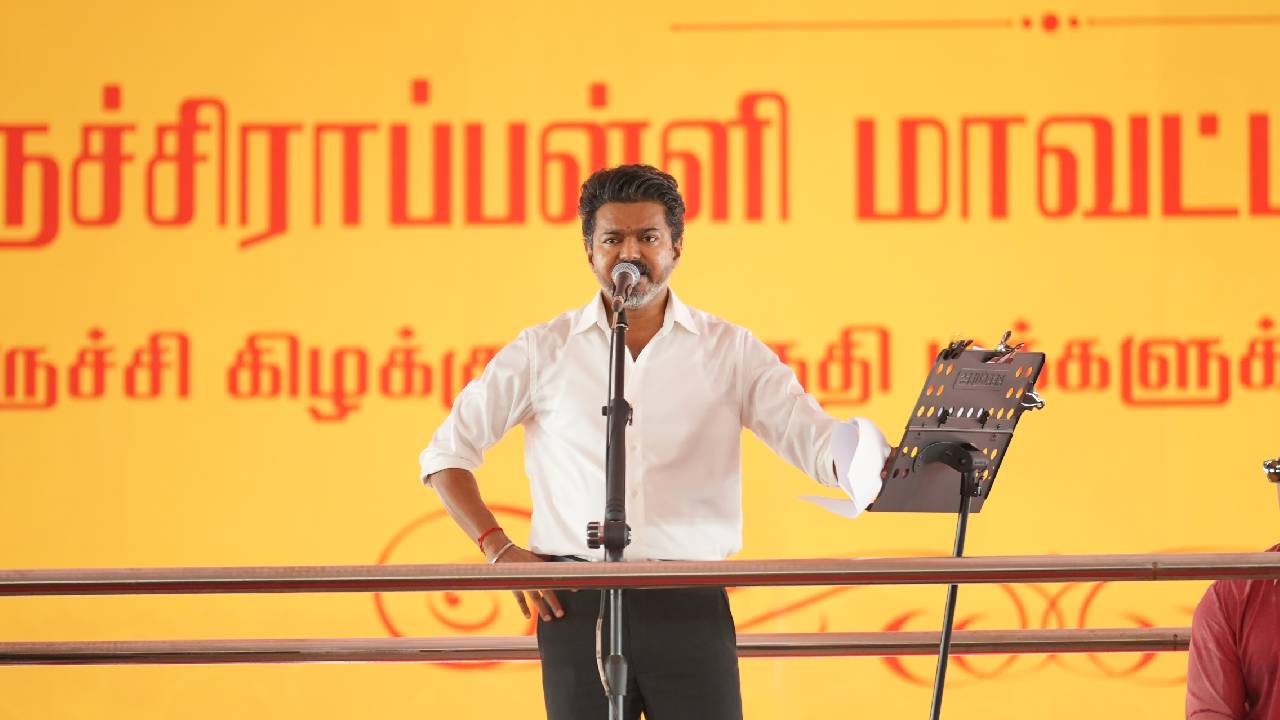
Tamil Nadu Chief Minister C Joseph Vijay addressing a rally in Tiruchirappalli on Monday, 1 June. (File Photo)

Synopsis: Ambedkar, Periyar, and Kamaraj represent ideas that have shaped modern Tamil politics. Velu Nachiyar and Anjalai Ammal, however, represent something new.
The rise of Tamilaga Vettri Kazhagam (TVK) and its victory in the 2026 Tamil Nadu Assembly election has generated significant discussion about Vijay’s popularity, campaign strategy, and the broad social coalition that rallied behind the party.
While these factors undoubtedly contributed to the electoral outcome, they do not fully explain the emergence of TVK as a political force. An equally important aspect of TVK’s success lies in the ideological framework that Vijay consciously attempted to construct during the election campaign. TVK chose to publicly identify five ideological pioneers as the intellectual foundation of the party: Dr BR Ambedkar, Periyar EV Ramasamy, K Kamaraj, Velu Nachiyar, and Anjalai Ammal.
These leaders were not merely featured on party posters. Throughout the campaign, Vijay repeatedly invoked values associated with them—social justice, self-respect, educational advancement, women’s leadership, and public service. More importantly, he attempted to translate these values into a contemporary political programme.
The ideological significance of these five pioneers becomes clearer when viewed as a coherent framework rather than a collection of historical personalities. Ambedkar, Periyar, and Kamaraj represent social justice, self-respect, development, equal opportunities—ideas that have shaped modern Tamil politics. Velu Nachiyar and Anjalai Ammal, however, represent something new.
Their inclusion suggests TVK’s attempt to add a fourth pillar to Tamil political thought: gendered citizenship, where women are recognised not merely as beneficiaries of welfare programmes but as leaders, freedom fighters, and agents of social transformation.
Among the five ideological pioneers of TVK, Dr BR Ambedkar arguably occupies the most prominent position. Throughout the election campaign, Vijay repeatedly spoke about equality, dignity, representation, constitutional values, and opportunities for historically marginalised communities. In recent years, major parties have increasingly invoked Ambedkar and celebrated his contributions.
By placing Ambedkar at the centre of its ideological framework, TVK signals that social justice is not merely one among many policy concerns but a foundational principle of governance. Vijay’s campaign speeches consistently emphasised representation, equality, and dignity, echoing Ambedkar’s vision of democracy as a means of social transformation. If Periyar challenged caste hierarchy through the language of self-respect, Ambedkar provided the constitutional and democratic framework necessary to realise social equality in Tamil Nadu. In many ways, Ambedkar serves as the moral anchor of TVK’s political vision.
Also Read: Politics or maintenance failures: What’s behind Tamil Nadu’s growing power outages?
If Ambedkar provides TVK with its framework of social justice, Periyar provides the language of self-respect and social equality.
From the beginning of its political journey, TVK has attempted to position itself within Tamil Nadu’s long tradition of social justice politics. In doing so, Vijay has repeatedly drawn upon ideas associated with Periyar EV Ramasamy, particularly the principles of self-respect, equality, and opposition to social discrimination.
The influence of Periyar was also visible in Vijay’s efforts to appeal across caste and community divisions. His campaign consistently emphasised social harmony, inclusion, and the need to move beyond politics that divides people on the basis of birth. Such messaging reflects Periyar’s broader challenge to social hierarchy and inherited privilege.
TVK’s emphasis on women’s empowerment similarly resonates with Periyar’s vision of social reform. Vijay’s campaign sought to reinterpret these ideas for a new generation, demonstrating that Periyar’s vision continues to shape the language of Tamil politics beyond the traditional Dravidian parties.
Throughout the campaign, Vijay repeatedly emphasised education, administrative efficiency, welfare delivery, and honest governance.
These themes closely mirror Kamaraj’s reputation as one of Tamil Nadu’s most respected administrators. By invoking Kamaraj’s legacy, TVK attempted to reassure voters that it was not merely a protest movement but a party capable of governing.
The emphasis on schools, youth development, and public welfare reflected a belief that governance should improve everyday lives rather than remain confined to political rhetoric. If Ambedkar represented social justice and Periyar represented social reform, Kamaraj symbolised the practical dimension of governance that TVK sought to project.
Among the most innovative aspects of TVK’s ideological framework is the inclusion of Velu Nachiyar. By placing Velu Nachiyar alongside Ambedkar, Periyar, and Kamaraj, TVK sent a powerful message that women are not merely participants in politics but makers of history.
Velu Nachiyar was not simply a queen. She was a military strategist, a resistance leader, and one of the earliest anti-colonial figures in Indian history. Her life symbolises courage, leadership, and the refusal to submit to oppression. The significance of her inclusion extends beyond symbolism.
Throughout the election campaign, Vijay repeatedly highlighted women’s participation in governance and public life. The party’s proposals concerning women’s safety and empowerment reflected an attempt to move beyond conventional welfare politics. One notable example was the proposal to establish Rani Velu Nachiyar safety initiatives aimed at strengthening institutional responses to threats against women.
By naming such initiatives after Velu Nachiyar, TVK consciously linked contemporary governance with a historical tradition of female leadership and resistance. More importantly, the inclusion of Velu Nachiyar reflects an effort to redefine political leadership itself. Rather than presenting women merely as recipients of state support, TVK sought to present them as leaders capable of shaping society and governance.
Also Read: Stalin questions Vijay’s silence day after Chennai sees 12 sexual assault cases
If Velu Nachiyar symbolises courage and leadership, Anjalai Ammal represents service, sacrifice, and grassroots activism. Among TVK’s five ideological pioneers, Anjalai Ammal is perhaps the least frequently invoked figure in mainstream political discourse. Yet her inclusion carries considerable ideological significance. Anjalai Ammal dedicated her life to the freedom struggle, public service, and social engagement, making her an important but often overlooked figure in Tamil Nadu’s political history.
By honouring her, TVK expands Tamil Nadu’s political memory beyond the familiar pantheon of male leaders. Her inclusion reflects an important political message: politics is not merely about acquiring power but also about serving society.
Throughout the campaign, Vijay frequently presented politics as a form of public service and collective responsibility, themes that resonate with Anjalai Ammal’s legacy. Her life demonstrates that meaningful social change is achieved not only through leadership but also through sustained engagement with people and communities. By recovering the memory of Anjalai Ammal, TVK has broadened the ideological foundations of Tamil politics and brought women’s contributions to public life into the centre of political discourse.
The true significance of Velu Nachiyar and Anjalai Ammal lies not merely in their inclusion on party posters but in the attempt to translate their legacy into governance. This became particularly evident through initiatives such as Singapenn.
Unlike conventional welfare schemes that often treat women primarily as beneficiaries, Singapenn projects women as leaders, protectors, and agents of social transformation. The symbolism is powerful. The very term “Singapenn” evokes confidence, courage, and self-belief. It reflects a vision of citizenship in which women are viewed not as passive recipients of state assistance but as active participants in public life.
In many ways, Singapenn represents the institutional expression of the values embodied by Velu Nachiyar and Anjalai Ammal. One symbolises leadership and resistance; the other represents service and social commitment. Together, they provide the ideological foundation for a more expansive understanding of women’s empowerment.
The real significance of TVK’s ideological framework lies not in the individual leaders it celebrates but in the synthesis it attempts to create. Ambedkar provides the language of social justice and constitutional equality, Periyar provides the framework of self-respect and social reform, Kamaraj contributes to the vision of developmental governance, Velu Nachiyar introduces the politics of women’s leadership and courage, Anjalai Ammal embodies service, sacrifice, and grassroots citizenship. Together, these figures create an ideological coalition that transcends caste, gender, and generational divides.
For decades, Tamil politics has been shaped by the language of social justice, self-respect, and development. TVK’s ideological intervention lies in its attempt to expand that tradition and add a fourth pillar: Women’s leadership and equal citizenship, where women are recognised not merely as beneficiaries of welfare but as leaders, freedom fighters, public servants, and agents of social change.
Whether this vision is fully realised will ultimately be judged by governance rather than symbolism. Yet the political significance of the attempt is already evident. The rise of TVK is not simply the story of a new party. It is an effort to redefine the ideological horizons of Tamil politics itself.
(Views are personal. Edited by R Rajesh Kumar.)



