

Published Oct 31, 2026 | 7:00 AM ⚊ Updated Oct 31, 2026 | 7:00 AM

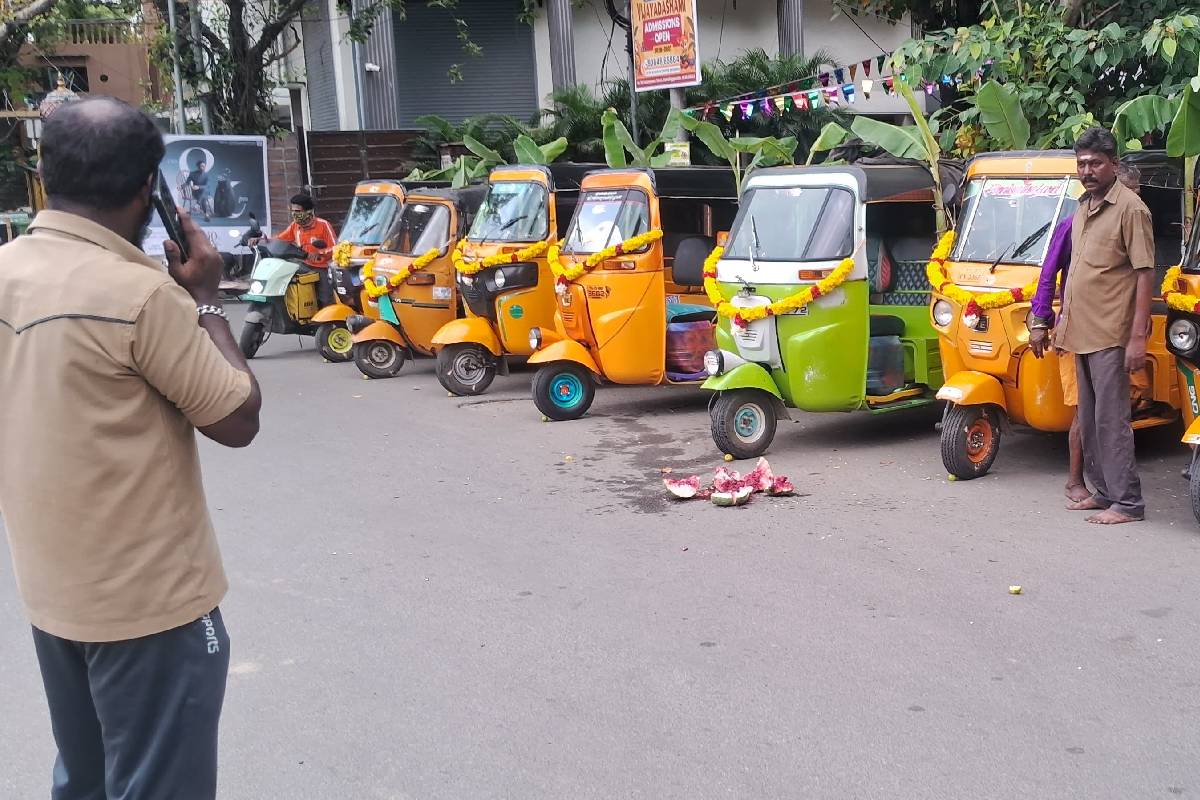
Auto drivers have welcomed the government's revised fare structure, saying it could benefit both drivers and passengers. (Photo| Special arrangement)

Synopsis: Tamil Nadu has revised auto fares after 13 years, but Ola, Uber and Rapido are yet to adopt the new rates, forcing passengers to pay higher fares. Auto unions have urged the government to intervene and have demanded a state-run auto-booking app.
Tamil Nadu has revised auto-rickshaw fares after nearly 13 years, with the government issuing an order on October 27. According to the revised fare structure, the minimum fare for the first 1.8 km has been fixed at Rs 50, while every additional kilometre will cost Rs 25.
While passengers have long complained about exorbitant fares, auto drivers, on the other hand, have accused corporate mobility platforms of exploiting their labour through high commissions. Against this backdrop, auto drivers have welcomed the government’s revised fare structure, saying it could benefit both drivers and passengers.
“If corporate platforms such as Ola and Uber implement the government’s revised fares, it will benefit both passengers and auto drivers. This is certainly a welcome announcement,” says S. Balasubramaniam, coordinator of the All Auto Workers’ Union Federation.
However, none of the major corporate mobility platforms has officially shifted to the government-prescribed fare structure so far.
Also Read: Three key issues arising from the arrest of economist Kalaiyarasan: MP Dr D. Ravikumar
Currently, mobility platforms charge between Rs 70 and Rs 90 for a two-kilometre ride.
Unlike the earlier system, in which platforms charged a commission for every ride, companies have now introduced a system under which auto drivers pay approximately Rs 29 as a daily platform fee and can accept any number of rides throughout the day.
Meanwhile, auto drivers who operate independently, without taking rides through these platforms, say they generally charge Rs 20 per kilometre. However, fares vary depending on whether the vehicle runs on petrol, electricity or CNG.
For instance, Rajeswari, who operates an electric auto in Chennai’s KK Nagar, said she does not charge more than Rs 20 per kilometre.
“I do not charge more than Rs 20 per kilometre. That is sufficient for me,” she said.
However, Manikandan, who operates a petrol-powered auto in Chennai’s Parry’s Corner, charges Rs 120 for a distance of just 800 metres. He attributed the higher fare to the heavy traffic congestion in the area and the fact that he operates a petrol-powered vehicle.
“Since women can travel free of cost on all government buses, we hardly get any rides. We can only charge this much for the few rides we manage to get,” he said.
Karmegam, who hails from Tiruppur and operates an electric auto in Chennai, also expressed similar concerns over the free bus travel scheme for women.
“During the previous government, free bus travel was available only on certain buses. Now, it is available on all buses, leaving us with hardly any rides. No matter how much the fares are increased, how can we manage our livelihoods if we do not get passengers?” he asked.
Thus, auto drivers say that even with the fare revision, the lack of passengers continues to affect their earnings.
Also Read: Dhanush, TVK and the politics of film stardom
Under the new government order, the minimum fare for the first 1.8 km has been increased from Rs 25 to Rs 50. The fare for every additional kilometre has been raised from Rs 12 to Rs 25.
Other revised charges include:
For passengers who currently pay between Rs 70 and Rs 120 for a two-kilometre ride, the revised government fare structure could offer considerable relief, says Roshini, a Chennai resident who uses autos at least four times a week.
She occasionally takes autos to commute to her workplace.
“I spend around Rs 1,000 to Rs 1,200 every week on autos alone. My office is within four kilometres of my home, but every time I take an auto, I end up spending around Rs 200. This has become a significant financial burden,” she said.
According to Roshini, if auto drivers and mobility platforms implement the government’s revised fare structure, her commuting expenses could come down to around Rs 100 per trip, reducing her current expenditure by nearly 50%.
On October 29, the All Auto Workers’ Union Federation, which includes trade unions such as CITU and AITUC, submitted a representation to the Tamil Nadu government welcoming the revised fare structure while seeking a further increase.
The federation has demanded a minimum fare of Rs 60 for the first 1.5 km and Rs 30 for every additional kilometre.
Speaking to South First, Balasubramaniam said the revised fares should strike a balance between the interests of passengers and auto drivers.
“People are already paying Rs 70 to Rs 80 for rides of up to two kilometres. The government should revise the fares in a way that is acceptable to both passengers and auto drivers, without imposing an additional financial burden on the public,” he said.
The federation has also urged the state government to immediately launch its own auto-booking application as an alternative to corporate mobility platforms.
Also Read: L. Murugan rejects speculations over his resignation; says focus is on strengthening BJP in TN
Apart from the fare revision, the federation has placed several other demands before the government:
1. Ban or regulate bike taxis: The unions have demanded a ban or regulation of two-wheeler bike taxis, alleging that they threaten the livelihoods of auto drivers.
2. Exempt autos from certain provisions of the Motor Vehicles Act: They have opposed the implementation of the new Motor Vehicles Act in Tamil Nadu and sought exemptions from online enforcement and penalties for auto drivers.
3. Subsidised fuel and electricity: The unions have demanded subsidised petrol, diesel, LPG, CNG and electricity for electric vehicles, similar to the subsidised diesel provided to fishing boats.
4. Festival bonus: They have sought a festival bonus of Rs 5,000 for auto drivers through the Auto Workers Welfare Board, on the lines of the Puducherry government’s assistance to auto drivers.
5. Financial assistance for fitness certification: Citing the Andhra Pradesh government’s annual assistance of Rs 15,000 towards fitness certification for autos, the unions have demanded similar financial support from the Tamil Nadu government.
6. Restrictions on bulk EV auto permits: They have demanded an immediate ban on issuing electric auto permits in bulk to large corporate entities and the cancellation of permits already issued to them.
Also Read: Who is R Premkumar arrested in alleged Rs 5,000-crore Bharat Lajna Society fraud case?
The federation has also raised concerns over Ola, Uber and Rapido continuing to charge fares that have not been aligned with the government’s revised tariff.
Balasubramaniam urged the government to intervene and ensure that these platforms immediately adopt the new fare structure. He also called for action, including a possible ban on the platforms, if they fail to comply.
“Platforms such as Ola, Uber and Rapido have still not implemented the revised fares. The government must intervene and direct them to adopt the new fare structure immediately, or ban them if they refuse to comply. Until the fare meters are updated in accordance with the revised rates, the Transport Department should also use the media to inform the public about the new fares and ensure that they are followed,” he said.
Despite the government’s long-awaited fare revision, the continued gap between official fares and the rates charged by app-based platforms remains a concern for passengers.
While auto drivers welcome the revision, they say its benefits will materialise only if the new rates are implemented across both independent services and corporate mobility platforms.
(Edited by Fayisa CA)



