

Published Jul 27, 2026 | 9:00 AM ⚊ Updated Jul 27, 2026 | 9:00 AM

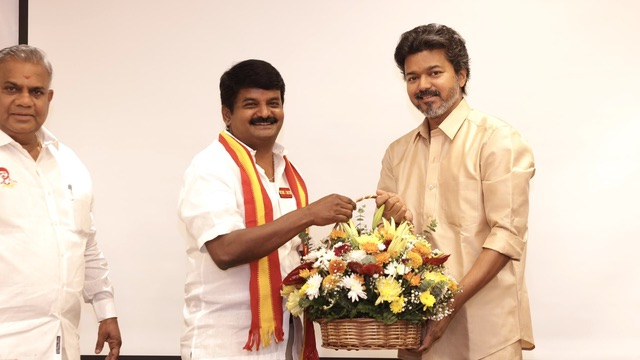
CM Vijay and Vijayabaskar

Synopsis: A steady stream of opposition leaders joining the ruling Tamilaga Vettri Kazhagam in the months since it assumed power in Tamil Nadu has triggered allegations of horse trading. The TVK, for its part, maintains that those joining its ranks have done so voluntarily. Insiders, however, say the party has systematically reached out to opposition leaders by offering political opportunities, though not financial inducements.
Within months of the Tamilaga Vettri Kazhagam (TVK) taking power in Tamil Nadu, the state’s political landscape has undergone a steady realignment. It began with a section of AIADMK MLAs seeking to break away and extend outside support to the TVK, which was then still short of a simple majority. Since then, it has evolved into a steady stream of former ministers, former MLAs and district-level functionaries crossing over from the Dravidian major to the ruling party in successive waves.
The fallout has been immediate. The AIADMK has repeatedly accused the TVK of engineering defections through horse trading, an allegation echoed by the DMK.
Complaints have been submitted to the Tamil Nadu Director General of Police and Governor Rajendra Vishwanath Arlekar, seeking action against the ruling party.
For its part, the TVK has consistently maintained that those joining its ranks have done so voluntarily and out of ideological conviction. However, party insiders say the TVK has been engaged in a systematic outreach effort to attract leaders from rival political parties.
Also Read: CM Vijay’s Jana Nayagan: A blockbuster for the black market
After emerging as the single largest party with 107 Assembly seats in the 2026 Assembly election, the TVK required the support of 11 more legislators to reach the majority mark of 118.
The party secured support from several constituents of the DMK-led alliance, including the Congress, the CPI, the CPI(M), the VCK and the IUML, enabling it to form the government.
Unexpectedly, during the confidence motion, a section of AIADMK legislators led by SP Velumani and CV Shanmugam voted in favour of the government, despite there being no formal understanding between the TVK and the AIADMK leadership. The move triggered allegations of political manoeuvring and eventually paved the way for a series of defections.
The AIADMK subsequently sought the invocation of the anti-defection law against 25 legislators who had voted against the party’s official stand. Within days, four of those MLAs — Maragatham Kumaravel, P Sathyabama, S Jayakumar and Dr Esakki Subaya — resigned from the Assembly before joining the TVK.
The resignations were followed by the induction of senior AIADMK leaders, including former ministers C Vijayabaskar, MR Vijayabhaskar, MC Sampath, NR Sivapathi, Kadambur C Raju, Udumalai K Radhakrishnan, MSM Anandan and S Valarmathi, along with several former MLAs, former MPs and district-level functionaries. The steady influx reinforced the opposition’s claim that the developments were part of a larger political exercise rather than a series of isolated individual decisions, further fuelling allegations of horse trading.
AIADMK Rajya Sabha MP IS Inbadurai told South First that the TVK had a political alternative after the election but chose a different course.
“They emerged as the single largest party with 107 seats and required only 11 more MLAs to form the government. The natural political option before them was to forge an alliance with the AIADMK because both parties had campaigned against the DMK. Instead, they attempted to split the AIADMK itself,” he said.
Inbadurai questioned why Chief Minister C Joseph Vijay visited the office where AIADMK legislators were staying after assuming office instead of meeting AIADMK General Secretary Edappadi K Palaniswami.
“That group was already known to be dissatisfied with the party leadership. The very next day, 25 legislators voted against the AIADMK’s official stand during the confidence motion,” he said.
He also disputed the explanation offered by legislators who later joined the ruling party.
“They claimed they joined the ruling party to better serve the people. But today they are not even MLAs. If they genuinely had differences with the AIADMK, they could have resigned before the election itself,” he said.
According to Inbadurai, 21 of the 25 legislators, including CV Shanmugam, submitted letters to the AIADMK leadership expressing regret for defying the party whip and assuring the party that they would abide by its decisions in future. Despite those assurances, he said, some of them later joined the TVK.
“Had they joined another political party, one could have viewed it differently. But when they repeatedly end up in the TVK, it only strengthens the allegation of horse trading,” he added.
Inbadurai also alleged selective action by the investigating agencies, claiming that complaints filed by the AIADMK had not received the same attention as those lodged by the ruling party.
Also Read: Tuticorin youth dies after hospitalisation; family alleges custodial torture, refuses to accept body
While the opposition has publicly held Chief Minister Joseph Vijay responsible for the defections, political insiders suggest that the day-to-day execution of the ruling party’s outreach is being handled by Minister Aadhav Arjuna.
A political source familiar with the developments told South First that Aadhav has emerged as the principal coordinator responsible for bringing AIADMK leaders into the TVK.
According to the source, however, the exercise does not involve financial inducements.
“Major monetary offers are generally not involved. The TVK is today the dominant political force in the State, and many leaders believe their political future is stronger within the ruling party. At most, assurances of organisational responsibilities or party positions are being given,” the source said.
The source argued that proximity to power has itself become a political incentive for many opposition leaders seeking relevance in the new political landscape.
At the same time, the source was categorical that Aadhav Arjuna’s role should not be interpreted as independent decision-making.
“Whatever Aadhav Arjuna may be doing, nothing of this nature happens in the TVK without Vijay’s approval. Every major political decision ultimately requires the Chief Minister’s consent. Aadhav may be executing the political strategy, but the direction comes from Vijay,” the source added.
Interestingly, Inbadurai arrived at a similar conclusion, albeit from the opposite side of the political divide.
“Today Vijay does not even personally receive many leaders joining the party. That itself is political theatre. Whoever may be executing this exercise, the ultimate beneficiary is Vijay. He heads both the government and the party. Nothing of this scale can happen without his approval,” he said.
Whether the continuing defections constitute political realignment or horse trading remains a matter of allegation, with no investigating agency or court having established wrongdoing.
(Edited by Dese Gowda)



