

Published Nov 10, 2026 | 6:30 PM ⚊ Updated Nov 10, 2026 | 6:30 PM

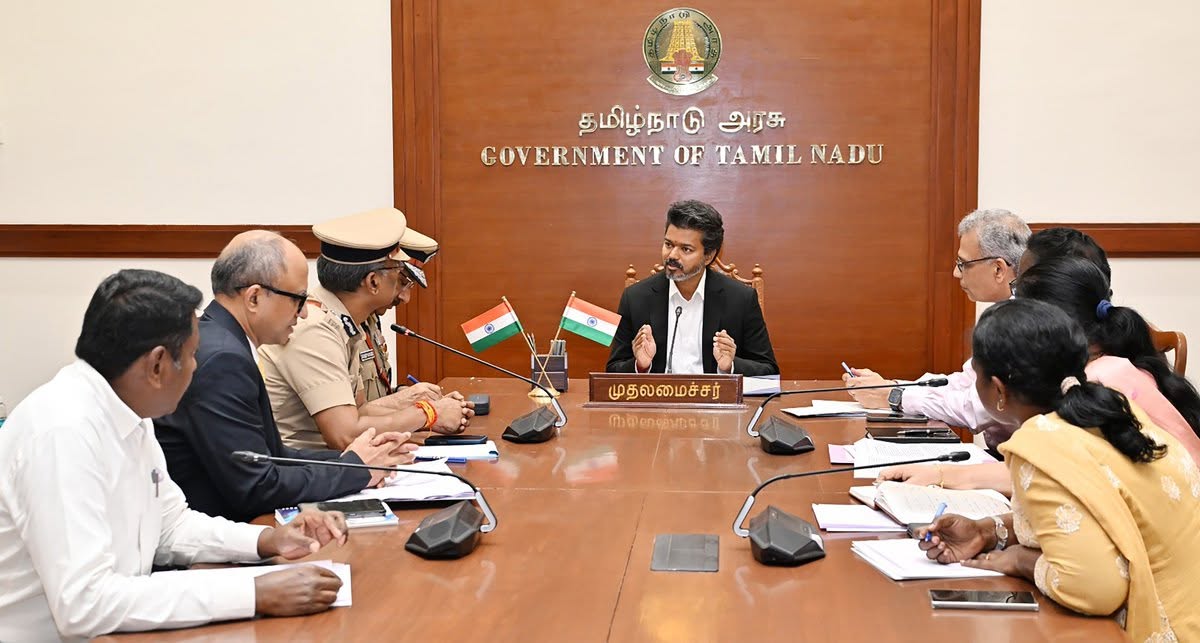
Tamil Nadu Chief Minister C Joseph Vijay chaired a meeting with senior government officials in Chennai on May 10 to review the law-and-order situation

Synopsis: The law and order situation in Tamil Nadu under the TVK government has become a matter of intense debate after at least 17 murder cases were reported across the State in just two days, on 8 and 9 November, during Deepavali. In response to mounting criticism, School Education Minister A Rajmohan sought to defend the government’s record by citing the number of murders reported during Deepavali under the previous DMK government. The response drew criticism from the Opposition and political observers, who demanded that Chief Minister Vijay take responsibility.
The law and order situation in Tamil Nadu under the TVK government has become a matter of intense debate after at least 17 murder cases were reported across the State in just two days, on 8 and 9 November, during Deepavali. The victims included 15 men and two women.
Separately, allegations of an assault involving Thuraiyur MLA and Deputy Speaker Ravi Shankar, and the controversy involving the Kallakurichi MLA over an alleged incident at the Collector’s residence, have added to the ruling party’s troubles.
In response to mounting criticism, School Education Minister A Rajmohan sought to defend the government’s record by citing the number of murders reported during Deepavali under the previous DMK government.
“Do you think how many murders took place during the previous Deepavali and the Deepavali before that? There is no information about that. Six murders took place during last year’s Deepavali, while 11 murders took place during the Deepavali before that,” he said while speaking to a private television channel on 9 November.
He also took aim at Opposition leaders, including AIADMK chief Edappadi K Palaniswami, DMK MP Kanimozhi Karunanidhi and TTV Dhinakaran, accusing them of speaking only about the murders reported this year while remaining silent about similar incidents in the past.
Rajmohan maintained that the government was taking action against those accused without political interference.
The response drew criticism from the Opposition and political observers, who questioned how comparing the number of murders with figures from previous governments addressed concerns over the current administration’s handling of violent crime.
In a statement on 10 November, Leader of the Opposition Udhayanidhi Stalin accused Chief Minister C Joseph Vijay, who also holds the Home portfolio, of downplaying the spate of murders and other incidents of violence in Tamil Nadu. He questioned when the Chief Minister would take charge of the law-and-order situation and rein in ruling party legislators.
Referring to the shooting of Gnanavel near Gudiyatham on 8 November, Stalin described the incident as shocking and accused the government of allowing a “gun culture” to take root in the State.
He also criticised the government’s description of the rising number of murders as “festival-time murders”, accusing the authorities of using such terminology to play down serious crimes. He cited the petrol bomb incident in Nungambakkam, alleging that the police had similarly described it as an incident involving an “inflammable object”.
Stalin also flagged contradictory statements by the Chief Minister and the police department over whether the Special Sub-Inspector who died in Theni was on duty when the assault took place.
He accused ruling party MLAs of involvement in intimidation, assaults, kangaroo courts, commission-related allegations and sexual harassment. He alleged that their conduct had affected ordinary people and even a woman IAS officer.
Calling the Chief Minister’s response inadequate, Stalin asked him to take responsibility for the situation and initiate appropriate action.
The killings were reported across several districts of Tamil Nadu, with the victims ranging from teenagers to people in their seventies.
On 8 November, Special Sub-Inspector Senthil Kumar died in Theni after he was allegedly assaulted for objecting to a group of youths bursting firecrackers on a public road.
In Tiruchi district, two 17-year-olds, Rahul and R Vishal, were hacked to death near the Pullambadi canal. In a separate incident in Purathakudi, Christopher, a 20-year-old IT employee who had returned to his native village for Deepavali, was allegedly stabbed with an iron spanner following a dispute over firecrackers.
In Chennai’s Vyasarpadi, 18-year-old Dhanush was allegedly attacked by a group of men over previous enmity involving his brother. In Cuddalore district, Prithiviraj was allegedly murdered following a dispute with Arularasan.
Sivaganga district reported two murders. Vignesh was killed near Manamadurai, while Thangasamy alias Naveen, 26, was chased and hacked to death near Kallal.
In Tiruvallur district, 24-year-old Manimegalai, a mother of three, was allegedly stabbed to death. In Virudhunagar district, 25-year-old Anbu Selvan was beaten to death by a group following a dispute near Aruppukottai.
In Vellore district, Gnanavel was shot dead near Gudiyatham. In Kancheepuram district, Parthiban’s body was found near railway tracks. Reports indicated that he had been attacked with a stone.
In Kanyakumari district, 52-year-old Jyothi was allegedly killed following a dispute over a pathway. In Kallakurichi district, 75-year-old K Balasubramanian was allegedly murdered following a dispute over family property.
Three more murders were reported on 9 November. In Chennai’s Thiruvottiyur, Pavithran, a 34-year-old animal welfare activist, was hacked to death following an argument with a group of youths over firecrackers.
In Dindigul district, 26-year-old Swetha was allegedly murdered by her husband. In Perambalur district, R Ravi was found murdered near a temple in Nochiyam.
Also Read: Tamil Nadu SSI dies after being assaulted for questioning bursting firecrackers on a public road
Senior journalist and RTI activist Aravindakshan BR said the debate over Tamil Nadu’s law-and-order situation should not be reduced to comparisons with previous governments. He accused the government of using such comparisons to deflect questions about its own record rather than accept responsibility.
“It is not just a law-and-order issue. This government is functioning without any real intention of being a responsible government or providing good governance. Its only attempt is to justify itself through comparisons rather than take responsibility for the issues,” he said.
Aravindakshan alleged that the government was turning questions about its functioning into political arguments between the DMK and the TVK.
“Over the last six months, whenever an issue has emerged, the government has cleverly attempted to divert attention and turn the discussion into a DMK-versus-TVK political argument instead of accepting responsibility,” he said.
He also questioned the Chief Minister’s accessibility and the government’s communication during controversies.
“After 6 pm, the Chief Minister is out of station and unavailable. Nobody here seems to know how to function or communicate without speaking to the Chief Minister. Everyone is afraid, and consequently, nobody is willing to speak,” he alleged.
He further claimed that the government was relying on leaders of supporting parties, including the Congress and the Viduthalai Chiruthaigal Katchi (VCK), to respond to criticism instead of issuing direct responses and taking responsibility.
Also Read: Chennai IT firm project manager attempts chain snatching to clear debts; arrested
Aravindakshan said that while murders and other crimes had occurred under successive governments, recent incidents involving elected representatives raised serious questions about the use of political power.
He referred to the Thuraiyur controversy, in which a man who reportedly approached MLA and Deputy Speaker Ravi Shankar over a local water-supply problem was allegedly assaulted.
“An incident in which someone who visits an elected representative’s residence is assaulted is something we have rarely witnessed. What makes the Thuraiyur incident particularly dangerous is the alleged involvement of the police. An inspector was taken to an MLA’s residence, and videos of the assault victim were recorded in multiple takes. These are extremely dangerous indications,” he said.
He said the alleged involvement of police personnel made the incident particularly serious and raised questions about the use of the police by those in political power.
Turning to the controversy involving the Kallakurichi MLA and allegations concerning the Collector’s residence, Aravindakshan questioned the government’s response, particularly Education Minister A Rajmohan’s reported statement that action would be taken if the Collector filed a complaint.
“Education Minister Rajmohan said that action would be taken if the Collector filed a complaint. There was no need for an Education Minister to make such a statement. Action can be initiated even without a formal complaint from the Collector,” he said.
Aravindakshan claimed that information about the incident involving an IAS officer had been conveyed to the Home Secretary or Chief Secretary around 20 days earlier. He also said security at the Collector’s office had subsequently been strengthened.
According to him, the security deployment was increased from one-plus-four personnel to two-plus-four. He said the increase showed that the authorities themselves considered the matter serious.
“Against this backdrop, insisting that the Collector must personally file a police complaint before any action can be taken is unreasonable. The government could simply have said that it was looking into the matter, seeking details or conducting an inquiry. Instead, its response reflects a certain level of immaturity and irresponsibility,” he said.
Also Read: How Vijay’s fan ecosystem turns routine governance into personal miracles
Aravindakshan said the government appeared to be handling controversies on the assumption that public attention would shift to other issues within a few days, allowing those in power to avoid taking responsibility.
“The government appears to be handling every issue with the assumption that people will forget it in two or three days. There is a general sense of complacency in the way problems are addressed. Nobody seems willing to accept responsibility. Everything is left to the administration and government officials,” he said.
He questioned whether the political leadership was prepared to stand by its decisions, pointing out that government officials would eventually have to answer for those decisions before courts and other authorities.
“Think about who will eventually have to stand before a court and answer questions. It will be the officers. They will be expected to defend the decisions and actions taken by the government. The political leadership seems content to leave everything to the bureaucracy, assuming that matters will somehow take care of themselves,” he said.
To illustrate what he meant by accountability, he cited an incident involving actor Dhanush, who publicly accepted responsibility after people were unable to enter an event organised by him.
“That was a simple but important demonstration of accountability. It was not an ordinary event, yet he was willing to accept responsibility. This government is not even prepared to demonstrate that minimum level of accountability,” he said.
Aravindakshan said the government could not answer criticism of its record by merely arguing that the situation was better than it had been under the previous administration.
Also Read: TVK MLA alleges horse-trading attempts by AIADMK, DMK; claims ₹15 crore offer
Retired Superintendent of Police M Karunanidhi said comparisons of crime figures across different years should be used for professional assessments of police performance, not as political arguments to defend or attack a government.
“Comparisons between incidents reported in different years should ideally be made by professionals who understand the subject and its complexities. Such data-based assessments help evaluate performance and identify whether incidents have increased or decreased. However, politicising these comparisons to target a government or the police department should be avoided,” he said.
He cautioned against blaming the government or the police for every crime, pointing out that individual incidents were shaped by several factors and circumstances. Crimes could still occur even when the authorities had taken the necessary measures, he said.
Karunanidhi said the focus should be on proactive policing and Problem-Oriented Policing (POP), rather than reactive policing. The police should maintain regular contact with residents, gather information at the local level and identify warning signs before they escalated into serious offences.
“The purpose of local policing is not merely to investigate crimes after they occur, but to gather information, identify warning signs and prevent offences before they happen,” he said.
(Edited by Dese Gowda)



