

Published Aug 13, 2026 | 2:03 PM ⚊ Updated Aug 13, 2026 | 2:03 PM

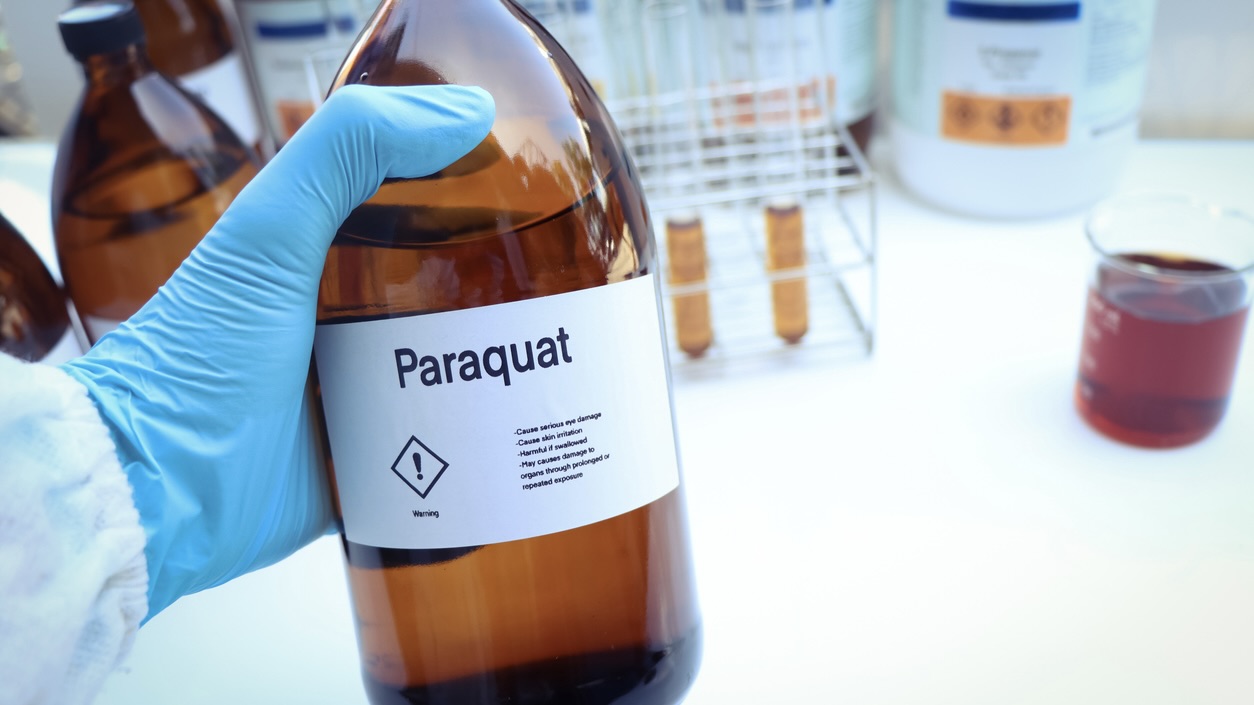
Paraquat accumulates in the lungs, triggers irreversible fibrosis, and causes acute respiratory failure, kidney failure, and liver injury.

Synopsis: The proposed Paraquat ban could hurt smaller formulators more than diversified agrochemical giants. A deep dive establishes the how and the why.
On July 13, 2026, the Ministry of Agriculture and Farmers Welfare published the draft Banning of Paraquat Dichloride Order, 2026 in the Gazette of India, proposing to prohibit the import, manufacture, sale, transport, distribution and use of the herbicide under Section 27 of the Insecticides Act, 19681. Paraquat dichloride is a highly toxic herbicide used to fight weeds. It has also been linked to many suicide deaths among farmers.
The draft followed the recommendations of an expert committee constituted in January 2026, whose findings were submitted in June and subsequently endorsed by the statutory Registration Committee2. If finalised after the mandatory 30-day consultation window, India would join more than seventy countries that have already banned or severely restricted the chemical, primarily on the grounds of its acute toxicity and the absence of a specific antidote3.
The public-health rationale for the proposed order has been widely reported. Less examined is its commercial dimension: which firms, within India’s fragmented agrochemical sector, stand to lose the most if the ban is finalised, and by how much.
This question is difficult to answer with precision, because no listed Indian agrochemical company discloses paraquat-specific revenue, and India’s exposure runs upstream and outward as well as across its domestic market — the country is structurally dependent on imported technical-grade material and, at the margin, also exports finished formulations. What follows is therefore a structured exposure analysis built from public disclosures, trade-shipment data, industry structure, and defensible scenario assumptions rather than reported company data. It should be read as an informed estimate, not a definitive accounting.
Indian agrochemical companies typically report revenue at the segment level (e.g., “herbicides,” “insecticides,” “fungicides”) rather than by individual molecule or brand.
Dhanuka Agritech, one of paraquat’s principal domestic marketers under the brand Ozone 24% SL, illustrates the pattern. Herbicides account for roughly 30–40 per cent of the company’s revenue depending on the crop season4; on a total FY2024–25 revenue of approximately ₹2,035 crore, this implies a herbicide segment of roughly ₹600–800 crore. Dhanuka’s herbicide portfolio, however, spans multiple brands — Targa Super, Sempra, Sakura, Noweed and Ozone 24% SL among them — with no brand-level breakdown disclosed. The same holds, in varying degrees, for UPL, Rallis India and other listed peers.
This opacity is not incidental. Paraquat is a mature, largely off-patent molecule sold by many formulators under many brand names, competing with a broader set of non-selective and selective herbicides. For most diversified companies, it is one input among dozens, and disclosure norms in India do not compel line-item reporting at that level of granularity. Any paraquat-specific revenue estimate must therefore be built up from indirect evidence rather than read off a financial statement.
Also Read: Actor Rahul Ramakrishna loses brother to paraquat, joins calls for ban
A reasonable estimation method combines three parameters: the size of the domestic paraquat market, a firm’s plausible market share within it, and the contribution of herbicides to that firm’s total revenue. Industry estimates place the Indian paraquat market at roughly ₹1,500 crore.
Applied to Dhanuka, whose Ozone 24% SL is one of several herbicides in its portfolio rather than a flagship product, a scenario range can be constructed as follows.
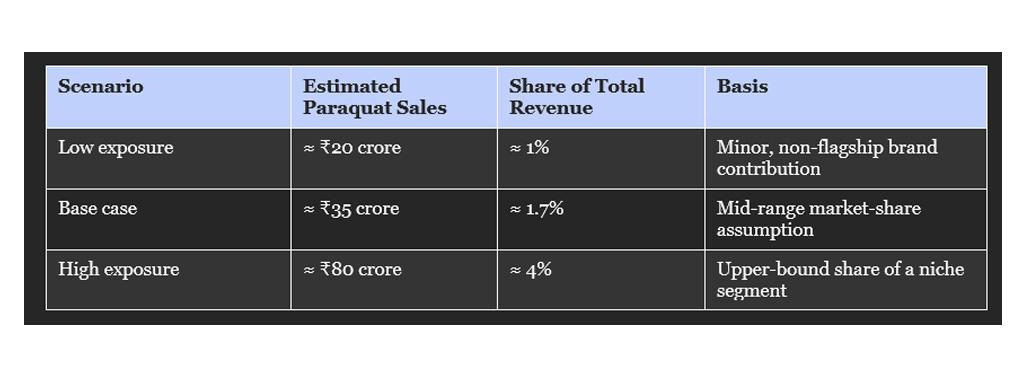
Three structural features support the low-to-moderate end of this range.
First, paraquat use in India is concentrated in a narrow set of applications—tea, coffee, rubber, fruit orchards, cotton, and non-crop or industrial vegetation management—rather than across the staple-crop acreage that drives volumes for herbicides such as glyphosate, pendimethalin or pretilachlor.
Second, official crop registration for paraquat covers only nine crops, though off-label use (for instance, to desiccate moong before harvest) has been documented and is itself a factor in the regulatory concern driving the ban.
Third, competitive intensity within the paraquat segment specifically is high: Crystal Crop Protection, UPL, and numerous regional generic manufacturers all fight for the same market share, which caps any single firm’s realistic share. Taken together, these factors suggest that even a complete ban is unlikely to materially threaten Dhanuka’s overall business, unless its paraquat exposure is substantially larger than current industry assumptions imply.
Also Read | Gaddi mandu: Rs 200 deadly poison bottle driving Telangana’s breadwinners to suicide
The exposure analysis above is framed around the domestic market, but the paraquat supply chain does not begin in India.
Technical-grade paraquat—the active-ingredient input that Indian formulators blend into products such as Ozone 24% SL—is almost entirely imported. Trade-data aggregators tracking shipment-level customs records show that Taiwan and China together account for essentially the whole of India’s technical paraquat imports, with Taiwan supplying roughly three-quarters of shipments and China most of the remainder. The United Kingdom was a smaller historical source.
Consignments are large and infrequent rather than continuous—2023–24 trade records describe individual bulk shipments of 17,000 to 35,000 kilograms, each large enough to support weed-management operations across an estimated 21,000 to 44,000 acres. This pattern is consistent with an industry that formulates and brands domestically but does not, in any meaningful sense, manufacture the underlying molecule.
This has two implications for the exposure map developed above.
First, it relocates part of the “manufacturing” loss outside India: the immediate upstream producers most affected by an Indian ban are Taiwanese and Chinese technical-grade suppliers, not domestic Indian firms, whose role in the value chain is predominantly formulation, packaging and marketing rather than synthesis.
Second, it introduces a distinct and previously unaccounted-for tier of potential losers—the importer-formulator whose business model depends on continued access to imported technical material.
Reporting from June 2026 described a surge in procurement from Chinese suppliers as Indian buyers, anticipating regulatory action, sought to secure volumes ahead of any restriction. If the final order does not include a defined transition mechanism for goods already imported or in transit, importers who accelerated purchases in this window could be left holding technical-grade inventory that is no longer legally saleable—a stranded-asset risk that sits alongside, and is analytically distinct from, the revenue-share exposure discussed earlier.
Exports complicate the picture, but the direction of the effect is more foreclosing than opening. Indian formulators—Dharmaj Crop Guard and Willowood among the more visible generic players—currently market paraquat formulations internationally as well as domestically, positioning India as one node in a broader global generic supply chain rather than a purely domestic-facing industry. The draft order, however, proposes to prohibit manufacture itself, alongside import, sale, transport, distribution and use—not merely domestic sale or use.
On a literal reading, a manufacture-wide ban forecloses export-oriented production along with domestic supply, since there would be no lawful manufacturing activity left to direct toward export markets. This differs from precedents such as captafol, dichlorvos, phorate and triazophos, which are formally banned for use but allowed for export under existing orders—a category that presupposes continued domestic manufacture for an external market. Nothing in the draft paraquat order, as currently reported, indicates a comparable carve-out; unless one is added during the consultation process, the export channel would close along with the domestic one.
The one scenario in which India could retain a role in international paraquat trade after such a ban is not as a manufacturer but as a re-export or trans-shipment point—importing technical-grade or formulated material from producing countries and moving it onward without domestic manufacture in the regulatory sense. Whether this is commercially or legally viable would turn on distinctions the draft order does not yet resolve: whether repacking or relabelling of imported material is itself treated as “manufacture” under the Insecticides Act (as it can be for licensing purposes), and whether the import prohibition applies to material in transit rather than material intended for the domestic market. Both are live drafting questions rather than settled ones, and the base case, absent an explicit carve-out, is that a full manufacture ban ends India’s role as an exporter of paraquat, not merely as a domestic seller of it.
Extending the same logic across the sector produces a rough ordinal ranking of exposure, from largest to smallest expected impact:
• UPL Limited — holds the largest absolute paraquat business among listed peers, reflecting its scale and long-standing presence in non-selective herbicides. On a consolidated FY revenue of roughly ₹18,335 crore14, however, even a full loss of paraquat sales would be a modest percentage hit, particularly given UPL’s alternative non-selective herbicide brands and its diversified biologicals portfolio. The company’s most recent quarterly results reinforce this reading of scale: for the quarter ended 30 June 2026 (Q1 FY27), UPL reported consolidated revenue of ₹10,181 crore, up 10 percent year-on-year, of which its India business contributed ₹2,602 crore, up 15 percent — its seventh consecutive quarter of year-on-year revenue and EBITDA growth — and the company reaffirmed full-year guidance of 7–11 percent revenue growth15. Set against a domestic business generating over ₹10,000 crore a year and still growing at double digits, the ₹1,500 crore paraquat market as a whole — let alone UPL’s share of it — is a comparatively small variable in the company’s near-term trajectory. Absolute exposure is highest among listed peers; relative exposure is comparatively low.
• Dhanuka Agritech — moderate absolute exposure but limited relative impact, per the scenario analysis above; herbicides beyond paraquat (notably Targa Super) remain the larger revenue driver.
• Rallis India — paraquat is a small component of a broader crop-protection portfolio; impact is expected to be limited.
• Coromandel International — minimal expected impact at the consolidated level, given the dominance of its fertiliser business over crop protection.
• Sharda Cropchem — limited direct domestic exposure, reflecting a business model weighted toward exports and multi-market formulation rather than concentrated India-facing paraquat sales.
One significant player sits outside this listed universe: Crystal Crop Protection, which acquired the Gramoxone trademark for India from Syngenta in 202316. As custodian of what is arguably the country’s best-known paraquat brand, Crystal’s proportional exposure — though not observable through public listed-company disclosures—is plausibly the highest of any single-branded player, even if its absolute revenue base is smaller than UPL’s.
A frequently cited statistic, drawn from a Government of India reply in Parliament, is that 1,503 manufacturing units hold licences related to paraquat17. The same reply clarified that the Ministry does not maintain data on the chemical’s annual production or sales — a fact that is often lost when the headline number is repeated. Crucially, 1,503 does not represent 1,503 independent producers of paraquat technical-grade material.
India’s pesticide licensing regime issues authorisations for at least three distinct activities: technical-grade manufacture (synthesis of the active ingredient), formulation manufacture (blending technical material into end products such as 24% SL), and, in some cases, repacking or relabelling. The overwhelming majority of the 1,503 licensees fall into the formulation category; the number of firms actually capable of synthesising technical paraquat is understood to be a small handful, with a portion of technical material imported. Many formulators, in turn, source technical paraquat from the same limited pool of suppliers before marketing it under their own brand names.
The practical implication is that market value should not be divided evenly across the 1,503 licensees to infer per-company exposure. Despite the breadth of licensing, commercial activity — and therefore commercial exposure to a ban — remains concentrated among a comparatively small number of major marketers: Crystal Crop Protection, UPL, Dhanuka, Coromandel, Rallis, and a long tail of smaller regional formulators whose individual exposure is difficult to quantify but collectively material.
Three broad conclusions follow from the analysis above.
First, losses are likely to be concentrated rather than diffuse. Diversified, large-capitalisation listed companies—Dhanuka, Rallis, Coromandel, and to a significant extent UPL—are structurally insulated by broad product portfolios in which paraquat is a minor contributor. For these firms, a ban is a manageable segment-level event rather than an earnings-threatening one.
Second, relative exposure is inversely related to diversification, not to company size. Crystal Crop Protection, as the owner of the Gramoxone brand, and the narrower tier of formulators and regional marketers for whom paraquat represents a larger share of a smaller revenue base, are plausibly the most exposed commercial actors, even though they are individually less consequential to the broader economy than a company like UPL.
Third, compliance costs will fall broadly across the licensed base. Under the draft order, registration holders would be required to surrender their certificates within three months of final notification18, a process that carries administrative and inventory-write-down costs for the hundreds of formulation licensees identified in the Parliamentary reply — costs that are largely invisible in revenue-based exposure estimates but real at the level of individual firms.
Fourth, the loss is not confined to India’s borders. Because technical-grade paraquat is almost wholly imported, the upstream producers most exposed to a full ban are foreign — chiefly Taiwanese and Chinese manufacturers — rather than domestic Indian firms. Within India, the importer-formulators who accelerated procurement ahead of the anticipated order face a narrower but sharper risk: technical-grade inventory purchased in the pre-ban rush could become stranded if the final order does not include a defined sell-through window.
And if the finalised order does not carve out export-oriented manufacture, as some other banned chemicals in India have historically been permitted, the loss would also extend to formulators serving overseas markets and their foreign customers, pushing total affected value beyond the ₹1,500 crore domestic market used as the baseline throughout this analysis.
Beyond the manufacturing and marketing tier, downstream stakeholders—distributors serving tea, coffee and rubber estates, and growers who have relied on paraquat as a low-cost non-selective herbicide—may also face adjustment costs in the form of higher-priced substitutes, even though they fall outside the scope of a corporate exposure analysis.
This analysis is necessarily speculative in its quantitative particulars. No company in scope discloses paraquat-specific sales, so the figures presented are scenario estimates built on industry structure and public market-size data, not reported results. The trade figures cited in Section 4 are drawn from commercial shipment-tracking aggregators rather than official Directorate General of Commercial Intelligence and Statistics (DGCIS) publications, and should be read as indicative of pattern and concentration rather than as precise, audited totals. The underlying regulatory action itself remains at the draft stage as of this writing, with a statutory consultation period during which the scope, timeline, or transitional provisions of the order—including any eventual treatment of existing inventory or export-oriented manufacture—could still change. The estimates should accordingly be treated as directional—useful for ranking relative exposure across firms and identifying which parts of the value chain are most exposed—rather than as precise forecasts of financial impact.
Also Read | Telangana’s CURE Bill 2026: The many flaws in the law that makes illegal buildings pay
(Edited by R Rajesh Kumar.)



