

Published Jul 19, 2026 | 8:00 AM ⚊ Updated Jul 19, 2026 | 8:00 AM

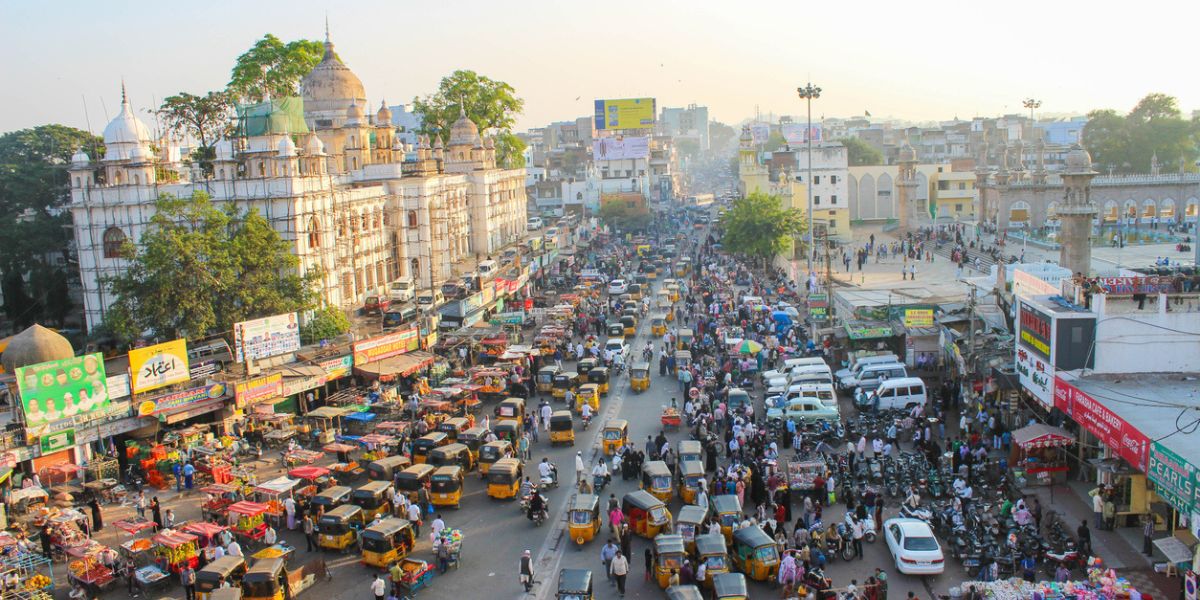
Street view from Hyderabad. (iStock)

Synopsis: Telangana’s new Core Urban Region Bill, 2026, was said to be aimed at bringing structural planning discipline to Hyderabad. But a careful dissection of its fiscal architecture reveals its many flaws: with unauthorised construction being rewarded, regressive utility frameworks being put into place, and administrative blind spots being turned into permanent revenue models.
If you set out to design a law that quietly rewarded unauthorised construction, encouraged tax inconsistency, and left zoning discipline to chance, you would struggle to improve on a few provisions tucked into Telangana’s new Core Urban Region (Integrated Governance) Bill, 2026. None of this appears to be the drafters’ intention. But intentions aside, the fiscal architecture of this Bill works, in practice, against the very planning discipline it claims to bring to Hyderabad’s core districts.
Start with what happens when a building goes up without permission. The Bill’s answer is a provision headed “Levy of penalty by way of property tax on unauthorised construction,” which lets the Corporation keep taxing an illegal structure—with a penalty running as high as three hundred per cent of ordinary property tax—for as long as it stands, “till such unauthorised construction is demolished or regularised.” No timeline forces a decision either way.
Actual enforcement—stop-work orders, sealing, demolition—proceeds only “without prejudice to” this tax-penalty track, meaning the Corporation is free to simply keep collecting instead of acting. The arithmetic is not subtle: the longer an illegal structure survives, the more revenue it generates for the very body meant to remove it. And HYDRAA—the agency whose entire public mandate is built around exactly this kind of enforcement—appears nowhere in this chapter of the Bill.
It’s baffling that the one institution people might expect to show up when a tower rises without permission has no defined role in the law’s own mechanism for dealing with it. A tax presumes something continuing; a penalty presumes something ending. Dressing the second as the first is not a drafting quirk—it is the mechanism by which the incentive runs backwards.
Then consider water and sewerage. For more than three decades, Hyderabad’s sewerage charge has been calculated as a fixed percentage of the water bill—a simple, usage-linked formula written into the law governing the Hyderabad Metropolitan Water Supply and Sewerage Board. This new Bill overrides that formula, decoupling the two charges entirely, so that sewerage now becomes a flat, independently set fee that then escalates automatically every year regardless of how much water a household actually uses.
That might or might not be a defensible policy. What is harder to defend is how it is being done: not by amending the water board’s own law, but through a clause in this separate Bill stating that it applies “notwithstanding anything to the contrary” in the older Act. The water board’s own statute will continue to say one thing; this Bill will quietly make it mean another. Anyone relying on the water board’s law in good faith—including, potentially, its own billing staff—will be reading a formula the government no longer intends to follow.
Property taxes fare no better on their own terms. The Bill pegs the tax base—what it calls “capital value”—entirely to a guideline value fixed by the Registration Department, a figure that moves with land prices and periodic government revision, not with a building’s own physical condition. There is no mechanism separating land value from structure value for the purpose of depreciation. A forty-year-old building, quietly deteriorating, is taxed on the same logic as a new tower on the same appreciating plot: only the land matters. A tax system that cannot distinguish an ageing structure from a new one is not measuring what it claims to measure.
The same section that fixes this tax base also leaves the door wide open elsewhere. Beyond property tax and a tax on the transfer of immovable property, the Bill gives the Corporation an open-ended power to impose “any other taxes subject to the previous sanction of the Government,” with no stated limit on subject matter. That matters because the taxation landscape has shifted since GST arrived: states and municipalities lost the power to separately tax several categories, including advertisements, once GST absorbed them as a supply of service. A residual clause with no guardrail against that overlap reads less like an oversight than an invitation—the kind of clause that looks harmless until a future government, hunting for revenue, decides to test it.
It is worth pausing on how casually this Bill treats money generally. Its chapter on borrowing consists of a single sentence: all provisions relating to the Corporation’s borrowing powers “shall be as specified in Schedule III.” Its chapter on revenue and expenditure does the same, pointing to Schedule IV. Two of the areas that ought to carry the most scrutiny in any law governing public money—how a Corporation may borrow, and how it must account for what it spends—are not legislated in the body of the Act at all. They are waved toward a schedule and left there, for provisions that arguably deserved to be argued over on the floor of the legislature rather than tucked out of sight.
That same instinct—collect first, account for it later, if at all—shows up again in how the Bill handles new development charges. A Capital Development Charge collected at the point of granting a building or layout permission is meant to be held in escrow and used only for capital works expanding water and sewerage infrastructure — a genuine safeguard, on paper. But the safeguard stops at the type of expenditure; it says nothing about where.
Also Read | The bullet train as optics: Questions Hyderabad’s high-speed rail push leaves unanswered
Nothing in the Bill requires that a charge collected from development in one area be spent augmenting infrastructure in that same area, which is the entire logic such charges are supposed to follow: new construction adds to the burden on local pipes and drains, so the fee it pays should relieve that same burden, not someone else’s. Without that link, an escrow account becomes a pooling mechanism that can legally send money raised from one neighbourhood’s growth to another’s—an arrangement that, if it favours a few well-connected or already well-served areas over the ones actually short of infrastructure, does so entirely within the law. A resident who wants to know whether their development charge became a pipeline in their own locality, or simply became revenue spent somewhere else, has no provision in this Bill to find out.
The debt side of this ledger is not hypothetical. HMWSSB reported a revenue deficit of roughly ₹8,800 crore to the Chief Minister in a briefing in January 2025, carrying ₹1,847 crore in past loan repayments and ₹5,500 crore in unpaid electricity dues at the time—and the government sanctioned it a further ₹612.5 crore in fresh loans as recently as May 2026, on top of ₹7,360 crore approved days earlier for a new supply project.
Debt of this scale does not stay with the households whose areas received the new infrastructure it funded; it is serviced through charges and tariffs spread across every connection in the Board’s jurisdiction, including areas that saw none of the corresponding investment and, in some pockets of the region, still depend on tanker deliveries and borewells for water that no pipeline reaches.
Repeated operational losses of the kind the Board has reported for years also raise an uncomfortable question this Bill never asks: how much of that shortfall reflects genuine cost of service, and how much reflects the ordinary maintenance burden of infrastructure that had to be redone because it was not built well the first time. Every rupee spent fixing avoidable failures is a rupee that did not go to an area still waiting for its first pipeline.
None of this requires assuming deliberate wrongdoing to be a problem. An escrow account with no requirement to report where funds went, no link between what an area contributes and what it receives, and no independent check on whether capital spending was even necessary in the first place, is a structure that will tend toward exactly this outcome regardless of anyone’s intentions.
If this Bill were serious about fixing that, it would require revenue raised through development charges, and the Corporation’s finances more broadly, to be spent against a transparent, published framework—one that states its own priorities and lets a resident check actual spending against them: equity between areas, proportionality between what an area contributes and what it receives, and demonstrable value for money on works already completed. It does none of this.
And then there is the mechanism this Bill does not mention at all: Transferable Development Rights, the scheme through which a developer can add floors beyond what a plot’s own zoning permits, in exchange for money or land surrendered elsewhere. TDR is, in substance, a way of monetising building rights—a live and heavily used revenue tool in this very region.
It does not appear anywhere in this Bill’s chapters on revenue, borrowing, or town planning, despite sitting squarely in that territory. The practical result is a familiar one to anyone who has watched a high-rise go up on a road never designed to carry its traffic: additional built capacity, sold for revenue, with no requirement that road width, drainage, or other infrastructure keep pace, and no connection whatsoever to whatever planning discipline this new Bill claims to introduce.
Taken individually, each of these might be dismissed as a technical footnote. Taken together, they describe a pattern that runs through the Bill’s entire relationship with money: it rewards the survival of illegal construction, overrides the water board’s own law instead of amending it, keeps an open door to tax categories GST has already claimed, legislates its own borrowing and spending rules by pointing elsewhere rather than writing them down, collects development charges with no requirement that an area’s own contribution serve that same area, lets the resulting debt be shared by everyone while the benefit concentrates in a few places, taxes buildings by a measure blind to their condition, and says nothing at all about the instrument most directly responsible for towers exceeding their zoning. None of these gaps alone would be damning. Together, they suggest a Bill whose money and whose stated purpose are not obviously in the same conversation.
A regional governance law serious about planning discipline would align its fiscal design with its stated goals—every rupee it collects tied visibly to the outcome it claims to want, every taxing power bounded by what it is actually meant to reach, every account open to the people paying into it. This one, on the evidence of its own text, does not—and that is worth fixing before it becomes the law of the land.
Also Read | Hyderabad’s high-speed rail push: An American example that serves as a cautionary tale
(Edited by R Rajesh Kumar.)



