
Published Oct 08, 2026 | 7:00 AM ⚊ Updated Oct 08, 2026 | 7:00 AM

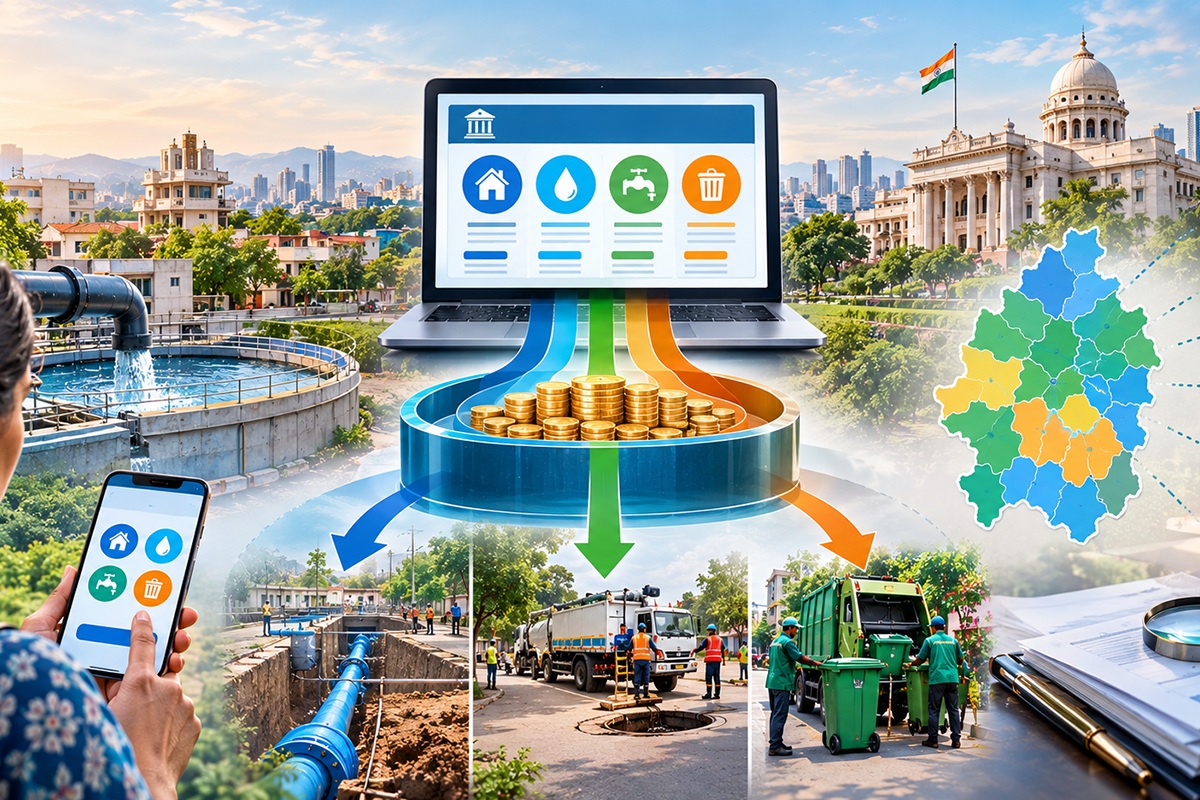
Telangana Core Urban Region (Integrated Governance) Act tells citizens how their dues will be paid. It does not say how the pooled money is returned.

Synopsis: Pooling taxes into one portal such as “CURE 1” looks efficient. The real question is who decides where the money goes.
Every few years, a governance reform arrives wrapped in the language of efficiency: one portal, one bill, one code for every property.
The Telangana Core Urban Region (Integrated Governance) Act, 2026, is the latest. It replaces a seven-decade-old municipal law, introduces a capital-value property tax, and creates “CURE 1”, an integrated platform that bundles property tax with water, sewerage and sanitation charges.
Few would argue against modernising a tax base frozen since 2000. But collecting centrally and spending centrally are different things, and the Act is far clearer about the first than the second.
The Act tells citizens how their dues will be assessed and paid. It does not tell them, or the ward-level officers who answer to them, how the pooled money returns. What share of CURE 1 collections goes back to the ward or zone that generated them? Is it a formula enforceable in court, or an annual budgetary decision? A ward engineer who cannot spend a small sum without sanction from above has no real authority, no matter what the organisation chart says.
The pattern of discretion is visible elsewhere in the Act. During the debate, the Legislative Affairs minister assured the House that the CURE Apex Governance Council would act in a strictly advisory role. Still, analysts noted that the statute’s text says something different. The bill also gives the Corporation an open-ended power to levy “any other taxes” with prior government sanction. A pooled revenue stream, a council with ambiguous powers, and an unbounded taxing power form a structure where discretion sits at the top.
Municipalities around Hyderabad had already lost control of their own collections to the state property-tax portal. Earlier this year, the Legislature merged 27 surrounding urban local bodies into the Greater Hyderabad Municipal Corporation (GHMC), raising the wards from 150 to 177. Consolidation can be defended on planning grounds. But merging bodies without guaranteeing them funds produces larger jurisdictions with the same thin delegated powers.
On-the-ground experience shows the consequences. Residents of municipalities such as Kompally describe routine requests, such as mosquito fogging in a lane, being sent to a central office and stuck there. Officials running electoral-roll revision exercises say they have paid out of pocket for shamianas and drinking water for visiting citizens. These are small items. They show what happens when revenue moves up, and expenditure authority does not move down.
The Hyderabad Metropolitan Development Authority (HMDA) area offers an older lesson. Development charges were pooled centrally, yet large stretches within its jurisdiction still lack basic infrastructure. A systematic audit would show whether collections were matched by spending in the areas that generated them, or diverted. Until such an audit is done, the claim of diversion remains a suspicion. That the data are not public is itself part of the problem. The state has also notified 27 urban development authorities with similar provisions for pooling development charges.
CURE’s most novel step is to centralise across bodies, not just within one. Property tax, water, sewerage, and waste charges, now collected by different organisations, will be merged on a single platform. The stated gain is the ability to funnel pooled funds into large projects. That is a legitimate aim, but it quietly changes the bargain between citizen and state.
A household paying a water or sewerage charge is buying a service in a particular place: a pipe, a pump, a treatment plant that serves its neighbourhood. The same holds for waste collection. Indian law has long distinguished a tax, which funds government generally, from a fee, which is meant to bear a reasonable relationship to the service it pays for. Once the charges are blended into one bill and one pool, that link becomes impossible to trace. A rupee collected for sewerage in one locality can be spent on something unrelated in another, and no one can show otherwise.
The principle that follows is simple: money collected from an area for a particular need should be spent in that area on related infrastructure. Large projects have a place, but they should be funded from general revenue and borrowing, not by drawing down service charges that residents paid for specific local services.
This concern was raised during the consultation on the draft, which opened on July 5, and has been raised again since. The Bill was passed on September 12 and received assent days later. If the objection was considered and rejected, the public is owed the reasoning. If it was ignored, that says more about the process than any clause.
A single revenue portal is being touted as a solution to end corruption by intermediaries such as bill collectors, and to avoid the diversion of collections. A single portal might also be a convenience for citizens. However, a single portal must keep separate ledgers behind it: ring-fenced accounts for water, sewerage, and waste, tracked ward by ward, with spending published.
A portal is only as accountable as the people who can see inside it. Citizens see a payment screen. They do not see who built the platform, who operates it, what the contract says, or who is liable if collections go missing or are under-reported. Private firms run most government portals, and the arrangement is rarely visible to the people whose money flows through them.
Dharani, the land-records portal, shows the risk. Its design, development and management were handed to IL&FS in 2018, after a bidding process, as officials told the Chief Minister in 2024. He questioned then why a private agency, not the Chief Commissioner of Land Administration, ran the system. Subsequently, the government engaged the National Informatics Centre (NIC) to take over the operation and maintenance of the Dharani portal. A forensic audit has reportedly flagged more than 10,000 suspicious transactions, and a Special Enquiry Team was set up in July 2026, only after a demand was made to reveal details.
The old system had its own leaks: GHMC bill collectors underreported collections. The promise a portal holds is that it closes that gap. It only does so if collections are visible to the public, not just to the operator and the department.
The fix is plain. Publish the operator’s identity and contract terms. Give the government, the auditor and the State Finance Commission full access to the underlying data. And put a public dashboard of demand, collection and arrears, by ward and by charge, on the portal itself, updated regularly. If a bill collector’s figures could be doubted, a portal’s figures should be open to checking.
The 73rd and 74th Amendments were meant to make panchayats and municipalities a genuine third tier of government, with State Finance Commissions to ensure a predictable share of state revenue. Critics of the CURE Act argue that its structure violates the 74th Amendment. Courts will decide that. The principle is simpler: a third tier whose income arrives at the discretion of the second tier is a department, not a government.
The same logic runs across Indian federalism. GST improved compliance but moved significant taxing power to a Council and a central platform, and states and municipalities lost the ability to tax categories such as advertisements. When the Union retains revenue streams outside the divisible pool and decides how to release funds to the states, it applies the same principle to the states that Telangana now applies to its municipalities. States that object to the first are the least well placed to defend the second.
Fragmented collection had its own set of problems. A centralised revenue collection mechanism must include provisions for transparency, citizen participation, oversight, and pre-approved, periodic procedures. The flow of funds/ revenue must become a matter of law rather than favour. With this in mind, the following steps will help:
1. A statutory formula returning a fixed share of CURE 1 collections to wards and zones, published annually.
2. Delegated financial powers for ward-level officers, with defined limits and time-bound disbursal.
3. A binding role for the State Finance Commission in determining the municipal share.
4. Public dashboards on the portal showing demand, collection, arrears and expenditure by ward and by charge, so that diversion is detectable rather than merely suspected.
5. An independent audit of HMDA development charges and the 27 newly notified authorities.
6. Ring-fenced accounts behind the single portal, so that water, sewerage and waste charges are spent on those services in the area where they were collected.
Efficiency and accountability are not opposites. But when revenue is pooled at the top with unclear rules for its return, efficiency tends to serve whoever controls the pool. Citizens of Telangana deserve to know who that is, and what they get back.
Also Read:
Telangana’s quiet double-engine Sarkar — Part 3: What the Congress and BJP protect
Telangana’s CURE Bill 2026: The many flaws in the law that makes illegal buildings pay
The bullet train as optics: Questions Hyderabad’s high-speed rail push leave unanswered
(Edited by R Rajesh Kumar.)



