
Published Sep 21, 2026 | 2:45 PM ⚊ Updated Sep 21, 2026 | 2:45 PM

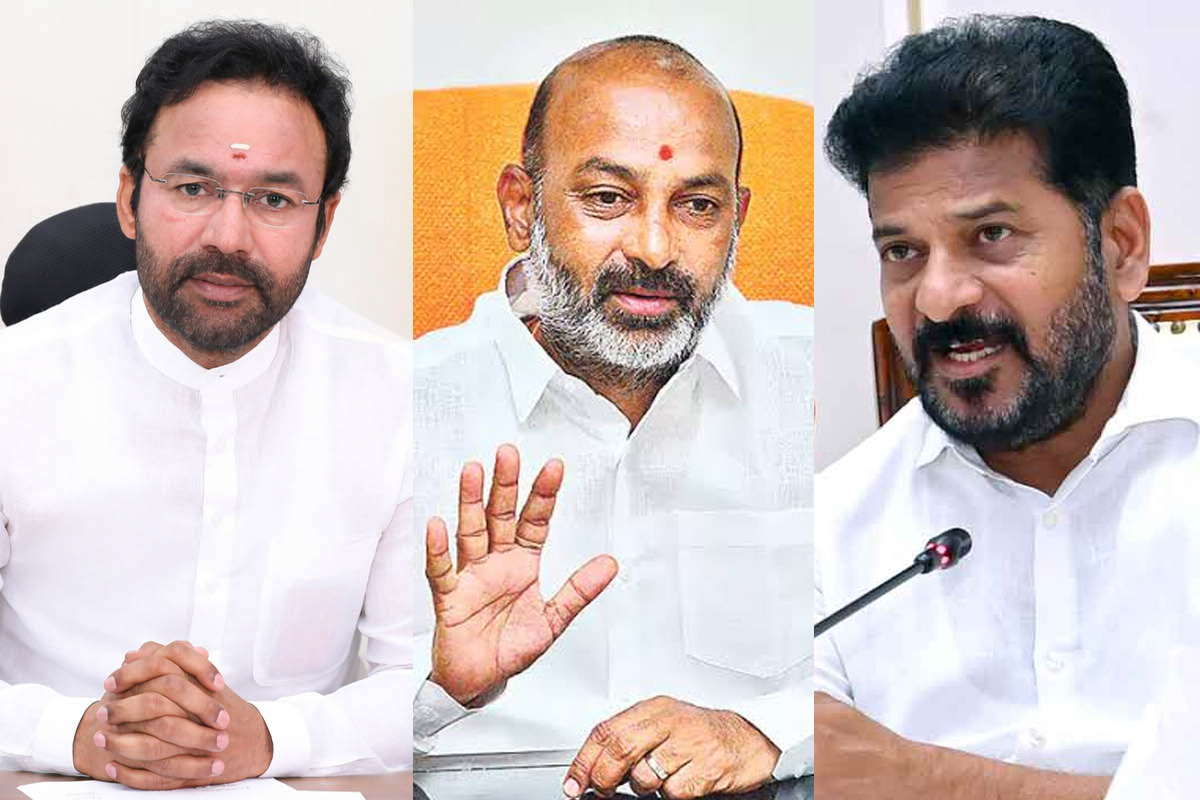
Union ministers Kishan Reddy, Bandi Sanjay and Telangana CM Revanth Reddy.

Part 1 of this series traced how closely Telangana’s Congress government has mirrored BJP-style policy — a Central bill replicated without debate, a river project modelled on Sabarmati, an industrial city pitched as bigger than GIFT City.
Part 2 turned to the politics: a Chief Minister who reserves his visible anger for one BJP minister, a rhetoric that cooled sharply once Delhi’s funding started flowing, a rebranded holiday that quietly concedes the argument it claims to be avoiding.
This third piece asks the harder question underneath both: why does none of this generate real friction? The likeliest answer is not ideological convergence at all. It is that development in Telangana, as in much of India, is no longer contested between parties so much as jointly managed by them — and the haggling that remains is almost entirely about credit, not substance.
No single fact captures this better than Megha Engineering and Infrastructure Limited (MEIL). Electoral bond disclosures show MEIL and its subsidiaries donated roughly Rs 584-670 crore to the BJP between 2019 and 2023 — the single largest amount any donor gave any party — alongside Rs 195 crore to the then-ruling BRS, and Rs 110-125 crore to the Congress, on top of reported cash transfers to Congress before the 2019 general election.
This is not a company betting on an outcome; it is a company insuring against every outcome. And the insurance has paid off regardless of who wins: MEIL has held some of Telangana’s largest irrigation contracts — including Kaleshwaram, the project whose barrage failures triggered a judicial commission — while simultaneously executing marquee Central projects like the Zojila tunnel in Jammu and Kashmir.
No party in office — the BRS, Congress, or BJP at the Centre — has treated MEIL’s role in Kaleshwaram’s failures, or its unusually well-timed bond purchases around major contract awards, as worth serious institutional scrutiny. A CBI corruption case was registered against the company in 2024 over an unrelated Ministry of Steel contract; it has had no visible bearing on its Telangana pipeline. When the same conglomerate comfortably outlasts and outfunds every change of government, that is a reasonable definition of who is actually setting the agenda beneath the party politics.
If crony capitalism needs one thing to run smoothly, it is weak oversight — and Telangana’s own transparency and accountability architecture has been allowed to wither with remarkably little political cost, under this government just as under the one before it. As of April 2025, twelve posts on the Telangana State Information Commission sat vacant, including the Chief Information Commissioner’s own chair, leaving more than 16,000 RTI appeals stuck with no one empowered to hear them. The government only moved after years of rebukes from the Telangana High Court, which had been pressing the state since at least 2023 to fill the posts; four new commissioners were finally appointed on May 12, 2025 — not proactively, but under sustained judicial pressure.
The State Human Rights Commission and the Lokayukta tell an almost identical story. The SHRC sat entirely defunct — no chairperson, no members at all — from December 2022 clear through the first sixteen months of this Congress government, leaving more than 10,000 human rights cases in limbo; it took a Telangana High Court PIL and a final, no-further-extensions deadline before a chairperson and two members were sworn in, on the same day in April 2025 that the state also finally filled its long-vacant Lokayukta post.
That the Lokayukta is now at least nominally functional cuts both ways for this argument: by August 2026 it had accepted a complaint from BRS leaders alleging Chief Minister Revanth Reddy himself had improperly allotted land worth Rs 200 crore to his brother’s company, so the institution isn’t wholly ornamental. But the years-long vacancy that preceded it, filled only under the same kind of court pressure as the other two bodies, fits the wider pattern: not defiance, not an active decision to weaken these institutions, but a passive, years-long neglect that only judicial orders could break — and neglect that cost the government nothing politically, because no constituency organises itself around demanding a functioning Information Commission or Human Rights Commission the way one might over a stalled bridge or a delayed pension.
Nowhere is the pattern of institutional neglect more measurable than in Telangana’s own record of publishing its Government Orders — the routine administrative instruments through which land is allotted, contracts are awarded, and policy actually gets made. An RTI reply obtained by former minister T Harish Rao and made public in December 2025 showed that of 19,064 GOs issued by state departments between December 7, 2023 and January 26, 2025, only 3,290 — 17.3 per cent — had ever been made available online; the remaining 15,774 were simply inaccessible to the public.
The Finance Department, which issued the most orders of any department, had published just 0.5 per cent of them. The Telangana High Court, hearing a PIL filed by a former BRS-aligned SC/ST Commission chairman, ordered the government in December 2025 to disclose all withheld GOs within four weeks, with the judge noting plainly that transparency in governance “is not a choice but a fundamental requirement of democracy.”
What makes this more than a Congress-specific failing is its ancestry. The practice of classifying GOs as “internal” and withholding them from public view began under the BRS government in February 2016, after a GO revealing legal-fee reimbursement for a senior bureaucrat drew unwelcome scrutiny; publication rates fell from effectively 100 per cent in 2014 to roughly 42 per cent by 2017, and by 2026 had fallen further still, with barely 300 GOs published in the entire year through mid-March.
Congress inherited a system built to obscure exactly the kind of decision-making — land allotments, project sanctions, contractor selections — that this series has spent three parts examining, and rather than reversing it, has operated it at an even lower rate of disclosure than the government it replaced. Development that neither party wants examined too closely does not require a conspiracy to stay hidden; it only requires that neither party disturb a system already built for that purpose.
Nothing illustrates the point more starkly than Kancha Gachibowli.
In early April 2025, the Congress government sent roughly 400 bulldozers to clear about 100 acres of forested land adjacent to the University of Hyderabad, aiming to auction the site for an estimated Rs 10,000-15,000 crore in IT and infrastructure investment. Students and environmentalists said the clearance proceeded without a proper Environmental Impact Assessment, targeting land housing Schedule-I protected species, and rushed ahead of a scheduled court hearing. The Supreme Court’s own Central Empowered Committee, after a field inspection, delivered a public dressing-down — rare even by the standards of Indian environmental litigation — asking state officials, on record, whether they even understood forest law, and warning that criminal cases and imprisonment were on the table.
What happened next is the more revealing part. The Union Environment Ministry, whose clearances the state was accused of bypassing, made no visible independent move against the state government. The one Union figure who spoke up was Bandi Sanjay, the same Kishan Reddy-adjacent BJP face who reliably supplies the individualised criticism this series has already described — not the Ministry’s regulatory machinery itself, which stayed as quiet as it had over Musi, Future City, or the Metro.
Meanwhile, Congress’s own national leadership has spent years — as recently as 2022, through former environment minister Jairam Ramesh — attacking the BJP-led Centre for diluting forest clearance rules in ways that disempower tribal and forest-dwelling communities, arguing that fast-tracked “ease of doing business” clearances gut the protections tribals are owed under the Forest Rights Act. Gachibowli is, almost point for point, the same complaint turned against a Congress state government: land use changed, clearance norms allegedly evaded, forest-dependent life treated as an afterthought to a big-ticket land auction. The party that built its national critique of the BJP partly on this exact issue did not pause to apply that critique to itself.
Corruption as headline, not as case file
The Lokayukta’s own record supplies a final, almost symmetrical illustration of the point. Even setting aside the years it sat vacant, the institution has never come close to clearing its caseload: its own annual reports show it disposed of just 1,516 of 5,121 pending and new complaints in 2023, and 1,976 of 5,079 in 2024 — a chronic clearance rate of roughly a third to two-fifths, year after year, regardless of which party held office. This is not a story of one government sabotaging a watchdog; it is a watchdog that has never been given the staff or urgency to do its job under any government.
What is more telling is how little either side actually uses it. Union Minister G Kishan Reddy has repeatedly accused the Congress government of sweeping corruption — in December 2025 alone claiming that graft, once “centralised under K Chandrashekar Rao,” was now “decentralised” under Congress, with “ministers and MLAs opening shops for mass corruption,” and separately alleging land scams and unpaid dues running into thousands of crores. Every one of these charges was delivered at a press conference or on social media. None was filed as a complaint with the Lokayukta, the state institution that exists specifically to investigate exactly these allegations against ministers and legislators.
The pattern is neither new nor is it one-sided: Revanth Reddy, in his years as opposition leader attacking KCR, took his own corruption allegations not to the Lokayukta but to Amit Shah’s office, the CBI, and “the Prime Minister’s notice” — and mocked BJP leaders’ promises to jail KCR as “hollow threats” for following the identical non-institutional path he himself was using. Both men, in their turn, treated corruption as material for headlines and pressure on Delhi rather than as evidence for the one body built to adjudicate it.
The sole recent exception — a BRS complaint against Revanth Reddy himself, over an alleged land allotment to his brother’s company, filed with the Lokayukta in August 2026 — is notable precisely because it is the exception: filed by the opposition BRS, not by the BJP that spends the most public energy alleging Congress corruption, and still pending as of this writing. When the loudest corruption charges never reach the institution designed to test them, the charges function as theatre for the same reason Kishan Reddy himself does elsewhere in this series — visible conflict that costs nothing and changes nothing, while the actual machinery of accountability sits, as it has for over a decade, underused by design.
Put the pieces from all three parts together, and a pattern emerges that is bigger than any single project or minister. The haggling between Telangana and the Centre — over Kishan Reddy, over airport timelines, over who gets credit for a bridge or a metro line — is real, but it is a fight over fame, name, and electoral benefit, conducted entirely within an agreed-upon model of development that neither side actually contests.
Neither government has moved to restore the land-acquisition protections BRS diluted. Neither has meaningfully disturbed MEIL’s position regardless of what its bond ledger or Kaleshwaram record might suggest. Neither has hurried to fully staff the transparency bodies that would let citizens see how these decisions are actually made. And when environmental law stood in the way of a marquee land deal, it was the law, not the deal, that gave way — under a Congress government using an argument its own national party would recognise as a rights violation if a BJP government had made it.
This is the real substance behind the “double engine sarkar” allegation in Telangana. Not that Congress has become the BJP, but that on the questions that would actually cost either party something — corporate accountability, institutional transparency, environmental and tribal protection, equitable versus extractive growth — both have arrived at the same answer. The friction that remains is theatre, useful for rallies and headlines. The cooperation that matters is quieter, and it runs through balance sheets, vacant commissioner posts, and forest land that used to have trees on it.
[Author’s note for publication: this piece makes a structural argument that is harder to falsify than the specific, dated claims in Parts 1 and 2, and should be framed to readers as such. Counter-considerations worth weighing: donating to every major party is standard hedging behaviour for large infrastructure conglomerates across India, not proof of a specific Congress-BJP arrangement; commission vacancies, GO non-disclosure, and Lokayukta case backlogs are chronic, near-universal problems across Indian states regardless of ruling party, which cuts against reading Telangana’s case as evidence of anything Telangana-specific; the Information Commission, SHRC, and Lokayukta were all in fact filled during this government’s term (May 2025, and April 2025 for the latter two), albeit only under sustained High Court pressure, and the Lokayukta has since accepted at least one complaint against the Chief Minister himself; and Kancha Gachibowli did generate real, substantial conflict — student protests, PILs, a Supreme Court-appointed committee, and an ongoing restoration order — so “uncontested” refers to the Centre’s own regulatory silence, not the absence of opposition altogether. It is also possible that public corruption allegations against political rivals are simply more effective politically than a quasi-judicial filing with an under-resourced institution, which would explain the pattern without implying any tacit understanding between the parties. The MEIL funding pattern, the GO-disclosure data, and the Kancha Gachibowli/Jairam Ramesh contradiction are the most factually clean anchors in this piece; the broader “shared ideology of development” thesis is the most interpretive claim across all three parts and should be presented to readers as an argued reading of the evidence, not a proven conspiracy.]
Also Read:
Even a dead worker’s family wasn’t spared: The decline and fall of Telangana’s police
Telangana’s invisible farmers need a name before they need a scheme
(Views are personal.)



