

Published Jul 06, 2026 | 1:09 PM ⚊ Updated Jul 06, 2026 | 1:09 PM

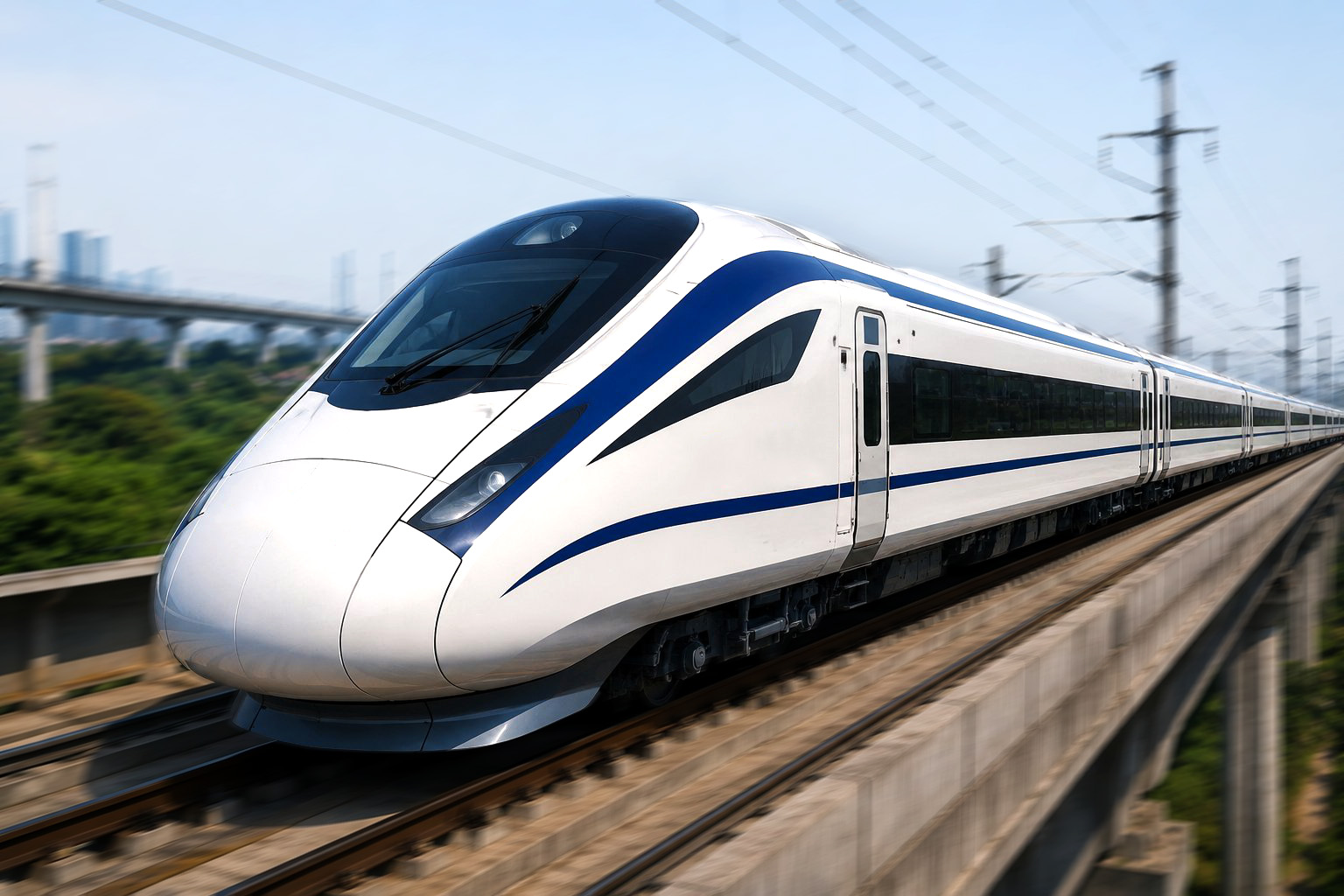
Image used for representational purpose.

Synopsis: There are at least eight questions that Hyderabad’s high-speed rail push has left unanswered. There is also a cheaper domestic alternative from a nearby state and an Indian precedent nobody is discussing…
Every few weeks now, a fresh headline arrives from Hyderabad: a corridor alignment finalised, a survey team marking farmland red-and-white, a minister announcing hundreds of acres set aside near Shamshabad.
The Bengaluru–Hyderabad line will apparently cut travel time to two hours across a 626-km route. The Hyderabad–Chennai corridor will run 236 km through Telangana en route to Chennai via Amaravati. The Hyderabad–Mumbai/Pune line has its Detailed Project Report ready, with a 500-to-650-acre hub coming up near Shamshabad airport.
Seven new high-speed corridors, spanning nearly 4,000 km, were unveiled in the Union Budget for 2026–27, with a combined investment appetite of roughly ₹16 lakh crore. What is missing from almost every one of these announcements is the thing that should have come first: a public, independently verifiable case for why this is the right way to spend that money, on this scale, ahead of the alternatives.
The pitch is always the same—a dramatic before-and-after travel time. Bengaluru to Hyderabad, currently 8 to 19 hours by train, or roughly 1 hour 15 minutes by air, becomes a 2-hour bullet train ride. Mumbai to Hyderabad goes from 12–15 hours to a little over three hours. These numbers are genuinely attractive on a slide. They are not, by themselves, a cost-benefit analysis.
None of the public material accompanying these announcements has addressed the basic questions that any transport economist would ask before committing lakhs of crores of public money:
Not one of these has been published as a standalone document ahead of beginning land surveys. What has instead been made public, repeatedly, is the alignment map, the acreage, and the ministerial press quote.
That a genuine comparison is possible, and that it changes the picture, is demonstrated by Kerala’s own interim high-speed rail report, submitted by engineer E Sreedharan to the state government in May 2026.
The proposed Kerala High-Speed Railway—a fully elevated, standard-gauge line from Thiruvananthapuram to Kannur—is budgeted at ₹60,000 crore for 473.2 km, or roughly ₹127 crore per km, running at a maximum design speed of 200 km/h and an average commercial speed of 140 km/h. Its land footprint is deliberately minimal—a 20-metre-wide corridor, with the report proposing that land be leased back to original owners for cultivation or grazing once construction is complete—and it is designed to run on a captive solar power system, feeding surplus electricity back to the state grid, branded explicitly as a “Green Rail Corridor”.
Set this against Mumbai–Ahmedabad’s true 320–350 km/h bullet train: roughly ₹1.98 lakh crore for 508 km, or about ₹390 crore per km—more than three times Kerala’s proposed cost per kilometre—for a top speed only around 1.7 to 2.5 times faster than Kerala’s commercial average, and with a far larger land footprint, no equivalent solar-and-lease-back model, and no comparable energy self-sufficiency plan. Kerala’s own proposal exists precisely because a lower-speed, standard-gauge, lighter-axle-load design sharply reduces both capital and operating cost, a trade-off its report makes explicit.
None of this is an argument that Kerala’s model is automatically right for Hyderabad’s geography or traffic. It is evidence that a serious, lower-cost, lower-displacement alternative is achievable and has been publicly detailed by a credible authority for another Indian state in the same year these southern corridors are being surveyed—which makes the absence of any published comparison between the 350 km/h model and a cheaper semi-high-speed model for Hyderabad’s own corridors even harder to explain as an oversight rather than a choice.
India already has one of these projects far enough along to check the assumptions against reality: the Mumbai–Ahmedabad High Speed Rail corridor, approved in 2015 at an estimated cost of ₹1.08 lakh crore, targeted for a 2023 launch. Its cost is now projected at close to ₹1.98 lakh crore—an overrun of roughly 83 percent, driven substantially by land acquisition delays—with only a partial Surat–Bilimora stretch expected by August 2027 and full operations pushed to December 2029. Independent revenue estimates built around the original fare assumptions found that even under optimistic ridership scenarios, annual revenue would fall well short of the annual loan repayment obligation, turning the project into a recurring net drain on the exchequer rather than the self-sustaining asset it was originally sold as.
This is not a reason to oppose high-speed rail as a category. It is a reason to insist that the next set of projects—running through Telangana, Karnataka, Tamil Nadu, and Maharashtra—be preceded by a public accounting of what went wrong with the assumptions the first time, and how the new corridors correct for it. So far, that accounting does not exist.
The project’s most technically striking milestone to date makes the underlying cost problem visible rather than hiding it. In mid-2026, Indian Railways began boring a roughly 21-km underground stretch in Mumbai using tunnel-boring machines weighing over 3,000 tonnes each, including a 7-km undersea tunnel beneath Thane Creek—India’s first. It is a genuine engineering achievement. It is also, unavoidably, one of the most expensive ways to build a kilometre of railway anywhere in the world, and that expense sits inside a project whose total cost has already risen 83 percent. Every additional kilometre of tunnel, viaduct, or difficult crossing on any future corridor adds to a bill that eventually has to be recovered from fares or from the taxpayer.
The deeper problem is not just that the budget is huge; it is who ends up excluded once the burden imposed by the bill is passed through to the fare. Trains in India are, overwhelmingly, mass transport—the bulk of rail passengers are exactly the people for whom a fare pegged at roughly 1.5 times a first-class ticket, as originally proposed for Mumbai–Ahmedabad, is simply not a transport option. A cost structure built around tunnels, undersea crossings, and land acquired at inflated urban prices does not stay mass transport; it becomes a premium product riding on public rails.
What is less discussed is that this same cost structure makes the bullet train a poor proposition even for the affluent passengers it is implicitly designed for. Business travellers and the upper middle class already have a faster, more flexible option: a flight between Bengaluru and Hyderabad takes roughly 1 hour 15 minutes in the air, and even after accounting for airport transit time, it competes well against a 2-hour rail journey that still requires getting to and from city-centre or peripheral stations. For this segment, the bullet train is not a decisive time-saving upgrade over what already exists—it risks being, at best, an occasional indulgence rather than a recurring travel choice. A project priced out of reach for the mass ridership that sustains Indian Railways today, while failing to decisively beat existing air travel for those who can afford it, occupies an unusually narrow, and commercially precarious, niche.
A 350 km/h electric railway is not just a track; it is a dedicated high-voltage power system layered on top of the existing grid, and that system rarely gets discussed as a line item separate from the headline project cost.
On Mumbai–Ahmedabad, NHSRCL’s own plan calls for 12 traction substations, 2 depot substations, and 16 distribution substations, more than 20,000 overhead electrification masts, and a full 2×25 kV traction supply system built to Japanese Shinkansen specifications along the entire 508-km corridor. NHSRCL has itself estimated that this single corridor will consume around 110 crore (1.1 billion) units of electricity annually once fully operational, a figure expected to rise further once additional services are added.
Four more corridors converging on Hyderabad would each require an equivalent dedicated substation-and-transmission build-out of their own. No public document has yet set out where this incremental power will come from—new generation capacity, purchase agreements, or simply drawing harder on an already-stretched state grid—or what it costs beyond what is bundled into the general project estimate.
The construction phase carries its own, separately unaddressed carbon cost. Peer-reviewed lifecycle studies of high-speed rail put construction-phase emissions in the range of roughly 58 to 176 tonnes of CO2 per kilometre of line per year, with viaducts and tunnels—not track or trains—accounting for the bulk of it: one case study of a Chinese HSR line found bridges alone responsible for about 60 percent of the construction footprint, driven by cement and steel.
A separate study of a Chinese HSR tunnel found that 97 percent of its entire lifecycle emissions occurred during construction alone, almost entirely from concrete and steel. Mumbai–Ahmedabad’s own profile—a 353-km viaduct, the longest in the world, plus 27.4 km of tunnel including India’s first undersea crossing—sits squarely in the highest-emitting category of HSR construction internationally. The southern corridors, with their own forest tunnelling and elevated stretches through hilly terrain, will add to this ledger. No construction-phase carbon audit has been published for any Indian HSR corridor, even as parallel state projects invoke “net-zero” branding for their own developments.
Next: The international precedent nobody is citing, the physics problem confronting bullet-train projects face and more
(Edited by R Rajesh Kumar.)



