
Published Oct 15, 2026 | 7:00 AM ⚊ Updated Oct 15, 2026 | 7:00 AM

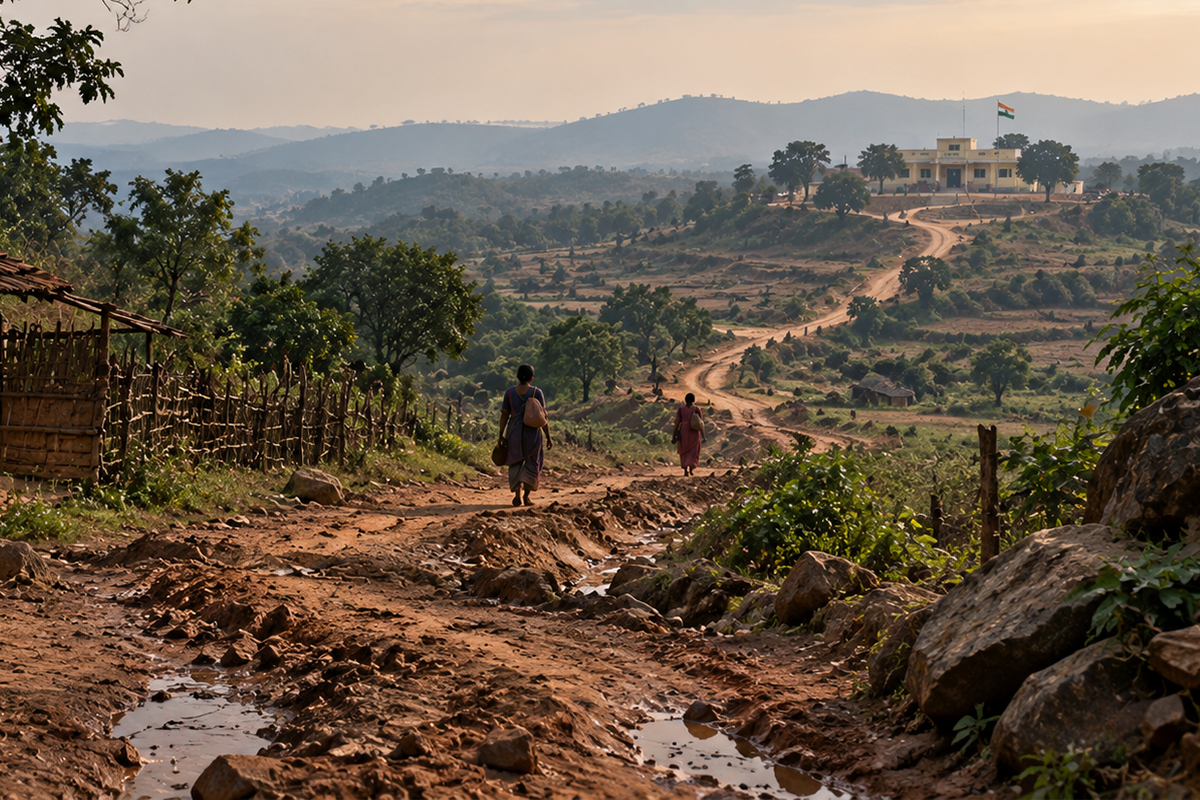
Image used for representational purposes only. (AI generated image)

Synopsis: India’s first National Household Travel Survey (NHTS) offers an unprecedented picture of how Indians move — to school, to work and through their everyday lives. But behind its statistics on distance, time, mode and cost lies a deeper question: who can actually use mobility to reach opportunity? Let’s explore what the NHTS reveals about that question, particularly for rural India and rural women.
In 2025, a young woman in a village in Jharkhand was offered a temporary job at a block headquarters 22 kilometres away. She turned it down. The reason she gave her family was not the wage, which was better than anything available locally, nor the work itself. It was the road. There was no bus she could rely on, no bicycle she owned, and no woman in her village who made that journey daily.
Twenty-two kilometres, in the end, was not a distance. It was a wall.
That story is not from the recent National Household Travel Survey (NHTS), conducted by the National Statistics Office during July 2025–June 2026. But the survey — covering 14,274 villages, 10,377 urban blocks, 4,92,023 households and over 2 million persons, and defining a “trip” as travel of more than one kilometre — offers the first serious attempt to measure how many Indians live on the other side of such a wall.
Of India’s 1.476 billion people, roughly 555 million live in urban areas. The remaining 920 million — nearly two-thirds of the country — live in rural areas.
The land they occupy is radically unequal. Urban India accounts for about 1.02 lakh square kilometres — roughly 3 per cent of the country’s land area. Rural India accounts for about 30.88 lakh square kilometres — roughly 94 per cent. In other words, the rural two-thirds of the population is spread across thirty times the land area of the urban third.
The road network reflects this asymmetry, but not quite in the way one might expect. Rural India actually has more road in absolute terms — about 46 lakh kilometres under the combined rural road programmes and state highways, against 5.86 lakh kilometres of urban roads. Rural roads are nearly eight times the urban length.
But spread across thirty times the land area, the arithmetic reverses. Rural road density works out to about 150 kilometres per 100 square kilometres. Urban road density is about 580 kilometres per 100 square kilometres — roughly four times the rural figure.
The numbers do not, by themselves, tell us whether a particular village has adequate transport. A road can exist without a dependable bus service; a bus route can exist without making a job, school or health facility practically accessible. But the geography establishes an important context: the distances that rural households have to bridge are often greater, and the transport choices available to them are fewer.
The findings that follow from the NHTS should therefore not be read simply as a story about preferences. They are, in significant measure, a story about distances — and about what it takes to overcome them.
The NHTS reveals that 66.8 per cent of rural students aged six and above make a trip of more than a kilometre to school, against 68.6 per cent in urban areas. Average travel time is almost identical: 23 minutes in rural areas and 22 minutes in urban areas. Within 30 minutes, the figures are 86.6 per cent and 89.6 per cent respectively.
At first glance, there seems to be remarkably little difference in the time taken to reach school.
The mode of travel tells another story.
Among rural children aged 6–14, 47.3 per cent walk, 11.9 per cent cycle and 28.4 per cent take a bus. Among rural students aged 15–29, walking falls to 22.2 per cent as bicycles (21.4 per cent) and buses (31.0 per cent) take over. Rural students also return home earlier: 28.3 per cent leave school between 3 and 4 PM, against 21.5 per cent of urban students.
Then there is the cost. Rural students spend ₹361 a month on average, compared with ₹617 for urban students.
The lower expenditure should not automatically be read as evidence of a cheaper transport system. It may also reflect the substitution of children’s own physical effort for paid transport. Walking costs little in money, but it is not costless.
The survey measures minutes and rupees. It cannot fully capture the effort involved in walking or cycling, nor the effects of heat, rain, fatigue or the absence of a reliable alternative. Yet these are part of the lived cost of getting to school in rural areas.
The NHTS reports that 54.5 per cent of rural workers travel more than a kilometre to work, against 64.1 per cent of urban workers.
But the figure that demands attention is the gender difference.
Only 37.7 per cent of rural women make a qualifying work trip, compared with 52.9 per cent of urban women and 59.6 per cent of rural men. Rural women are the least mobile group in the survey.
The spending figures reinforce the contrast. Rural women spend just ₹307 a month on commuting to a fixed workplace. Rural men spend ₹674. Urban women spend ₹884 and urban men ₹1,076.
The rural-urban gap matters. But so does the gap within rural India itself. Rural women spend less than half as much on commuting as rural men.
This does not necessarily mean that rural women have found a cheaper way to travel. It may partly reflect the fact that many of them are not travelling to fixed workplaces at all.
That distinction matters.
The NHTS is a travel survey, not a complete survey of women’s work. It counts trips of more than one kilometre and explicitly excludes travel intrinsic to work — the movements of vendors, rickshaw pullers and drivers, for example. Many rural women work at home, on farms, or within a kilometre of home.
But that limitation also points to something important. The survey reveals how sharply women’s work-related mobility falls when work requires them to cross the immediate geography of home.
A woman may be economically active without commuting. But when a better job, training opportunity or workplace lies beyond her immediate surroundings, access to transport can become one of the conditions determining whether that opportunity is realistically available to her.
For some women, therefore, the barrier is not simply the distance itself. It is the combination of distance, transport, cost, safety, timing and freedom of movement that makes the distance difficult to cross.
The mode split makes the rural-urban contrast sharper still.
36.6 per cent of rural workers walk to work; only 13.5 per cent of urban workers do. Cycling accounts for 13.4 per cent of rural commutes, compared with 5.8 per cent in urban areas. Two-wheelers account for 37.1 per cent of rural commutes and 52.3 per cent of urban ones.
Urban mass transit — metro, suburban rail and trams — carries five per cent of urban commuters, concentrated in Maharashtra (20.7 per cent), West Bengal (16.5 per cent) and Delhi (14.4 per cent). For rural workers, such forms of transport are largely absent.
Among urban women, 21.7 per cent take the bus — a travel mode that barely registers in the rural statistics.
The broad contrast is striking: rural India moves much more heavily on feet and bicycles; urban India has substantially greater access to motorised transport.
This matters because transport is not simply a means of getting from one point to another. It changes the geographical range within which a person can search for work, attend school, access services or make choices about where to spend time.
There is another paradox in the figures.
Rural workers reach a fixed workplace in an average of 23 minutes; urban workers take 27 minutes. Some 86.1 per cent of rural workers reach their workplace within half an hour, against 79.3 per cent of urban workers.
So rural workers appear to travel faster. But a 23-minute walk is not the same journey as a 23-minute bus ride.
The survey measures travel time. It does not fully measure physical exertion, exposure to heat or monsoon rain, safety, reliability, or the opportunities forgone because a person cannot travel farther.
Nor does the lower monetary cost tell the whole story. Rural workers spend ₹612 a month on commuting, compared with ₹1,044 for urban workers.
The rural discount is real. But part of it may be paid for in physical effort.
The Household Consumption Expenditure Survey 2023–24 provides a broader context for understanding the burden of travel. Conveyance accounts for 7.6 per cent of monthly per-capita expenditure in rural India and 8.5 per cent in urban India — the single largest non-food expenditure category in both. Average monthly per-capita expenditure itself was ₹4,122 in rural areas and ₹6,996 in urban areas.
Seen against these totals, commuting costs matter.
A rural worker spending ₹612 a month on commuting is making a substantial claim on a monthly per-capita consumption level of ₹4,122. The comparison needs to be treated with care, since commuting expenditure relates to workers while consumption expenditure is averaged across household members. But even with that qualification, transport represents a significant economic burden for households with limited resources.
For rural women, the ₹307 spent on commuting may look modest. Yet the figure cannot be interpreted simply as evidence that mobility is affordable. It also reflects the fact that many rural women make relatively few qualifying journeys to fixed workplaces in the first place.
Low expenditure can sometimes be a sign not of easy mobility, but of limited mobility.
India does not have one travel experience.
The divide is not simply between rural and urban India. It is also between those who can turn money, infrastructure and transport into movement — and those whose movement still depends heavily on their own bodies.
The NHTS does not tell us everything about this divide. It does not capture every form of work, every reason for not travelling, or every burden carried by those who walk or cycle. But it makes one thing difficult to ignore: the ability to move through space is unevenly distributed.
For a child, the difference may be between walking and taking a bus. For a worker, it may be the difference between a job within walking distance and one twenty kilometres away. For a rural woman, it may determine whether a job outside her immediate surroundings is a genuine option at all.
The distance between a rural woman’s home and a workplace is therefore not measured only in kilometres. It is also measured in money, time, physical effort, safety and the availability of reliable transport.
And that is why the distance between home and opportunity can be much greater than the distance on a map.
For the young woman in Jharkhand, twenty-two kilometres was a wall.
The question for India is how many opportunities remain on the other side of it.
Also Read:
Gandhi and Ivan Illich: What two barefoot prophets saw coming
The Sea speaks Malayalam: The 122 words that sailed back with Vasco da Gama from Calicut
The timeless satire of C Northcote Parkinson and what it teaches about our work life today
(John Kurien is a reflective development practitioner working at the interface of livelihood processes, organisational initiatives and environmental concerns.)



