
Published Jul 18, 2026 | 8:00 AM ⚊ Updated Jul 18, 2026 | 10:38 AM

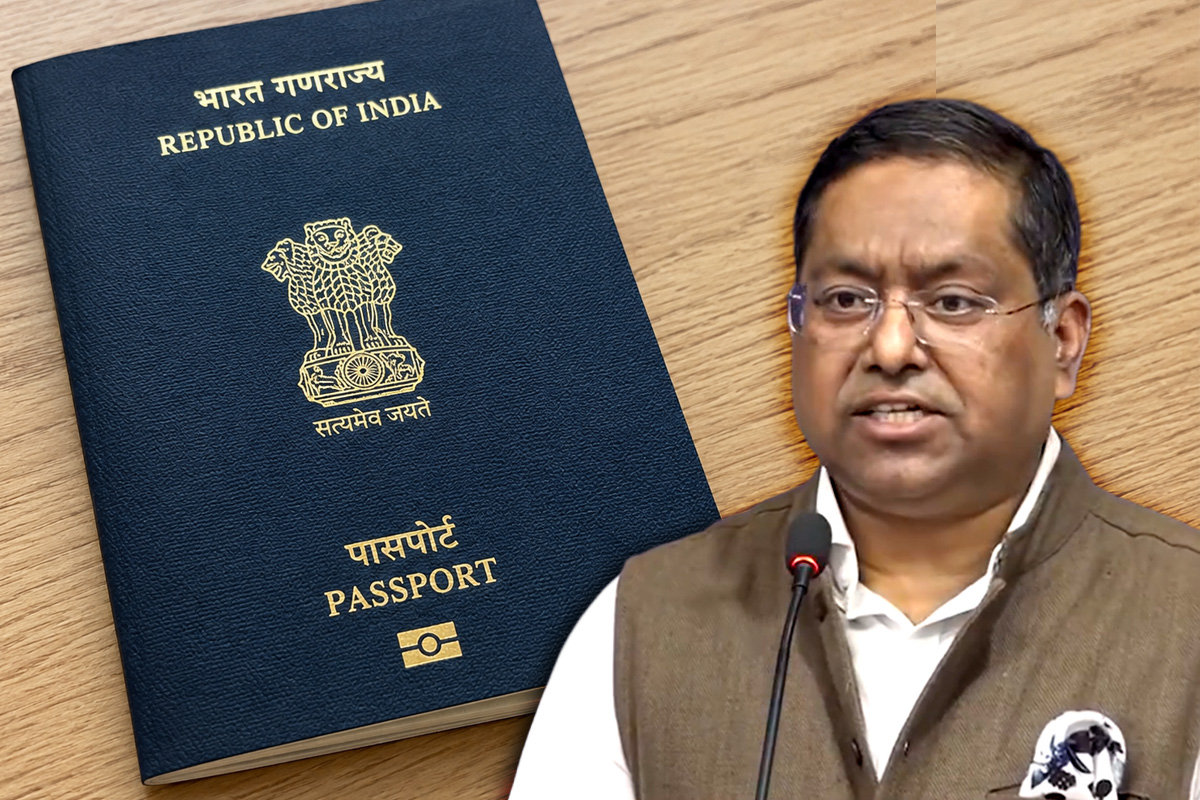
Ministry of External Affairs Spokesperson Randhir Jaiswal.

Synopsis: What is behind the government’s clarification that a passport issued by Order of the first citizen of India is not proof enough of Indian citizenship? Why now? What about the just over 3.7 crore Indians worldwide who hold them? How does this affect them? An Indian who has held at least five passports and lived in sixty countries tries to answer these and other pressing questions.
I got my first Indian passport in the early 1980s, at a time when fewer than one per cent of Indians owned one. Only a determined few even applied—it meant submitting a stack of documents and a long wait for police verification. My mother later told me a constable had come to our village to check on me, and—this being India—asked for a little “bakshish” along the way.
The booklet arrived by post; I still remember the excitement, the black-and-white photo that looked like me more or less, and pages so fresh I flipped through them for the sheer pleasure of it. Stamped somewhere inside—I no longer remember the exact wording—was a line to the effect that it was not valid for travel to Israel or South Africa, a sentence that told you more about Indian foreign policy in 1983 than any newspaper editorial could.
India had not yet recognised Israel, and South Africa was under apartheid; both exclusions were, in their own way, principled. It is strange now to recall that the very booklet barring me from Tel Aviv and Cape Town was, on its very first page, making an enormous promise about exactly who I was. When I finally did need to travel abroad, three years or so later, my friends and I agreed: getting that passport early had been the wise decision after all.
My current passport—perhaps my fifth or sixth—is biometric, laminated, with a colour photograph, and I suspect that a few weeks ago was the first time I actually read its bio-data page properly. Printed right after the four lions of the national emblem, in the unmistakable prose of a government that has never used one word where twelve would do, it says all in capital letters
“These are to request and require in the name of the President of the Republic of India all those to whom it may concern to allow the bearer to pass freely without let or hindrance and to afford him or her every assistance and protection of which he or she may stand in need.”
“By order of the President of India.”
It is, I’ve come to realise, an actual Presidential instruction, issued in advance, to every immigration officer on the planet, on my behalf—and this Republic prints more than a crore such booklets every year. I have carried that thick, dark booklet, its four golden lions and “Satyameva Jayate” stamped beneath them, to more than sixty countries, with real pride.
I could have taken another country’s citizenship—I had lived abroad long enough to qualify—but chose not to, since India does not allow dual citizenship. Friends called it madness: the visas alone, page after page of them stuck into ageing passports, cost me time, money, and no small amount of queueing. It would have been far more convenient to travel on the passport of the country where I actually lived and worked. I kept the Indian one anyway, as a prized possession, and gently ridiculed the friends who had given it up—until this summer, when the Ministry of External Affairs spokesperson stood in front of the cameras and said that holding one is “not proof of citizenship.”
On June 24, 2026—Passport Seva Divas, the ministry’s own annual pat on its own back—senior MEA officials said an Indian passport is a travel document, not proof of citizenship. It resurfaced, more formally, on July 14, when spokesperson Randhir Jaiswal told the ministry’s weekly briefing: “An Indian passport is a document that, as per the Passports Act, 1967, is issued by the Government of India to regulate the departure from India of citizens of India.” He added, for good measure, that fewer than eight per cent of Indians currently hold one.
My first reaction was the reaction of anyone raised on Indian bureaucracy: this is a junior official over-speaking, or a reporter in pursuit of a byline over-interpreting, or—most likely—both. Surely, I thought, there had to be a catch. So I checked. And checked again. It is, maddeningly, exactly what it sounds like—not a fake, not a misquote, not a misinformed junior official, but restated twice, three weeks apart, by the ministry’s own spokesperson, on the record, citing the Passports Act by section number.
My second reaction was less measured. There is something almost comic about a Republic that prints “these are to request and require, in the name of the President” on your travel document, and then sends a spokesperson out to tell the cameras—for Indians and the watching world alike—that the very same document proves nothing about who you are.
It is bureaucratic slapstick of a very high order—the kind only a government with 545 Passport Seva Kendras, six-day processing, and a hundred crore rupees’ worth of new e-passport chips could produce with a straight face. We have, in short, built one of the more efficient passport-issuing machines on earth, purely, it now turns out, to hand out a very handsome souvenir stamped, ostentatiously, by order of the President of the Republic of India.
Once the anger cooled into curiosity, I went looking for the data, because if a document held by “fewer than eight per cent” of Indians is suddenly not proof of anything, it seemed worth asking: eight per cent of what, and is that low, average, or catastrophic by world standards?
The trend for India is actually a good-news story, though nobody in the ministry seemed keen to mention it that week. In 2017, about 5.5 per cent of Indians held a valid passport. By December 2022, a Regional Passport Officer told the Bharat Chamber of Commerce the number had crossed 9.6 crore, or roughly 7.2 per cent, and was about to cross ten crore. By December 2023, it was 6.5 per cent.
The Ministry itself processed 1.39 crore passports in the calendar year 2025 alone — a 66 per cent jump in annual issuance over the past decade, alongside a new nationwide e-passport rollout. Run the arithmetic against India’s mid-2026 population of roughly 1.48 billion, and “fewer than eight per cent” works out to somewhere in the neighbourhood of eleven to twelve crore Indians—a genuinely enormous number of people to be told, in the same breath, that their most authoritative-looking government document doesn’t actually vouch for them.
Is eight per cent embarrassing by world standards? Not remotely, once you look outward. The often-cited comparison is the United States, where the State Department reports over 183 million valid passports in circulation—somewhere between 48 and 53 per cent of the population, an extraordinary jump from about 4–5 per cent in 1990. The United Kingdom sits far higher still, commonly cited at around 60-plus per cent.
But glance instead at Japan, home to arguably the world’s most powerful passport by visa-free access, and only about 17 per cent of Japanese citizens hold one—a figure that has been falling, not rising, since a peak of 27 per cent in 2005, blamed variously on a weak yen, a homebody younger generation, and general economic caution. China, despite everything said about its outward reach, sat at roughly 13 per cent as of 2023. South Korea is around 40 per cent, Australia around 53 per cent.
India’s eight per cent, in that company, is low but perfectly ordinary for a large, young, still-developing country—not the outlier the framing implied, and certainly not evidence that the passport itself is somehow a lesser document. Give it a decade, and that figure will likely climb past fifteen per cent on its own.
For a moment, I wondered whether I was being uncharitable—whether the MEA’s point was simply the sober, lawyerly one that a passport is not the only proof of citizenship, alongside Aadhaar, voter ID, birth certificates and the rest. That would be a defensible, even useful, clarification. I re-read every transcript, looking for that softer version. It isn’t there.
The statement, both in June and again in July, was specifically that the passport is not proof of citizenship at all—a much stronger and stranger claim, especially for the one document that Indian missions abroad, foreign governments, and airline check-in desks the world over have spent eight decades treating as exactly that. Let’s say the next time an immigration officer in the UAE, the UK, or the US asks me whether I am a citizen of India—what, exactly, is the correct answer now? Do I say, confidently, “here is my passport,” or must I add, “here is my passport, though it may not actually prove I’m a citizen of India”? I genuinely don’t know the right answer.
Naturally, the next question was whether this is some universal quirk of how passports work everywhere, or a peculiarly Indian piece of theatre. The honest answer is: a little of both, but not in the way the ministry implied.
It is true, as a matter of law, that countries can and do issue some travel documents to non-citizens—though never one identical to what they issue their own citizens. The UK issues British National (Overseas) passports to Hong Kong residents who are British Nationals but not full UK citizens; the Netherlands issues ordinary Dutch passports to Moluccan residents who are not, strictly, Dutch nationals; American Samoans receive US passports at birth while remaining “US nationals” rather than citizens until they naturalise; and Panama’s so-called “investment passport” is a travel document, not a grant of Panamanian nationality.
Around 146 countries, India among them, also issue “Convention Travel Documents”—refugee travel papers—to stateless people precisely because they have no passport of their own. Crucially, none of these looks like an ordinary national passport; they are marked, inside, as exactly what they are. Nowhere in the world is this used to argue that a citizen’s ordinary passport fails to establish their citizenship—which raises the obvious question: why did the MEA suddenly say so, and to what end?
The timing supplies its own answer. This coincided with the Election Commission’s Special Intensive Revision of electoral rolls in several states, where the live question was blunt: can a passport prove you’re a citizen when your name is being struck off a voters’ list? Is that, in the end, what this was really about—a proud Republic quietly telling the world that the roughly eight per cent of its citizens holding a document issued “by order of the President” may not, after all, be proof that they belong to it?
And here is the delicious irony the ministry did not advertise: India’s own Passports Act, 1967, Section 20, already allows the Central Government to issue “a passport or travel document to a person who is not a citizen of India” if it is in the public interest. That is the actual, narrow, sensible reason a passport can never be airtight, unfalsifiable proof—because the law itself carves out rare exceptions for non-citizens, and because, like any document, a passport can be obtained by fraud and later revoked. That is a world away from telling eleven crore honest citizens that their passports prove nothing about them.
The other pillar of the government’s defence was a 2013 Bombay High Court judgment, cited by the ministry as having “already made it clear that a passport is not proof of citizenship.” Journalists who went back and read the actual order—by Justice K. U. Chandiwal, in a case called Anwar Hussain Abdul Kadar Shaikh & Ors v. State of Maharashtra—found something narrower: the court refused to accept the accused’s passports as citizenship proof because those very passports had already been terminated, i.e., cancelled for suspected fraud, before the case reached court. A cancelled document proving nothing is not exactly a shocking legal principle; the government appears to have stretched a fact-specific ruling about fake, revoked passports, thirteen years later, into a rule about every valid passport in the country. If bureaucratic overreach had an Olympics, this citation would be a strong medal contender.
The other data set worth sitting with is who, exactly, is holding these passports, because the ministry’s phrasing landed with special force on the diaspora. As of January 2026, the Ministry’s own diaspora database counts just over 3.7 crore Overseas Indians worldwide—roughly 1.78 crore Non-Resident Indians (NRIs, Indian citizens living abroad) and 1.95 crore Persons of Indian Origin (PIOs, foreign citizens of Indian descent). Nearly a crore of those NRIs are in the six Gulf Cooperation Council states alone—the UAE tops the list with over 43 lakh, Saudi Arabia has over 27 lakh, Kuwait over 10 lakh, Qatar over 8 lakh, Oman nearly 7 lakh, and Bahrain over 3 lakh.
The United States has roughly 23 lakh NRIs and 38 lakh PIOs; Canada roughly 14 lakh NRIs and 19 lakh PIOs; the United Kingdom roughly 3.7 lakh NRIs and 9 lakh PIOs. These are, overwhelmingly, ordinary working Indians carrying Indian passports because they are, in fact, Indian citizens—construction workers in Dubai, nurses in Riyadh, engineers in Silicon Valley—the same people who send home their hard-earned foreign currency, often spending months or years away from their families to do it, and who have now been told, in effect, that this doesn’t prove they belong to the country they are working so hard to support.
And this is where the much-abused acronym OCI needs its own paragraph, because half the online outrage after the MEA’s statement confused it with NRI status. An Overseas Citizen of India card—held by an estimated 47 to 50 lakh people worldwide as of 2026—is explicitly not Indian citizenship and does not come with an Indian passport; it is a lifelong visa for people of Indian origin who hold a foreign passport.
You cannot be an OCI cardholder and an Indian passport holder at the same time—the whole point of the card is that you gave up your Indian passport when you naturalised elsewhere. So when the government says a passport is not proof of citizenship, it is not describing OCI holders at all—those millions of people have already, formally, told India they are not its citizens. The confusion is worth naming because the government’s framing let two very different populations blur into one anxious mass of “overseas Indians who might get told they don’t belong.”
Also Read: 2010 MEA records contradict Centre’s claim that passports were never proof of citizenship
Strip away the legalese and you are left with an uncomfortable truth — one that reads almost like a deliberate negation of the very phrase printed, in Hindi, on that passport: Satyameva Jayate, truth alone triumphs. If a valid, unexpired, uncancelled Indian passport is not proof of Indian citizenship, then the External Affairs Minister who signs off on this policy, the spokesperson who announced it at the podium, and every official in that briefing room are themselves carrying a document that, by their own logic, proves nothing about their citizenship either.
Nobody in government has, of course, drawn that conclusion about themselves—which is rather the point. A rule that nobody applies to their own passport is not a legal principle; it is a talking point that got away from its authors. Push the logic further: if someone were to ask the Minister himself whether his own Indian passport proves his citizenship, what would the honest answer be? Asking any Indian citizen to prove they belong to their own country is not a comfortable question—a minister included.
Somewhere in that eleven or twelve crore, sure—some individuals will have obtained a passport through forged documents or a bribed clerk at a Regional Passport Office; India’s own courts have prosecuted exactly such cases, including the fraud-tainted, terminated passports at the heart of the 2013 Bombay judgment itself. Nobody sensible disputes that fraud exists, or that the government has both the right and the duty to investigate it, case by case, exactly as Section 10 of the Passports Act already allows: impound and revoke the specific document, prosecute the specific fraud.
What does not follow, constitutionally or logically, is moving from “a small number of passports were fraudulently obtained” to “your passport, and yours, and yours, proves nothing”—a blanket statement that punishes eleven crore honest citizens for the sins of a vanishingly small number of forgers, while the document itself remains unchanged, still accepted by more than 190 countries at their borders.
It would be one thing if this were careless phrasing at a press conference nobody remembers by Friday. But it lands at a moment when citizenship documentation is actively contested—through the Special Intensive Revision of electoral rolls, through the long shadow of the Assam NRC exercise, through a Home Ministry busy digitising OCI cards even as its sister ministry casts doubt on the passport’s evidentiary worth. Kapil Sibal’s dry public question—if not the passport, then which document proves citizenship?—has, as of this writing, gone unanswered, save for a defensive social-media post citing the same 2013 judgment whose actual holding is disputed.
None of this needs to end in gloom, because the fix is genuinely not complicated, and India has, when it wants to, shown it can move fast on documentation—witness the e-passport rollout, the new e-OCI digital card, and the 66 per cent rise in annual passport issuance over a decade. A few modest, doable steps:
First, the government could issue one clear, written circular—not a press-briefing aside—stating that a valid, unexpired passport carries a rebuttable presumption of citizenship, challengeable only through due process on specific evidence of fraud, never through blanket administrative doubt. That single sentence would defuse most of the anxiety at a stroke.
Second, separate SIR/NRC-style citizenship-verification exercises entirely from passport messaging. If the Election Commission needs a hierarchy of documents for electoral rolls, publish that hierarchy plainly, rather than letting a passport-specific soundbite do duty for a much narrower rule.
Third, talk to the diaspora directly. A short, plain-language advisory from Indian missions in the Gulf, the US and Canada—explaining exactly what did and did not change, and reassuring NRIs (as distinct from OCI holders) that nothing about their status has shifted—would cost a press release and save many anxious calls to consulates.
Fourth, keep prosecuting actual fraud, loudly and specifically, by name and case number, rather than by innuendo against the whole passport-holding population. Nothing restores public confidence faster than seeing the guilty punished individually instead of the innocent tarred collectively. A dedicated MEA cell for reporting suspected passport fraud—one ordinary citizens could actually use—would channel that vigilance usefully, instead of leaving it to float around as blanket suspicion.
And finally—since India has built one of the more efficient passport bureaucracies among developing nations, post office kendras included—perhaps someone senior enough could simply read the ministry’s own bio-data page before the next press briefing. It is right there, four lines under the lions, in the name of the President of the Republic: a promise, printed on my behalf, to every stranger with a stamp. It seems only fair that the government which authored that sentence should be the last to publicly doubt it. Let me end this with a rudimentary proverb I used to hear as a child in my village: some men will set their own house on fire to get rid of the rats.
Also Read: Indian Editor on travails without voter ID and passport; imagines fate of the marginalised
(Edited by R Rajesh Kumar.)



