

Published Jul 17, 2026 | 9:00 AM ⚊ Updated Jul 17, 2026 | 9:00 AM

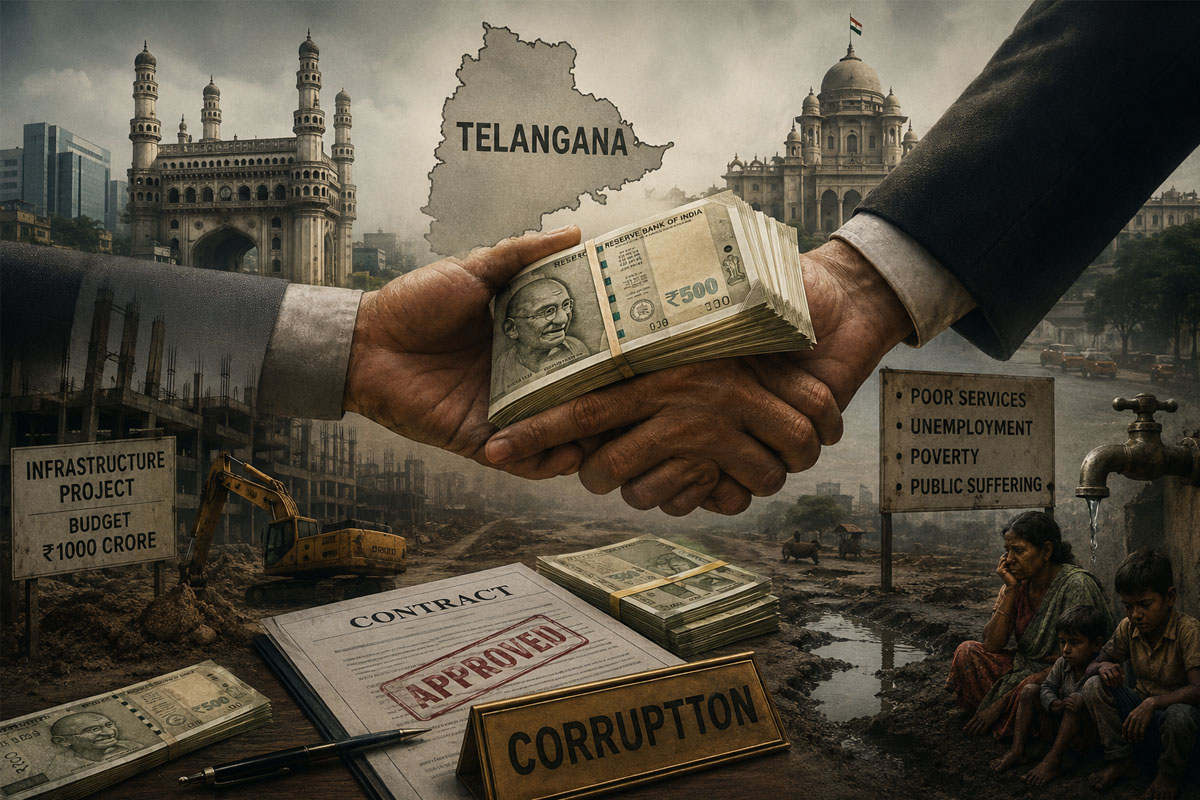
AI-generated image

Synopsis: What the recent Telangana Anti-Corruption Bureau raids reveal is the extent of the rot that has seeped into the system over decades. What has been unearthed might only be the tip of the proverbial iceberg.
The bundles of currency notes, gold and silver, property deeds, bank deposits, vehicles and other assets unearthed during Anti-Corruption Bureau (ACB) raids on the residences and bank lockers of several government officials over the past two or three weeks raise an unsettling question. If such enormous wealth has accumulated in the hands of relatively lower-ranking officials, one can only imagine what would come to light if searches were ever conducted at the homes of senior bureaucrats, political leaders, ministers and legislators—the real centres of policy-making and, often, of illicit enrichment. One is reminded of the stories surrounding the hidden treasures of the Padmanabhaswamy Temple in Thiruvananthapuram; raids on the powerful might well reveal scenes that surpass those legends.
At the residence of a Deputy Director in the Survey, Settlement and Land Records Department, the ACB recovered ₹1.54 crore in cash, bank balances worth ₹2.29 crore and fixed deposits amounting to ₹5.04 crore. The following day, officials opened lockers held in his wife’s name at another bank and found another ₹1.5 crore in cash along with two kilograms of gold biscuits and jewellery. The officer had joined government service as a surveyor in 1987, later served as Assistant Director in Survey and Settlement and was functioning as Deputy Director when the raids took place. Newspapers reported that bundles of currency notes had been stacked beneath the mattress on which he slept.
In another case, raids at the residence of a woman Tahsildar yielded disproportionate assets worth more than ₹5 crore, including cash, gold and diamond jewellery. ACB officials estimated that the market value of these assets could exceed ₹50 crore.
In yet another case, an Excise Department Superintendent was found to possess assets worth ₹2.25 crore beyond his known sources of income. Reports said he never spared even a routine payment of ₹1,000 and that investigators had gathered details of the monthly collections he allegedly extracted from every toddy shop under his jurisdiction.
The most sensational case involved a Deputy Superintendent of Police attached to Police Computer Services. Simultaneous searches at sixteen locations, including the residences of relatives and suspected benamis, uncovered nearly two kilograms of gold jewellery, twenty kilograms of silver, landholdings in different places, including Karnataka, houses and vehicles. The total value of the assets is estimated at around ₹200 crore.
Investigators found that a substantial portion of these properties had been registered in the names of benamis, prompting speculation that the officer himself might merely be a benami for more powerful political figures. According to media reports, before leaving on the Char Dham pilgrimage and uncertain whether he would return alive, the officer meticulously documented every asset held by him and by his benamis, distributed them among his children and other family members, and even sent the details to his two sons through WhatsApp. Those leaked messages reportedly became crucial evidence.
In English, these discoveries would be described as merely the tip of the iceberg. No one knows how much remains submerged beneath the surface. Within the ocean of our dysfunctional and self-serving system of governance, there may be countless unseen icebergs of corruption far larger than those already exposed.
The four departments in which these cases surfaced—Land Survey, Revenue, Excise and Police—are institutions that ought to constitute the very pillars of governance. Instead, they have increasingly become patrons of illegality and corruption. Significantly, among the four officials caught, only one occupied a somewhat higher rung in the administrative hierarchy; the remaining three belonged to the lower levels. Above each of them stand at least five or six layers of authority. Even if one assumes that a handful of officers at those higher levels are honest, the overwhelming majority either receive their share from corruption flowing upward or enjoy opportunities for corruption on an even larger scale.
If corruption and accumulation of disproportionate assets are taking place on such a massive scale, raids may make banner headlines. But are trials and convictions following? Is corruption declining? Do corrupt officials even fear the law anymore?
For the past decade or so, Telangana has been debated as either a prosperous state or a financially distressed one. Estimates differ according to one’s perspective. The same reality often appears entirely different depending on where one stands. Perspective itself is shaped not merely by physical location but also by interests and ideology. Those who proclaim Telangana to be a wealthy state on one occasion readily claim on another that its finances are in poor shape. The same government that promises to spend ₹1 lakh crore on rejuvenating the Musi River and constructing the Gandhi Sarovar may simultaneously refuse to pay even much smaller amounts legitimately owed to individuals. For the moment, however, the debate over whether Telangana is rich or poor may well be settled by describing it instead as a state rich in corruption.
The Telangana Anti-Corruption Bureau registered fifteen disproportionate assets cases during the whole of 2025. In just the first six months of 2026, it had already registered fourteen such cases, almost matching the previous year’s total. Officially, these are not described as “corruption cases” but as “Disproportionate Assets” (DA) cases. They involve situations where a public servant accumulates assets beyond what could reasonably have been acquired through known lawful sources of income. Sections 13(1)(b) and 13(2) of the Prevention of Corruption Act, 1988, treat such accumulation as a criminal offence. The law defines disproportionate assets as wealth acquired during a specified period that is inconsistent with the public servant’s lawful and known sources of income.
When the suspect is a public servant, investigators first determine the income earned during a specified check period. They calculate all declared and lawful sources of income, the family’s declared expenditure during the same period and the assets standing in the names of the officer and family members at the end of that period. The total expenditure is deducted from the total income, and the balance is compared with the value of the assets found. The larger the unexplained difference, the stronger the basis for initiating criminal proceedings.
An ACB raid may originate from a specific complaint, intelligence input or information received from the department in which the officer works. Whatever the source, the Bureau first conducts a discreet verification of salaries, tax returns, immovable properties, bank accounts and even assets held by relatives or suspected benamis. Once sufficient material is gathered, an FIR is registered. Armed with search warrants, simultaneous raids are conducted on the residences, offices, bank lockers, farmhouses, relatives’ houses and suspected benamis’ premises to seize documents and electronic evidence relevant to the investigation.
When asked to explain assets found in excess of known income, the accused may claim that the property was inherited, earned through agriculture, purchased from a spouse’s income, received as gifts or acquired through loans. If these explanations are supported by credible evidence, the case may not proceed further. Even after the investigation is complete, prosecution cannot begin unless the government grants sanction to prosecute the officer. Only after such a sanction can the ACB file the case before the Special Judge dealing with corruption cases. Hundreds of corruption cases remain pending today solely because government approval for prosecution has not been granted.
Even after a sanction is obtained, these trials usually take years. Unlike ordinary criminal cases, they rarely depend on eyewitness testimony or cross-examination. Instead, they involve scrutiny of hundreds of documents—valuation reports, income tax records, bank statements and other financial records—examined by engineers, auditors, registration officials and chartered accountants, whose reports ultimately form the basis of the court’s decision. Corruption may infiltrate this process itself as well, allowing corruption cases to become victims of corruption. Where the process functions honestly, however, punishment can include confiscation of disproportionate assets, imprisonment, fines, dismissal from service and restrictions on pensionary benefits. Unfortunately, very few cases reach that stage.
According to National Crime Records Bureau statistics, seven corruption cases were decided in Telangana during 2021. Convictions were secured in six and one ended in acquittal, enabling the ACB to claim an impressive conviction rate of 85.7 per cent.
The reality, however, was that nearly 900 corruption cases were pending at the time, and only seven reached completion during the entire year. Likewise, the government claimed a 70 per cent success rate in 2024 without disclosing the total number of pending cases. During that year alone, 213 corruption cases were registered, including eleven disproportionate assets cases. In 2025, the number of disproportionate assets cases alone rose to fifteen. As mentioned earlier, the corruption detected in the first six months of 2026 almost equals that uncovered during the whole of the previous year.
Ordinarily, newspapers report instances where government officials are caught red-handed while accepting bribes. Such cases generally involve lower-level employees and relatively modest amounts running into a few thousand or a few lakh rupees. They are the proverbial small fish. Disproportionate assets cases are of an altogether different order. Here, the official may not be caught accepting a bribe on any particular occasion, but raids reveal crores of rupees in cash, property documents, gold, silver and other valuable assets accumulated over many years.
These are not isolated instances of bribery in return for a single favour. They reflect a system in which bribery has become an integral part of official duty itself, where virtually every public transaction is converted into an opportunity for illegal gain until immense fortunes are amassed over a lifetime in public service.
These cases involving the big fish are therefore not the disease itself. They are merely the symptoms of a chronic illness that has afflicted our system for decades. If these symptoms compel us to identify and confront the deeper disease that is steadily hollowing out our institutions, they may yet serve a useful purpose.
Also Read: Two incidents and how they raise serious questions about Telangana government and police
(Edited by R Rajesh Kumar.)



