

Published Jul 02, 2026 | 6:08 PM ⚊ Updated Jul 02, 2026 | 6:08 PM

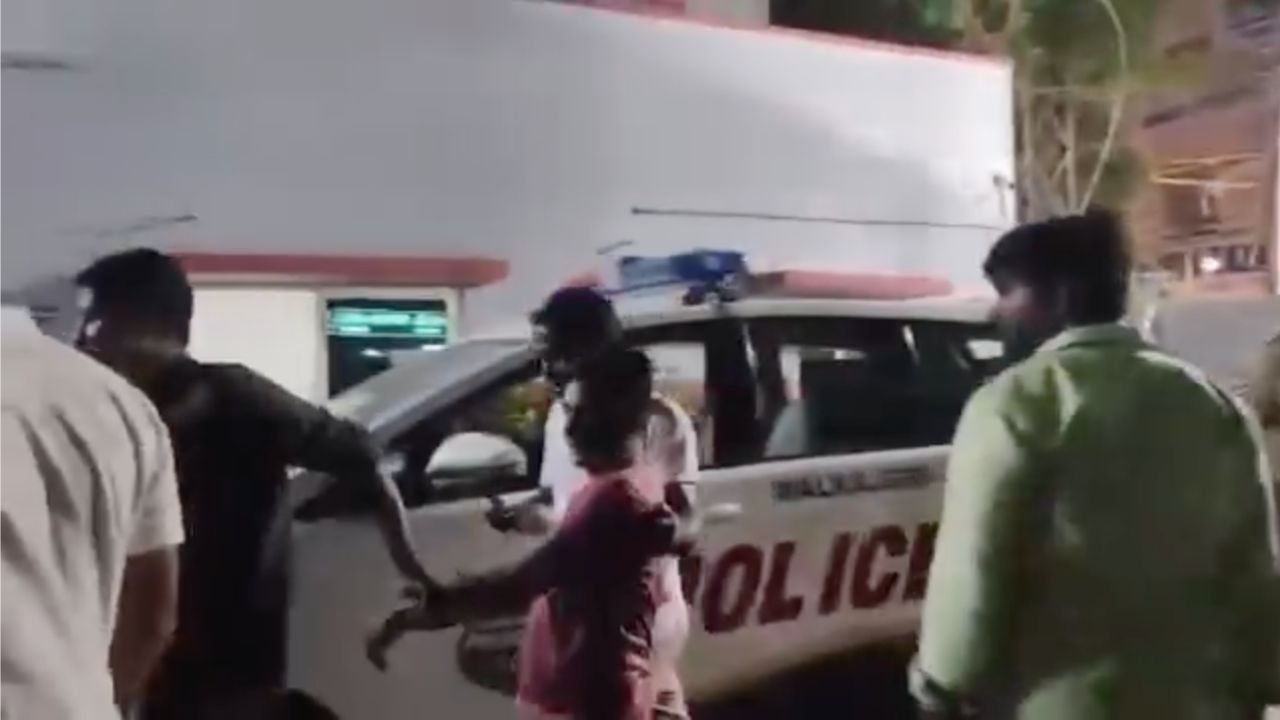
KV Reddy was arrested by the Andhra Pradesh police in Hyderabad.

Synopsis: An incident that served as a reminder of the long-standing, insidious efforts of the Sangh Parivar to poison Telangana society and two unauthorised arrests have highlighted how the state only has a Congress government by name.
The pace at which changes and developments are taking place in Telangana society is such that the contemporary issue I plan to write about at the beginning of the week under this column changes by the middle of the week. By the time I sit down to finalise the column, yet another new issue takes its place. Is this speed good or bad? Do these developments indicate social progress, or do they signify a continuous decline in social, political, economic, and cultural life—like the proverbial descent “from the heavens to Shiva’s head and further down”?
In Telangana, the misdeeds of the Sangh Parivar and police excesses are increasing by the day. Though there is nominally a Congress government, the situation raises doubts whether it is, in effect, a Sangh Parivar government. It is unclear whether the Congress high command is aware that there is little respect here for the Constitution that Rahul Gandhi constantly holds up and displays, or for the rule of law. Whatever the Telangana ruler may say outwardly, developments continue smoothly and routinely in a manner that makes the Sangh feel satisfied that he is part of their fold.
Let us look at just two incidents that occurred this week. One is the poisonous, hate-driven propaganda being carried out by Sangh Parivar forces using a trivial incident in Armoor as a pretext. The second is the manner in which Andhra Pradesh police abducted two Hyderabad journalists for making comments related to Andhra Pradesh politics. Both these incidents have direct or indirect connections with the Telangana government, its police, and its governing methods.
These are not isolated, sudden incidents. Though they appear as present-day events, they are links in the chain connecting past, present, and future, capable of deeply influencing the trajectory of Telangana society. Their impact on the future will be even more severe.
The first incident may appear as an isolated event, but it is actually part of the long-standing, insidious efforts of the Sangh Parivar to poison Telangana society, divide it along religious lines, sow seeds of hatred among ordinary people toward those of other faiths, and ultimately capture political power in the state. It is a truth proven many times that all forms of religious fanaticism are essentially the same, and that they feed off each other like parasites. This truth has manifested once again in Armoor.
Taking advantage of a foolish, improper act by an individual belonging to one religion, the Sangh Parivar unleashed its aggression. Instead of using available official mechanisms to stop the act or take administrative action, it used the opportunity to spread poison, tear society apart, and instill fear among the people.
The allegation made by the Sangh Parivar is that Urdu was being taught to students in a private school called Bharat Chandra School in Perkit village of Armoor mandal in Nizamabad district. If that were the concern, they could have discussed it with the school management, the education department, or government authorities and resolved it smoothly. Instead, local leaders of the Bharatiya Janata Party went in a crowd, accompanied by the police, and attacked the school. In the presence of the police, they physically assaulted the school headmaster.
When a school is in session, for members of a political party to forcibly enter and assault the headmaster is an objectionable and even punishable offence. That such an act occurred in the presence of the police reflects negligence and irresponsibility on their part. In fact, teaching Urdu to students is not at all wrong. It merely equips children with an additional language skill. If it imposed an extra burden on students or displaced prescribed subjects, one could question why something outside the curriculum was being taught. But this attack was driven by the poisonous notion that Urdu is somehow the language of a particular religion.
Urdu is the second official language of this state. It is the mother tongue of a significant section of the population here. As early as 2018, the Telangana government had included Hindi, Urdu, and Sanskrit as third-language options alongside English and Telugu in English-medium schools.
Teaching Urdu is not inherently wrong. If there was a complaint that it was being taught outside the curriculum, it could have been addressed through official and democratic means. But assaulting the headmaster reveals a tendency toward violence and the arrogance that such acts will go unpunished. While the police registered a case against BJP leaders for the attack, they also filed a case against the school management regarding “unauthorised teaching”. In reality, one of these is a punishable offence, while the other is, at most, overenthusiasm. Filing a case in the latter instance is not only unnecessary but also an act of appeasement toward the perpetrators of violence.
On the orders of the district Additional Collector and the Armoor Sub-Collector, an inquiry was conducted by the Armoor Revenue Inspector, Mandal Education Officer, and local police, who met students, teachers, the correspondent, and other concerned persons. The committee found that a teacher appointed to teach Hindi to classes one through five had also been teaching Urdu. It also recorded that complaints had been received from parents and that the teacher had been instructed to stop teaching Urdu.
To counter the argument that teaching a language is not wrong and does not warrant violence, a new allegation was added—that children were also being taught namaz. Whether this is true or not should be known to the children themselves. But since social division and the spread of poison have already taken place in Armoor, and a neutral atmosphere no longer exists, the truth may never come out.
In any case, the spread of such hatred against Urdu in Telangana is deeply objectionable and runs contrary to the history and heritage of Telangana society. As the Sangh Parivar claims, Urdu is not the language of any one religion. It is an Indian language, recognised by the Constitution, and has been an integral part of Telangana society for centuries. Until two generations ago, many ordinary people, writers, and political leaders conducted their affairs in Urdu. My own father maintained his daily diary in Urdu. Across the Indian subcontinent, irrespective of religious beliefs, there are countless admirers of the Urdu language and literature. To spew venom against Urdu is an insult to our history and culture.
The second incident occurred on Tuesday night, when some individuals in plain clothes suddenly attacked and abducted two journalists. It is believed that these assailants were from the Andhra Pradesh police. One of the journalists, K Venkatarami Reddy, had earlier been abducted in connection with a case registered in Vizianagaram for comments he allegedly made in his YouTube videos about the son of the Andhra Pradesh Chief Minister, Education Minister Lokesh. He was then subjected to torture for a week and released only after widespread concern in Telangana society. Now, claiming there was a non-bailable warrant in the same or another case, they carried out another attack.
A non-bailable warrant is a court order directing the police to produce a person before the court if they fail to appear. It is a lawful arrest. The duty of the police is to show the warrant, take the person into custody, and present them before the court. Since this is an official duty, the police must be in uniform and use official vehicles. They must not use force or commit excesses.
However, videos show that those who claimed to be executing such an arrest did not follow any of these procedures. They dragged away Venkatarami Reddy from his home, where he was in shorts and a vest with his family, without even allowing him to dress properly. Not only were they not in uniform, but they also appeared like hired goons. There was no proof that they were police. They did not arrive in an official vehicle but in a private car with Telangana registration.
When his wife resisted the abduction, recalling the torture he had suffered previously, male police personnel pushed her aside and forced him into the car. When gathered locals questioned their credentials and demanded the presence of local police, he was taken to Saroornagar police station. The Saroornagar police ensured that this abduction proceeded smoothly.
While this kidnapping was recorded and became known on social media, another similar incident came to light on Wednesday morning. A journalist named Ravan from the Prashna YouTube channel was abducted at midnight on allegations that he had spoken against Andhra Pradesh Deputy Chief Minister Pawan Kalyan.
If these journalist–YouTubers made objectionable comments, the law provides for investigation, filing of cases, and trial in court. If proven, punishment can also be imposed. Since cases against them were registered in Andhra Pradesh, the Andhra Pradesh police should have informed the Telangana police and local authorities and carried out an official arrest.
Instead, abducting them in a clandestine and unauthorised manner, using force against the accused and their families, is a sign of a police state, illegal conduct, and police tyranny. It is even more unjust that when police from a neighbouring state enter and act with such high-handedness, the Telangana police not only fail to stop them but also extend direct or indirect cooperation.
Both these incidents raise serious doubts about the Telangana government and its police. One is compelled to question whether the state is being governed by a Constitution-abiding Congress government or by a regime aligned with the Manudharma-driven, coercive politics of the NDA.
Also Read: Are thirty-seven per cent of voters in Telangana suspect? Seriously!
(Edited by R Rajesh Kumar.)



