
Published Nov 10, 2026 | 11:10 AM ⚊ Updated Nov 10, 2026 | 11:10 AM

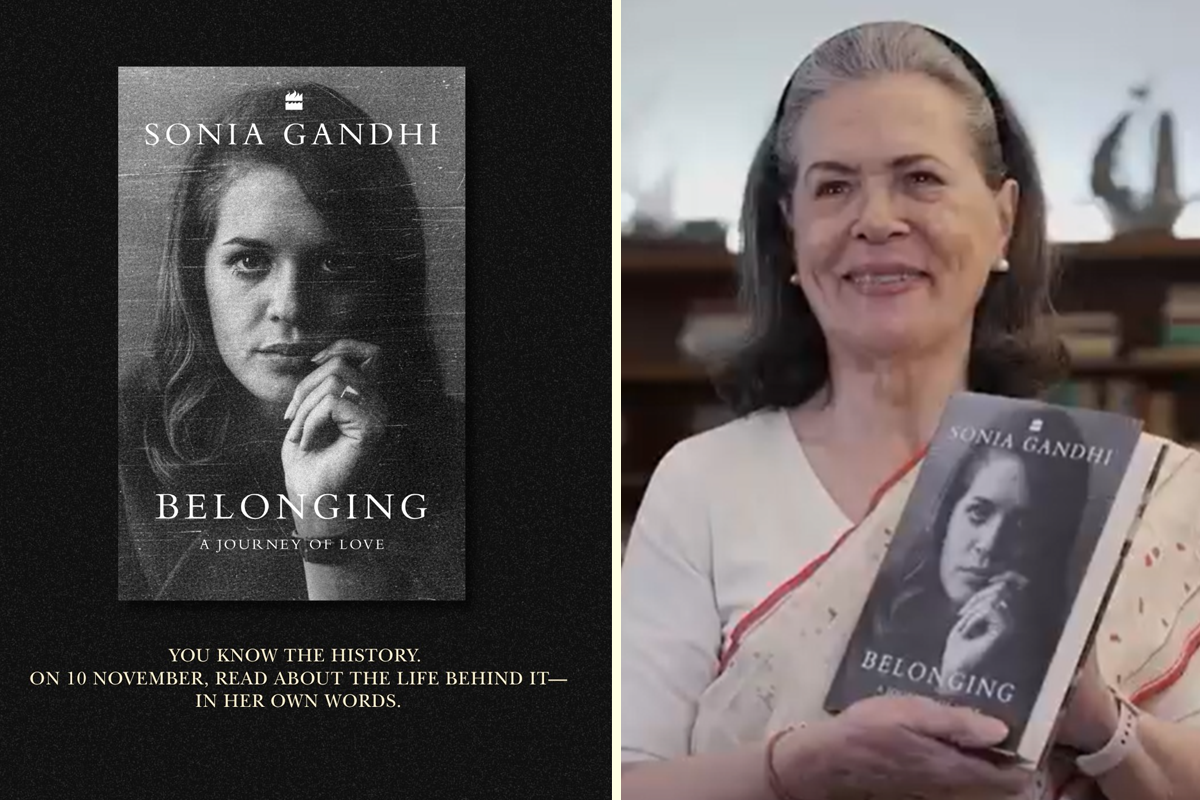
Belonging: A Journey of Love, which generated discussion even before its release, is certain to attract widespread attention.

One question can invite several answers, while several questions may lead to one.
What can a book written from the heart reveal? How much can it tell us?
Sonia Gandhi, who entered Indian politics reluctantly but played an active role, directly and indirectly, for nearly three decades, is set to stir debate with her memoir. Belonging: A Journey of Love, which generated discussion even before its release, is certain to attract widespread attention. “Yes, I felt the time had come to tell my own story,” she says.
At a time when the ruling party regularly targets the Nehru-Gandhi family, the account of someone who witnessed nearly six decades of its history is bound to generate interest. Her recollections of the assassinations of Indira Gandhi and Rajiv Gandhi, the Emergency, her political entry and her sense of identity could fascinate readers and provoke controversy.
More importantly, Sonia explains how her sense of belonging to a family, a country and its people evolved from personal affection into a larger love for the nation. Perhaps that is why she describes the book as “a book about family, not politics”.
Excerpts, interviews and disclosures released ahead of publication suggest that Sonia has shared several previously unknown aspects of her life. Some details were revealed by Sonia herself on social media, others by publisher HarperCollins India.
Veteran journalist Neerja Chowdhury also brought out insights through her interactions. Interviews with Sonia by N Ram of The Hindu and Hannah Ellis-Petersen of The Guardian offered further glimpses into the book.
Sonia recalls strongly opposing her husband Rajiv Gandhi’s entry into active politics following Indira Gandhi’s assassination. She admits she could never understand why he was drawn into politics. Her own eventual entry, despite urging her children Rahul and Priyanka to stay away, involved immense inner turmoil.
“I would wake up in the middle of the night. There were so many unanswered questions. I did not know what to decide. There was a battle within me,” she writes, describing a political world marked by greed, hypocrisy, hunger for power, betrayal and broken trust.
Having witnessed her mother-in-law’s assassination and subsequently losing her husband, Sonia says she entered politics reluctantly because she could not allow their sacrifices to go in vain. Their commitment to India’s secular and pluralistic character inspired her to remain steadfast during difficult times.
When forces opposed to the values for which Indira and Rajiv sacrificed their lives began gaining strength, how could she remain comfortably confined to her home? This realisation gradually became clearer after Rajiv’s death and when circumstances eventually pushed her towards accepting responsibility.
Her reflections on the Emergency reveal that she considers it an unfortunate and authoritarian chapter in India’s history. She highlights the contrasting positions of Indira Gandhi’s sons, Rajiv and Sanjay, towards its implementation. According to Sonia, Rajiv was among the few who conveyed public opposition and feedback to the Prime Minister.
She believes Indira gradually understood the situation and initiated corrective measures. Public unrest and growing resistance within sections of the bureaucracy and armed forces may have contributed to the decision to impose the Emergency. However, Sonia points out that Indira eventually called elections in March 1977 and publicly apologised for the excesses committed during that period.
Sonia provides a detailed account of the developments between 1995 and 1997 that drew her into active Congress politics. She rejected suggestions from senior leaders to support a breakaway faction in 1995. Several prominent leaders, including Arjun Singh, ND Tiwari and Mohsina Kidwai, left the party. Others, including GK Moopanar, P Chidambaram and Madhavrao Scindia, also took different political paths. The Congress suffered a major setback in the 1996 elections. Sonia recalls that at the party’s 80th plenary session in Kolkata in 1997, then president Sitaram Kesri invited her to join as a primary member.
She offers a different perspective on the 1999 controversy when Sharad Pawar and two other senior leaders questioned her nationality. What hurt her more, she says, was not the suggestion that she was ineligible to occupy the country’s highest office, but the feeling that she was still being treated as an outsider. In Chapter 30, she explains why she decided against becoming Prime Minister following the Congress victory in 2004. Her decision to decline the position, which came her way twice, reflects a conscious choice.
“For a long time, I kept my private world to myself. Although destiny reluctantly drew me into politics, I remained as private as possible. Only after stepping away from public life could I look back at my story with clarity,” she writes.
Love, she explains, has been the central thread running through her life. It began when a young woman from a small Italian town fell in love with an Indian student in England. That affection grew into bonds with an unfamiliar family and a deep relationship with her mother-in-law, Indira Gandhi. It strengthened through years of raising her children and endured even after violence took away first her mother-in-law and then her husband. What sustained her, she says, was her love for Rajiv and for India, the country she came to regard as her own.
Several books have explored Sonia Gandhi and the Nehru-Gandhi family, including works by Pupul Jayakar, Natwar Singh, Rashid Kidwai, Javier Moro and Rani Singh. Yet Sonia’s own account stands apart.
She admits writing did not come easily after years of not practising it. She began writing nearly a decade ago and completed another section five years ago. At times, she struggled to find words, but when thoughts and expressions came together, the writing flowed. Family, friendships and values, she says, gave her the strength to survive.
Sonia also reveals that she has been studying the essence of the Bhagavad Gita since 1987 under Professor Vachaspati Upadhyaya of Lal Bahadur Shastri Sanskrit Vidyapeeth. Referring to Krishna’s teaching, she says she performed her duty without expecting rewards. A leader who chose responsibility over political ambition, she offers a personal account of love, loss, sacrifice and belonging. How readers respond to this journey remains to be seen.
Also Read:
Forget NDA vs INDIA, Modi vs Rahul: The real battle is between universal and limited franchise
‘Jo Jeeta Wohi Sikandar’: Congress needs a winning instinct
Sonia Gandhi’s memoir: When publishers start censoring ideas
(R Dileep Reddy is a political analyst and director of the People’s Pulse Research Organisation. Edited by R Rajesh Kumar.)



