
Published Oct 12, 2026 | 6:37 PM ⚊ Updated Oct 12, 2026 | 6:38 PM

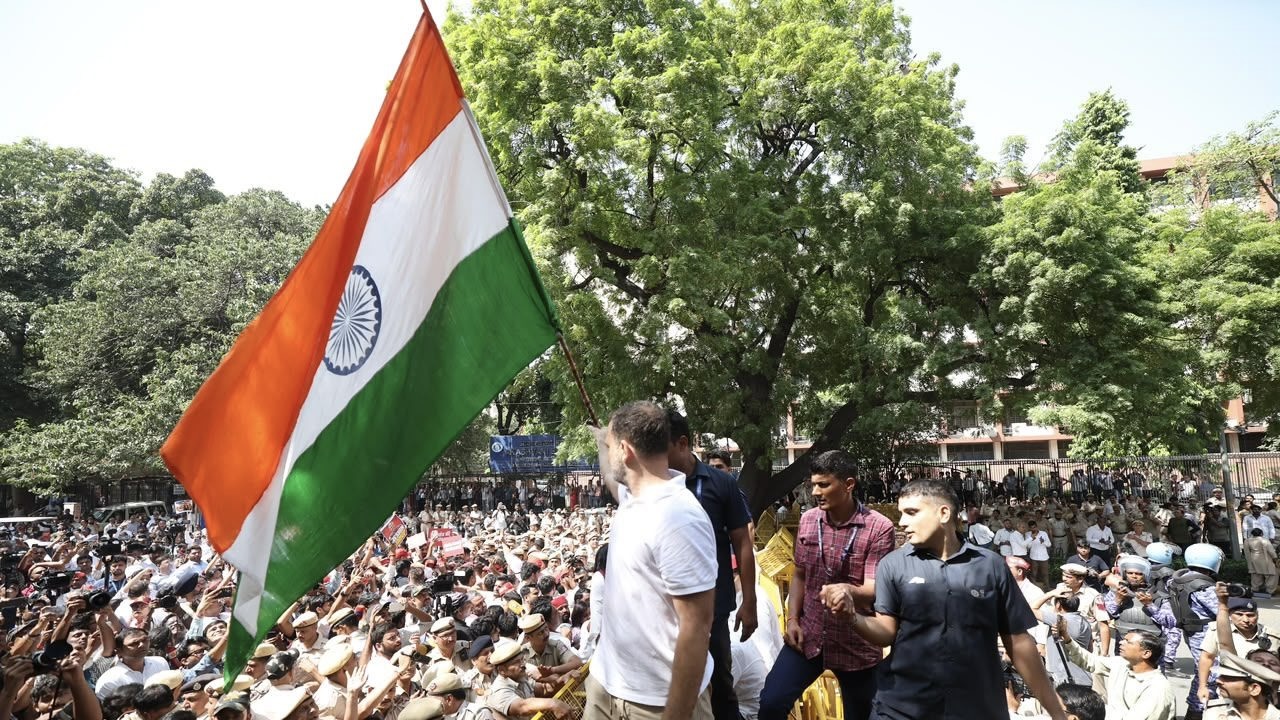
Leader of the Opposition Rahul Gandhi holds the tricolour while standing atop a police barricade. (Credit: INC)

Synopsis: Rahul Gandhi’s popularity may be rising, and anti-incumbency against the NDA government may be mounting. But Congress must grow, and the opposition must strengthen its unity. With both Congress and the INDIA bloc desperately needing victories, the spotlight is on Rahul. Yet his focus on strengthening his own party appears inadequate.
Congress has lost the habit of winning elections, managing only occasional victories. Some see Rahul Gandhi’s lack of an obsessive desire to win as a virtue; others see it as his biggest weakness.
Congress is losing its killer instinct to win. In contemporary politics, where Jo Jeeta Wohi Sikandar (the winner takes it all) holds increasing relevance, a party that struggles to win risks losing its political relevance.
Rahul’s popularity may be rising, and anti-incumbency against the NDA government may be mounting. But Congress must grow, and opposition unity must strengthen. With both Congress and the INDIA bloc desperately needing victories, the spotlight is on Rahul. Yet his focus on strengthening his own party appears inadequate.
Also Read: Rahul Gandhi files petition against ECI in Supreme Court
Congress urgently needs a victory to regain its electoral momentum. Political opportunities do not automatically translate into votes. Success requires a strong organisation, unity among allies and the ability to convert public sentiment into electoral gains.
While Congress and its INDIA bloc partners struggle on these fronts, the BJP has made victory routine. Recent by-elections underline this contrast. Despite protests over alleged irregularities in the Special Intensive Revision (SIR) of electoral rolls and the Election Commission (ECI)’s functioning, Congress failed to win anywhere.
The BJP performed strongly in northeastern states, while an NDA ally won in the south. Though these results may not reflect the entire country, recent electoral trends offer Congress little encouragement.
Congress must first put its own house in order. Uttar Pradesh, Gujarat, Bihar, West Bengal, Odisha and Tamil Nadu illustrate its prolonged decline. In Gujarat, Congress has remained in opposition for nearly three decades. Uttar Pradesh, which has produced eight of India’s 14 prime ministers, has remained beyond its independent reach since N.D. Tiwari’s tenure ended in 1989.
Congress has increasingly become a junior partner to the Samajwadi Party, often recording a lower success rate than its allies. Its poor performance was also blamed for preventing RJD leader Tejashwi Yadav from becoming Bihar Chief Minister after the 2020 Assembly elections.
Also Read: All protests are one movement to defend Constitution
The coming February-March elections in Uttar Pradesh, Punjab, Uttarakhand, Manipur and Goa will test the party.
AAP appears capable of retaining Punjab, while Congress has little reason for optimism in Manipur. The BJP retained power in Uttarakhand despite the state’s tradition of changing governments. Gujarat and Himachal Pradesh will vote a year later. Congress has not won Gujarat in 30 years.
It currently governs Himachal Pradesh, Karnataka and Telangana, leads the UDF government in Keralam, and remains a junior partner in coalition governments in Jammu and Kashmir, Jharkhand and Tamil Nadu. A breakthrough remains elusive.
Also Read: Rahul Gandhi invites Vijay to join anti-BJP campaigns
Rahul has become a sharper communicator, with greater clarity and a stronger focus on public issues. Yet, his growing appeal is not translating into votes. His participation in youth and student conventions under Chhatron Ki Goonj has generated public interest. Still, Congress finished third with just nine per cent of the vote in Assam’s Nowgong Lok Sabha by-election.
The BJP won two by-election seats in West Bengal, while the NDA-backed NR Congress candidate won in Puducherry. In Tamil Nadu, Congress lost despite support from the ruling TVK led by Chief Minister Vijay.
The numbers expose the deeper problem. Between 2009 and 2024, BJP votes increased from 7.84 crore to 23.59 crore, while Congress votes rose only from 11.9 crore to 13.67 crore. Despite its historic legacy, Congress has weakened organisationally. Leadership networks have eroded, and top-level policy announcements rarely translate into grassroots action.
The 2022 Udaipur Chintan Shivir promised greater opportunities for youth and women, yet Karnataka’s 33-member Cabinet has no women. Representation for younger leaders, Dalits, Adivasis and weaker sections also remains uneven. Meanwhile, the BJP has built a formidable organisational and financial network, reinforced by the RSS.
Congress must prioritise organisational renewal and electoral strategy alongside its opposition to the Union government on governance, employment and education. It must also reconcile differences with INDIA bloc partners and practise the give-and-take expected of its principal party. Although this approach yielded some success in 2024, subsequent differences strained relations with AAP, DMK and NCP.
Before the June 2029 general election, 20 states — accounting for 2,437 Assembly seats — are scheduled to vote, including Congress-ruled Himachal Pradesh, Karnataka and Telangana. Previous results offer a warning. Of 2,252 Assembly seats contested in earlier elections, Congress skipped 185, lost 1,746 and won only 506, a success rate of about 22 per cent. Since the 2024 general election, it has contested 924 of the 1,686 seats available to it in alliances across eleven states, winning just 171, or 19 per cent.
Rahul’s popularity alone cannot revive Congress. The party needs organisational strength, stronger alliances and a clear winning strategy. In politics, rhetoric and public sympathy have their limits.
Ultimately, Jo Jeeta Wohi Sikandar.
(Edited by Majnu Babu).



