
Published Nov 06, 2026 | 8:34 PM ⚊ Updated Nov 06, 2026 | 8:34 PM

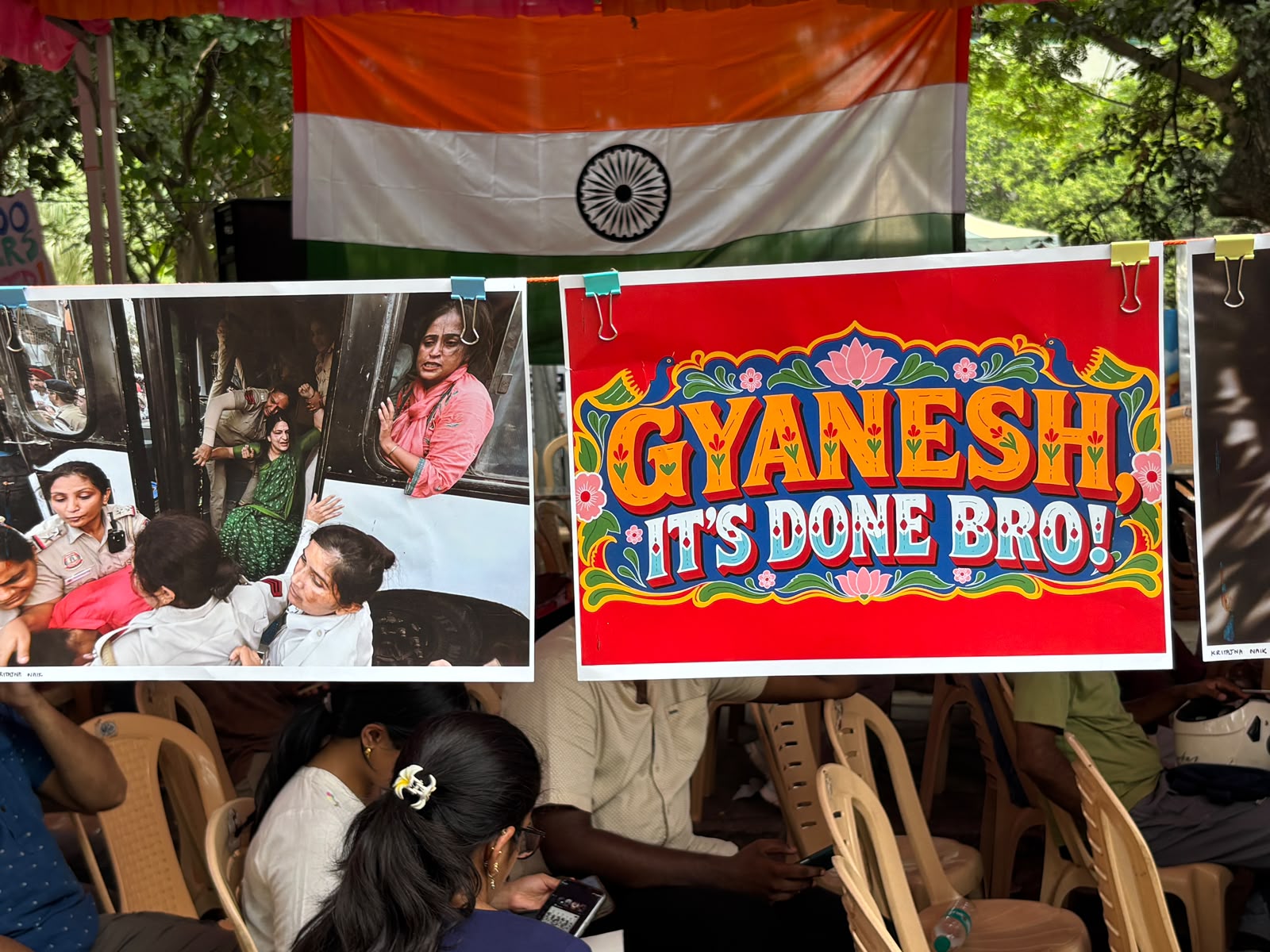
A satirical poster calls for Chief Election Commissioner Gyanesh Kumar to step down.

Today the contest is not between two alliances, two parties, or two leaders. It is between two projects of India, two ideas of India: an India of limited franchise and an India of universal franchise.
Even those who are in favour of the present political dispensation on account of their various predilections need to decide whether they are also in favour of limited franchise. And those who are not in favour of the dispensation but are also not favourably inclined towards the opposition alliance or any of its leaders too will have to decide if they are willing to give up an India based on universal franchise.
The anti-SIR movement need not be seen merely as a movement in favour of the INDIA bloc or against the NDA. It is not. It need not necessarily be in favour of Rahul Gandhi nor does it need to be against the Shah-Modi dispensation. The battle lines today are drawn elsewhere. Those lines should be recognised for what they are and where they are. Where does one stand on the question of universal vs limited franchise? That is the primary question India is facing. It is the foundational question, and it should be seen as such.
Every point of appreciation, satisfaction, support, and pride about the current dispensation will have to take a subordinate position in this contest. Similarly, every point of opposition, dislike, dissatisfaction, complaint with regard to the current Shah-Modi regime will have to take a subsidiary place. Similarly, every point of apprehension, misgiving, reservation, hesitation about the forces ranged against SIR will have to be placed on the back burner. Those who support or oppose the Shah-Modi dispensation and the combine of opposition alliance and civil society organisations will have to decide their respective positions on only one footing: whether they are for universal franchise or limited franchise.
Those who are in favour of limited franchise do not dare to show themselves and openly bat for it. They dress up their project of limited franchise as the cleaning up of the electoral roll by deleting the names of absent, shifted, duplicate and dead voters. The task of exposing this mission to ‘purify’ the electoral roll for what it is rests on the shoulders of the forces that champion the idea of universal franchise in India.
This, from now on, must be an open, bare-knuckled political fight for an idea of India; not a fight for who should sit in the government. The contest is not for the position of Prime Minister. India can no longer afford to be namby-pamby about it any longer. The Punch and Judy show of NDA vs INDIA bloc, Modi vs Rahul, should now stop. It has entertained the nation long enough. India can’t afford these prime-time television side shows anymore. It has had enough of this. It is time to get real and choose between universal franchise and limited franchise.
With nearly 14 crore names already excluded and the possibility of many more deletions before the cynical SIR exercise is completed, the issue is no longer a clean electoral roll vs an electoral roll with dead people and foreigners in it. Clear evidence is pouring in from different parts of the country continuously that the overwhelming majority of the deletions are malevolent when they’re not comical.
People who are alive are shown as dead. Those who were born in an area, grew up there, married and settled there, raised children and continued to live there are today shown as permanently shifted and are deleted. Those shifted people are not added to the electoral roll anywhere else. Neither the ECI nor the Union Home Ministry has released any official count of the detected infiltrators and foreigners.
The Home Ministry has told Parliament on record, repeatedly, that it has no data on illegal immigrants. The ECI is yet to make an announcement on the final tally of foreigners that it detected in the nearly 14 crore deletions. It has not complied with the 27 May 2026 directive of the Supreme Court to submit the list of detected foreigners to the Competent Authority constituted under the Citizenship Act, 1955.
While his Ministry tells Parliament that it has no data on illegal immigrants, the Home Minister announces at his political rallies that the SIR process has detected and deleted from the electoral roll about 3 crore ‘illegal infiltrators from Bangladesh’.
The ECI, it must be highlighted, has not given out any consolidated official figure of illegal immigrants or foreigners in the SIR exercise it has carried out in 26 states and union territories. Of the twenty-six, eleven CEOs responded to a media query about the number of foreigners detected in their respective states. Of them, six gave numbers. Those numbers added up in all to 1600 foreigners. Nearly all of them turned out to be Nepalese, and two each turned out to be from Afghanistan and Bangladesh.
The union minister of home affairs is wrong about Bangladeshi infiltrators by a margin of only 2,99,99,998 – that is 2 crore 99 lakhs 99 thousand 998. But if one assumes that the minister in charge of home affairs is unlikely not to know the actual numbers, he probably lied.
By now the unsuspecting initial hypotheses that the deletions are random and due to clerical oversight and bureaucratic inefficiency and that they are not targeted, stand totally refuted. That the deletions are targeted, executed mostly by the ECI itself in a centralised manner, and also in some small measure by the local functionaries of the ruling dispensation, is today clear.
It has also become plain that the preponderant majority of those deleted are Muslim and Christian minorities, Dalits, Adivasis, and daily wage and migrant labourers, as well as marginalised and voiceless people. And among these sections, it is women who bore the brunt of deletions.
Targeted deletions are part of a project: to create two classes of Indians, one with franchise and the other without franchise. The project is to hive off the targeted sections of the country’s population from its political society. The exercise to purify the electoral rolls is, in practice, intended to cleanse the country’s political society of the targeted sections.
It is nothing less than a bloodless political genocide. It is wrong to view SIR merely from an electoral point of view and speculate about which parties benefit from it and which parties are harmed. The project is much deeper than that. SIR, in many ways, is an afterlife of the now-buried CAA-NRC project. It intends to reconfigure the Indian Republic into a limited-franchise democracy.
The political contest today in the country is akin to the political contest in South Africa during the apartheid regime. The question there then was apartheid vs no-apartheid. It was not a question of FW De Klerk vs Nelson Mandela. It was not a question of the National Party vs the African National Congress. It was not a question of Whites vs Blacks. It was only a question of whether one was in favour of apartheid or opposed to it. India faces nearly an identical political question today: is this country for universal franchise or limited franchise? Like South Africa then, India too has its share of Chief Buthelezis now.
Every individual in the country, every platform, every social and cultural association, and every political party will have to undertake a deep examination of their political consciences and find out which side of the battle lines they ought to stand on at this hour of enormous significance for our Republic. They should not let any other consideration blur their vision. This deep search of conscience is even more urgently necessary for individuals in the Shah-Modi government, in the ruling party, in those alliance partners who are there merely for transactional reasons, those in the civil society, and for those former and serving bureaucrats and for those who are and were in the judiciary. It is time for them to stand up and be counted. They should give up the role of Chief Buthelezi.
The only question they need to put to themselves is: would we be able to sleep well at night when India is turned into a limited-franchise country because we remained indifferent, watched the drift as bystanders, played practical politics, contented ourselves with small bargains, or disliked those who were fighting to defend universal-franchise democracy, and did not join the resistance?
Also Read:
Lest we forget, India resisted Modi and his men long before the Gen-Z agitation
Karnataka’s voter roll needed cleaning, but it shouldn’t have lost 37 lakh real voters
(Parakala Prabhakar is a political economist and author of The Crooked Timber of New India. Edited by R Rajesh Kumar)



