

Published May 21, 2026 | 2:26 PM ⚊ Updated May 21, 2026 | 2:26 PM

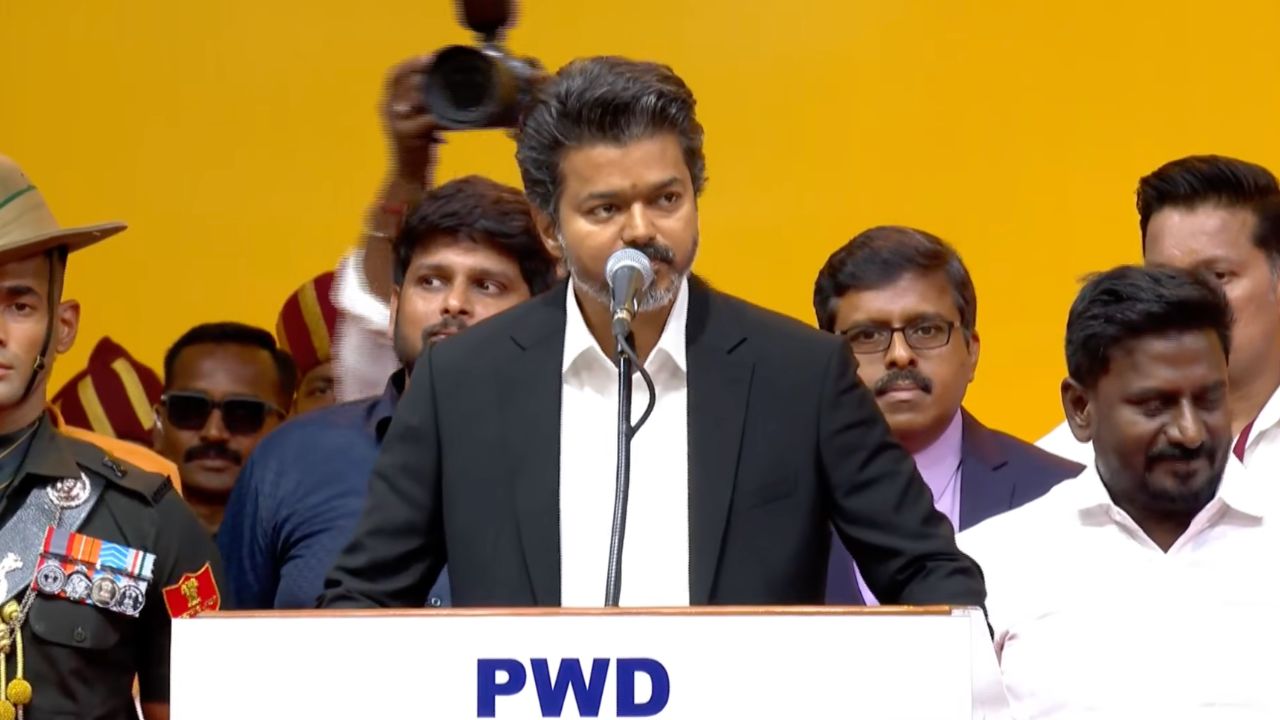
Vijay seen taking oath as the Chief Minister of Tamil Nadu on 10 May 2026. (File Image)

Synopsis: In 34 years, having acted in 68 films, averaging two a year, you likely barely had time to read film scripts. We can understand that you have not had time to study deep subjects like Sanatana Dharma. But after forming a government, it is disgraceful for a ruling party to speak on subjects about which it is ignorant, just as the opposition’s Udhayanidhi babbles. Your Muslim MLA and your ministers who spoke disparagingly about Sanatana are ignorant fools. (This editorial piece was written by S Gurumurthy and originally published on 16 May 2026 in the Tamil weekly magazine Thuglak.)
An open letter to Tamil Nadu Chief Minister C Joseph Vijay from S Gurumurthy, Editor of the Tamil weekly Thuglak:
Dear Mr Joseph Vijay,
To the nation’s surprise, and perhaps beyond even your own expectations, 35 percent of the people of Tamil Nadu voted for you, making you the Chief Minister. Having convinced the people that the DMK is an “evil force” [theeya sakthi] to secure this mandate, I pray to the Almighty that your administration proves to be a regime of good governance.
Politics is neither entertainment nor a spectacle like cinema. As a serious matter, it cannot be treated as a part-time pursuit. You must observe where Rahul, a part-time politician lacking seriousness, has led the Congress from where it once stood.
In politics, especially in your current position of power, those at the helm cannot even afford to sleep. This is not merely because you lack administrative experience, but because your party remains a mere crowd rather than a structured organisation, and your government lacks a simple majority, placing formidable challenges before you.
With limited administrative acumen and political experience, you and your colleagues must reflect deeply on how to govern with integrity and strategy while avoiding unnecessary conflicts. Instead, owing to the lack of competent advisers at the very outset, you have found yourself entangled in avoidable issues.
Also Read: The hijab order Karnataka got half right
When you took your oath of office, I was reminded of the moral dilemma [dharma-sangada] faced by Dharmaputra (Yudhisthira) upon ascending the throne after the Mahabharata war. Having won the war, he agonised over the realisation that “it is easy to oppose an unjust rule, but difficult to administer a moral one”.
Sri Krishna sent him to Bhishma Pitamaha, who was awaiting death on his bed of arrows, to learn the rules of Raja Dharma (statecraft) for good governance. Bhishma’s discourse on Raja Niti in the Shanti Parva of the Mahabharata is world renowned.
If you read it, you will understand, just as Yudhisthira did, that while it was easy to oppose the “evil” DMK rule, providing a “pure” administration [thooya aatchi] is an uphill task. We shall elaborate on this further. Your promise to provide a pure administration is going to be your greatest challenge. Having won by branding the DMK as evil, you require a party filled with pure and competent individuals as an alternative. You do not have that.
In politics, “pure” individuals are not easily found. It takes decades for a party to churn and refine such people, much like churning butter. Having leapt from cinema to politics, you do not have that kind of time. Consequently, you have attracted the same kind of people from the general public that other parties do.
Furthermore, you have imported members from other camps. Reportedly, 30 of the elected TVK MLAs have defected from the DMK, AIADMK and other parties. Of the rest, 90 percent are novices to politics. Your party is a crowd, not a structured organisation built on the foundations of disciplined hierarchy and long-term relationships.
This is precisely why you claimed, “I am the sole power centre.” No leader of a properly structured party would say such a thing, nor would the party accept it. By declaring “I alone”, you have ensured that no one within your party will be respected besides yourself. Will even high-ranking officials respect them? It is doubtful.
Your announcement betrays the fact that a party lacking a disciplined, naturally grown structure is a burden to you. Moreover, corruption has permeated the administration over the last 60 years of rule. By claiming total authority, every responsibility, and every blame, will fall squarely on you. We write this to warn you, citing examples of the challenges inherent in this enigmatic situation, against “buying” unnecessary trouble.
Also Read: Beyond numbers: Reimagining justice for women in India
In our previous editorial, we stated that we would monitor and critique your governance. This applies to all new administrations. However, your party, your government, and even you are new to politics. Not only that, many critics view you and your rule as an “unsolved enigma”.
From the transition of dhotis and shirts to trousers and T-shirts, and now to wearing coats, your attire, gait and mannerisms are new to Tamil Nadu politics. It heralds your claim: “I am different.”
Beyond that, you have vowed to replace an “evil” rule with a “pure” one. The two Dravidian parties that have ruled and divided Tamil Nadu for 60 years never promised “pure” governance. Against this backdrop, your unexpected victory, having defeated both, has created expectations among the Tamil people, who are weary of the Dravidian parties, that they have not held for six decades.
You may be “different”, but your party is not. As mentioned, a significant portion consists of those steeped in corrupt party cultures who sought refuge with you for political survival. Others are entirely new. Where did your MLAs come from? Reflect. They are the product of a society eroded by 60 years of Dravidian ideology.
The Dravidian regimes removed ethical texts like Aathichoodi, Konraivendhan and Nannool, which traditionally instilled virtues in children, from schools. Consequently, two generations of Tamil society lack an education that fosters honesty, integrity, humility and character. Furthermore, your party is largely populated by the “latest generation” immersed in social media, specifically those who cheer for you.
The rigorous training that disciplined organisations like the old Congress, Communist parties or the RSS provide their members is absent in your party, which has come to power suddenly and surprisingly.
In this context, it is our duty to remind you of how heavy the burden of public expectation is. We wish to express our views and concerns because, from the very day you sought the House’s confidence, trends contrary to those expectations have emerged from your side. Whether you will read this, I do not know.
You have raised immense expectations among the people. High expectations often lead to deep disappointment. Here are two examples of the democratic consequences of failing to meet public expectations. The Congress ruled stably at the Centre for 30 years.
At its end, the “sudden” Janata Party, formed by the hasty merger of four parties, achieved a massive victory in the 1977 elections, toppling the Indira Gandhi government that had ruled tyrannically during the Emergency.
There was a huge expectation that it would provide a stable government. However, the Janata Party remained a loose coalition of four entities. It fractured, the government collapsed, and public hope turned to resentment. Consequently, Indira Gandhi, whom everyone thought was politically finished, returned with a massive victory in 1980. The Janata Party, which came to power by opposing Indira, failed in the art of cohesive and efficient governance.
Next, Rajiv Gandhi, who won a staggering 414 out of 542 seats in the 1984 Lok Sabha elections, promised, much like you, to provide a pure administration by eliminating “brokers” from his party. Immense expectations surrounded him. For two years, the world hailed him as “Mr Clean”. It seemed he faced no opposition.
But a single allegation of corruption, the Bofors scandal, became a dark stain. The result: the people, feeling betrayed by the man who claimed to be pure, defeated him in 1989. Not only that, the Congress, once an immovable force, began a decline that has left it today like an elephant reduced to the size of an ant.
Also Read: The minister who sat on a stove and turned up the flame
The media has not sufficiently discussed the profound shift that occurred in Tamil Nadu politics in this election. Let me explain. In a state where 87.5 percent of the population is Hindu, your election, after proudly declaring “I am a Christian”, is no ordinary electoral result.
It reflects the immense broad-mindedness of the Hindus. Your heart should acknowledge this. If not, it is a misfortune. Usually, Christian politicians in Tamil Nadu hide their identity behind Hindu names, for example former Speaker Appavu, former Ministers M Thambidurai and Anita Radhakrishnan, or your own Minister Aadhav Arjuna.
By getting elected while openly identifying as a Christian, you have demonstrated to them that there is no need to hide one’s faith before the broad-minded Hindu majority. While you were famous in cinema as “Vijay”, a Hindu name, becoming “Joseph Vijay” in politics shows your Christian conviction. It has shattered the “pseudo-secularism” that claims minorities need protection from the Hindu majority.
The fact that you, a member of a minority community, became Chief Minister proves that minorities face no threat from the majority. Moreover, the majority Hindus have accepted you.
Therefore, you must realise that the slogan of “protecting the minorities” does not apply to a government led by Joseph Vijay. Since you, the Chief Minister, are a minority, you must realise you are responsible for every section of the diverse Hindu majority. Your rule is not that of the pseudo-secular Dravidian parties that deceive minorities with “protection” rhetoric. Your rule is one where you, a minority, exercise total power.
You claim to be common to Hindus, Christians and Muslims alike. Yet your Minister Aadhav Arjuna, also a Christian, claims this is a “regime to protect minorities”. This irrelevant, outdated slogan carries no weight under your leadership. It is, in fact, absurd. “Joseph Vijay in power” and “a government to protect minorities” are contradictory statements.
The brand of secularism that focuses on “minority protection” is not based on the principle that all religions are equal. It is a blatant lie that has been exposed as veiled Hindu hatred and vote-bank politics. Regarding politics and governance, you must keep in mind that you are not just Vijay, but Joseph Vijay.
In this context, at the very moment your government is beginning its journey, you and your party have fallen into the “anti-Sanatana” fraudulent political mousetrap of the DMK, a party with an inherent DNA of Hindu hatred, disguised as pseudo-secularism. Let me explain how dangerous this is for you.
When Udhayanidhi Stalin compared Sanatana Dharma to dengue and malaria and called for its eradication, the Supreme Court condemned it as an abuse of free speech. Facing criminal cases, Udhayanidhi stopped such rhetoric in public. Now, as the Leader of the Opposition, he used his very first speech in the Assembly to call for the eradication of Sanatana Dharma.
Someone likely advised him strategically that he could not be prosecuted for words spoken inside the Assembly. He set this “anti-Sanatana” trap before you, and you fell for it.
You remained silent while he spoke. Emboldened by this, a Muslim MLA from your own party went a step further and absurdly claimed, “We have come only to destroy Sanatana Dharma.” You did not condemn it. Your Minister Aadhav Arjuna practically endorsed Udhayanidhi’s opposition to Sanatana. Because of your silence while your colleagues spoke in this manner, it is natural for an impression to form among Hindus that you, too, are an enemy of Sanatana Dharma.
Falling into this unnecessary anti-Sanatana trap on the very first day of your administration shows a lack of maturity. You could have easily avoided this mess. How? Let me tell you. Cases regarding Udhayanidhi’s anti-Sanatana remarks are pending in the courts. It is a long-standing parliamentary and Assembly tradition that matters sub judice, pending in court, should not be discussed or debated in the House.
Had you possessed a competent and strategic adviser, they would have sent a note to you and the Speaker citing this tradition the moment Udhayanidhi breached it. By pointing out this tradition, you or someone from your party could have raised a Point of Order to object and stop him, or the Speaker himself could, and should, have intervened.
Even if you failed to stop him, you could have had his remarks expunged from the House records. Even if Udhayanidhi’s vitriol against Sanatana Dharma was “music to your ears”, you should have stopped it because it violated House rules. Your failure to do so is a black mark against you.
Also Read: Modi’s austerity call: Proof of governance failure or prudent crisis management?
In 34 years, having acted in 68 films, averaging two a year, you likely barely had time to read film scripts. We can understand that you have not had time to study deep subjects like Sanatana Dharma. But after forming a government, it is disgraceful for a ruling party to speak on subjects about which it is ignorant, just as the opposition’s Udhayanidhi babbles. Your Muslim MLA and your ministers who spoke disparagingly about Sanatana are ignorant fools [vada-vivaadha tharkurigul].
Even if they knew nothing of the subject, your MLA or Minister could have searched Google to see what Sangam literature, the Thirukkural, and great sages have said about Sanatana. You could do the same. Sangam works like Purananuru, Pathitrupathu, Paripaadal, Thirumurugatruppadai, Madurai Kanchi and Mullai Paattu, as well as the Thirukkural, revere Sanatana.
This is why EVR (Periyar), who opposed Sanatana, spoke disparagingly of Tamil texts, Valluvar and Tamil poets. Do you, who revere Periyar, know this?
Vallalar revered the Advaita philosophy, which is the source of Sanatana. Are you aware of this? Gandhi proudly declared, “I am a Sanatani Hindu.” Did you know that? Sri Aurobindo said Sanatana Dharma is the very life of our nation, and that as long as it exists, Bharat will exist. Have you heard this?
Swami Vivekananda proclaimed to the world that Sanatana Dharma is the heartbeat of our country. Are you aware of this? Has anyone told you that Bharatiyar praised Sanatana Dharma? Thuglak has explained all of this with evidence many times. You likely do not have the habit of reading Thuglak.
Your Minister Aadhav Arjuna, fancying himself a great intellectual, has pontificated: “We are enemies of Hindutva, not of Hindus.” Because of his ignorant babbling, it has become our duty to provide an elementary lesson to him, and through him to you, on what Hindutva, Hindu religion and Hindus mean in the eyes of the Constitution.
In the 1991 elections, the BJP and Shiv Sena contested and won 84 seats claiming Hindutva as their spiritual-political ideology. A case was filed seeking to annul their election, arguing that Hindutva refers to the Hindu religion and is therefore communal politics seeking votes on religious grounds.
Resolving this, the Supreme Court ruled that Hindu religion and Hindutva cannot be confined within a narrow religious definition. It held that both are the ancient “way of life”, cultural foundations and “lifestyle” of our nation. The case was dismissed.
This judgment came in 1996, during a Congress regime. Between 2004 and 2014, under another Congress regime, several petitions were filed seeking reconsideration of this decision. But finally, in 2016, a seven-judge bench refused to review that ruling. The 1995 Supreme Court decision was not a new one; it was based on prior judgments.
When a Chennai businessman who had married a German Christian woman died, his Christian son claimed the inherited property was Hindu ancestral property. In 1976, a five-judge bench accepted the son’s argument that “I, a Christian, am a cultural Hindu”, stating that the Hindu religion is not merely a faith like Christianity or Islam, but a cultural stream.
Therefore, “Hindutva” has no narrow meaning in the Constitution. It only has a narrow meaning in vote-bank politics, which your “Brihaspati” [an ironic reference to a wise counsellor] Minister does not understand. Tell your ministers that, having become ministers, they must study these nuanced subjects before they speak. You should read about them too. If you continue to speak without reading, like Udhayanidhi, there will be no difference between your government and its arch-enemy, the DMK.
In the next issue, we shall discuss the primary problems facing you as you remain entangled in these unnecessary distractions.
(This editorial piece was originally published on 16 May 2026 in the Tamil weekly magazine Thuglak. It has been reproduced with permission.)



