

Published May 19, 2026 | 2:26 PM ⚊ Updated May 19, 2026 | 2:26 PM

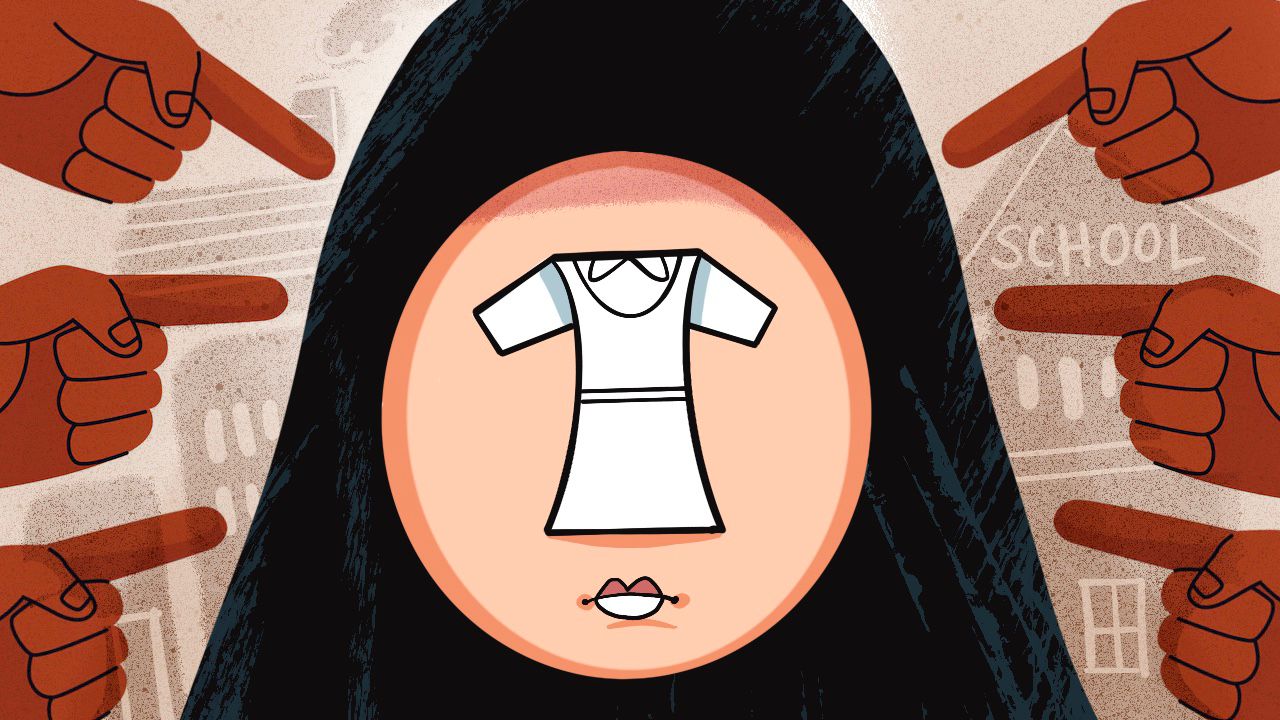
In 2022, the Basavaraj Bommai government banned the hijab in classrooms, stating it “disturb[s] equality, integrity and public law.”

Synopsis: The Siddaramaiah government’s 13 May order withdrawing Karnataka’s 2022 hijab ban is a constitutionally grounded decision taken in defence of students whose education the state had an obligation to protect. The order has, however, drawn predictable opposition. The BJP has alleged minority appeasement and selective secularism. Giving the students the choice to wear hijab with colours that match the uniform demonstrates that the revocation of the hijab ban was always about a student’s right to her classroom, not the political contest being fought over her head.
The Siddaramaiah government’s 13 May order withdrawing Karnataka’s 2022 hijab ban is a constitutionally grounded decision taken in defence of students whose education the state had an obligation to protect. The Karnataka Ministry of Primary and Secondary Education had itself placed on record that 1,010 hijab-wearing girls dropped out of pre-university colleges following the ban. Muslim enrolment in government pre-university colleges in Udupi, the epicentre of the controversy, fell by nearly half between 2021-22 and 2022-23.
The People’s Union for Civil Liberties, Karnataka, documented in Closing the Gates to Education the systematic harassment and exam exclusions that produced these numbers. The order corrects that record.
Its constitutional footing is equally firm. Justice Sudhanshu Dhulia, in the Supreme Court’s October 2022 split verdict, held that demanding Muslim girls remove their hijabs at the school gate constituted an invasion of privacy, an attack on dignity, and a denial of secular education, in violation of Articles 19(1)(a), 21, and 25(1) of the Constitution.
The new order also carries notable constitutional symmetry: by listing Hindu, Sikh, and Muslim religious markers together as permissible, it rests the state’s secular obligation on equal treatment across faiths rather than on the removal of faith from institutional life.
Also Read: Karnataka revokes BJP-era hijab ban, allows limited religious symbols in classrooms
The order has, however, drawn predictable opposition. The BJP has alleged minority appeasement and selective secularism. Sri Rama Sene announced statewide protests and is exploring a public interest litigation (PIL). The government has defended itself by arguing that the revised dress code is consistent with the framework followed in Kendriya Vidyalayas run by the Union government.
That defence was only strengthened by what immediately preceded the order. At Karnataka Common Entrance Test (KCET) examination centres in April 2026, students were asked to remove their sacred threads before entering examination halls, an incident that drew condemnation across the political spectrum and made clear that the 2022 framework was being applied in ways that harmed students of every faith, not only Muslim girls wearing hijabs.
But a more precise design choice at the drafting stage could have considerably narrowed the space for the BJP’s more structural objection.
That objection turns on one practical distinction that the order does not draw. The symbols the order lists as permissible are not equivalent in their relationship to the school uniform.
A rudrakshi around the neck, a janivara across the torso, a shivadara at the wrist; none of these disrupts the visual uniformity the dress code maintains. A headscarf worn in a colour contrasting with the school uniform does.
The BJP’s claim that the order reintroduces visible religious differentiation at institutions built around a common dress code is, on this specific point, not without basis. By leaving it unaddressed, the order gives that argument more room than it deserves.
Also Read: Two dress code rows, two different outcomes in Karnataka
The students of Udupi had themselves identified a workable resolution four years ago. They offered to cover their heads using that already formed part of their prescribed uniform, a headscarf in school colours and tonally continuous with the rest of what they wore. That proposal was refused.
A student wearing a headscarf matching her uniform colour enters the classroom wearing, by every visual measure, her prescribed uniform. Her religious practice is preserved. The dress code is maintained. And the argument that her presence signals communal rather than student identity does not arise, because there is nothing to visually distinguish her from any other student in that uniform.
The split verdict in Aishat Shifa v State of Karnataka need not, on this reading, have presented a binary choice between institutional uniformity and religious freedom. Justice Gupta held that “the concept of fraternity will stand fragmented as the apparent distinction of some of the students wearing a headscarf would not form a homogenous group of students in a school where education is to be imparted homogeneously and equally, irrespective of any religious identification mark.”
Justice Dhulia held that asking girls to remove their hijab at the school gate was “first an invasion on their privacy, then an attack on their dignity, and then ultimately a denial to them of secular education.” A headscarf in the uniform’s own colour satisfies both: It removes the visibility that concerned Justice Gupta while preserving the practice that Justice Dhulia held to be constitutionally protected, and it is a formulation under which minority religious freedom and institutional integration are not in irresolvable tension.
The Siddaramaiah government has honoured a commitment it made in opposition and restored educational access to students who had been wrongly denied it. A supplementary instruction on headscarf colours would complete what this order has started, and demonstrate that the revocation of the hijab ban was always about a student’s right to her classroom, not the political contest being fought over her head.
(Jehosh Paul is a lawyer and former political consultant)



