
Published Oct 06, 2026 | 7:00 AM ⚊ Updated Oct 06, 2026 | 8:12 AM

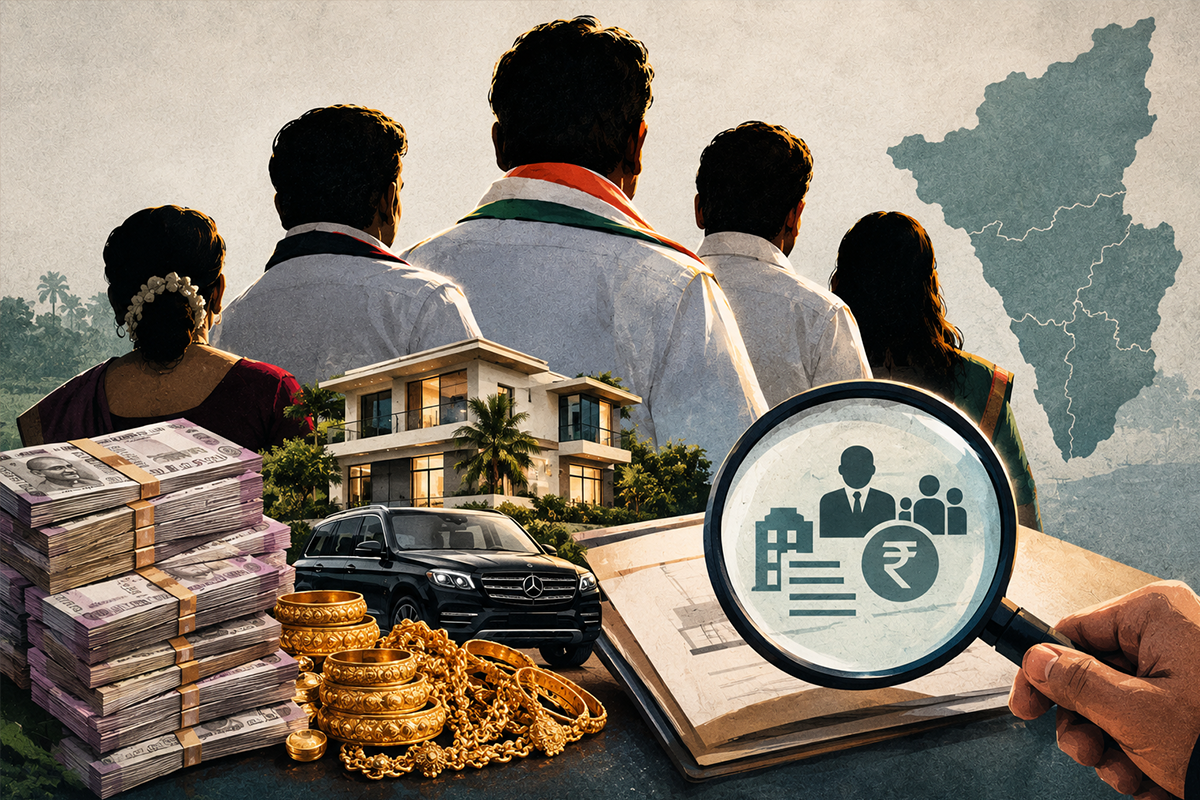
Image used for representational purpose only. (AI generated image)

Synopsis: Andhra Pradesh’s Chandra Sekhar Pemmasani declared assets of about ₹5,705 crore, while Telangana’s Konda Vishweshwar Reddy declared approximately ₹4,568 crore. That is okay when accounted for. The trouble is when the wealth of those in power grows faster than public confidence in its origins. Transparency then is no longer optional.
Is public office becoming a pathway to private wealth? The question is being endlessly debated in India. And understandably so.
When political leaders and their families command fortunes running into hundreds or thousands of crores, it becomes essential to know whether their wealth can be explained, independently verified, and shown to be unconnected to the misuse of political power.
India has never barred wealthy people from entering politics. Wealth acquired legitimately through business, inheritance, investments or professional success cannot be treated as corruption merely because its owner becomes a politician. The danger begins when political authority and private economic interests overlap, when family networks benefit from public decisions, or when political influence shields unexplained wealth.
The contrast is striking. A Member of Parliament or legislator receives a legitimate salary and allowances, yet some politicians declare assets worth hundreds or thousands of crores.
According to the Association for Democratic Reforms, 504 of the 543 MPs elected in 2024, or 93 per cent, declared assets exceeding ₹1 crore. Andhra Pradesh’s Chandra Sekhar Pemmasani declared assets of about ₹5,705 crore, while Telangana’s Konda Vishweshwar Reddy declared approximately ₹4,568 crore. Both have substantial business backgrounds. Their cases demonstrate that extraordinary political wealth does not necessarily originate in politics, but they also underline why the sources, ownership structures and growth of such wealth must be transparent.
Southern India provides several such examples. Karnataka Deputy Chief Minister DK Shivakumar has declared assets exceeding ₹1,400 crore, while Andhra Pradesh Chief Minister N Chandrababu Naidu has declared assets running into hundreds of crores. The issue is not their wealth alone. It is whether these assets can be explained through legitimate, documented sources and whether their public positions have had any improper bearing on their accumulation.
Telangana makes the question particularly relevant.
The Association of Democratic Reforms (ADR) analysis of the 2023 Assembly election affidavits found that 114 of the State’s 119 MLAs declared assets exceeding ₹1 crore. The average declared assets of Congress MLAs were about ₹48.20 crore, compared with ₹32.62 crore for BRS legislators and ₹21.83 crore for BJP legislators.
Congress leaders Gaddam Vivekanand and Ponguleti Srinivasa Reddy declared assets exceeding ₹600 crore and ₹430 crore respectively. The average assets of 103 re-contesting MLAs increased from ₹14.44 crore in 2018 to ₹23.87 crore in 2023, nearly 65 per cent.
These figures do not prove corruption. They do, however, establish a compelling case for systematic scrutiny. An election affidavit is a starting point for accountability, not a verdict on integrity. Disclosure must lead to verification.
The debate has become sharper as Telangana’s parties trade allegations over wealth accumulation.
Chief Minister A Revanth Reddy has targeted former Chief Minister K Chandrashekar Rao and his family over alleged landholdings around the Erravalli farmhouse. In September, Revanth alleged in the Assembly that around 700 acres in the area were under the control of the KCR family and that approximately 388 acres involved government land. The BRS rejected this.
Until official records establish the facts, allegations cannot be treated as proven possession. But claims involving public land and political families cannot be dismissed as mere partisan exchanges; they require transparent examination.
The controversy has also reached Revanth Reddy’s family. BRS spokesperson Manne Krishank has alleged that the Chief Minister’s family accumulated business interests and assets worth more than ₹50,000 crore. He has questioned alleged business ventures involving Revanth’s daughter, Anumula Nymisha Reddy. The allegations also concern alleged associations with healthcare and pharmaceutical businesses.
These claims require the same caveat and the same standard of scrutiny. An allegation is not proof. A politician’s relative engaging in business is not automatically an abuse of political power. Nor can family-linked company or property values be equated casually with personal wealth.
What matters is beneficial ownership, investment sources, valuation, corporate records, tax compliance and whether public authority was used to confer improper advantage. The principle must be simple: political families are entitled to conduct legitimate business, but political influence must not become an invisible source of private enrichment.
The controversy over government land allegedly allotted to a company linked by the opposition to Revanth’s brother illustrates why scrutiny matters. If public land is transferred to a private entity at a concessional rate, citizens deserve to know the valuation, eligibility criteria, process and policy rationale. Such decisions must withstand independent review, regardless of which party is in power.
This principle must apply equally to the ruling party and opposition. A government cannot demand transparency from political rivals while resisting questions about its own leaders and families. Opposition parties, equally, cannot turn every increase in property or family business into proof of corruption. Selective outrage protects the political class; consistent verification protects the public.
There is another danger. Wealth is increasingly becoming part of the electoral ecosystem. Financially powerful candidates possess advantages unavailable to ordinary aspirants. If parties increasingly prefer candidates who can finance their campaigns, democratic representation can become skewed towards economic privilege. Politics then risks becoming not merely a route to power, but a system in which power and wealth reinforce each other.
India already has an important transparency mechanism through mandatory election affidavits. But disclosure without verification is incomplete accountability. Asset declarations need credible scrutiny, political funding requires greater transparency, and investigations must be independent. Beneficial ownership, related-party transactions, land transfers and sudden increases in declared wealth should be examined through institutions insulated from political pressure.
The real issue is not whether a politician owns ₹10 crore or ₹1,000 crore. It is whether the wealth can be explained, documented and independently verified, and whether public power contributed improperly to its creation. Wealth is not itself evidence of wrongdoing; unexplained wealth in the vicinity of political power is a legitimate matter of public concern.
Politics should not punish legitimate prosperity. But political status should not provide a protective wall around unexplained wealth. In Telangana, as elsewhere, the answer cannot lie in competing allegations over who is richer. It must lie in records, audits, investigations and facts applied equally to every party and every political family.
Public office is an opportunity to exercise power on behalf of citizens, not an investment vehicle for political families. When the wealth of those in power grows faster than public confidence in its origins, transparency is no longer optional. It becomes the minimum condition for democratic credibility.
Also Read:
Telangana tangle: When thieves fall out, the truth comes out!
Telangana: A state rich in corruption
(Edited by R Rajesh Kumar.)



