

Published Sep 22, 2026 | 12:15 PM ⚊ Updated Sep 22, 2026 | 12:15 PM

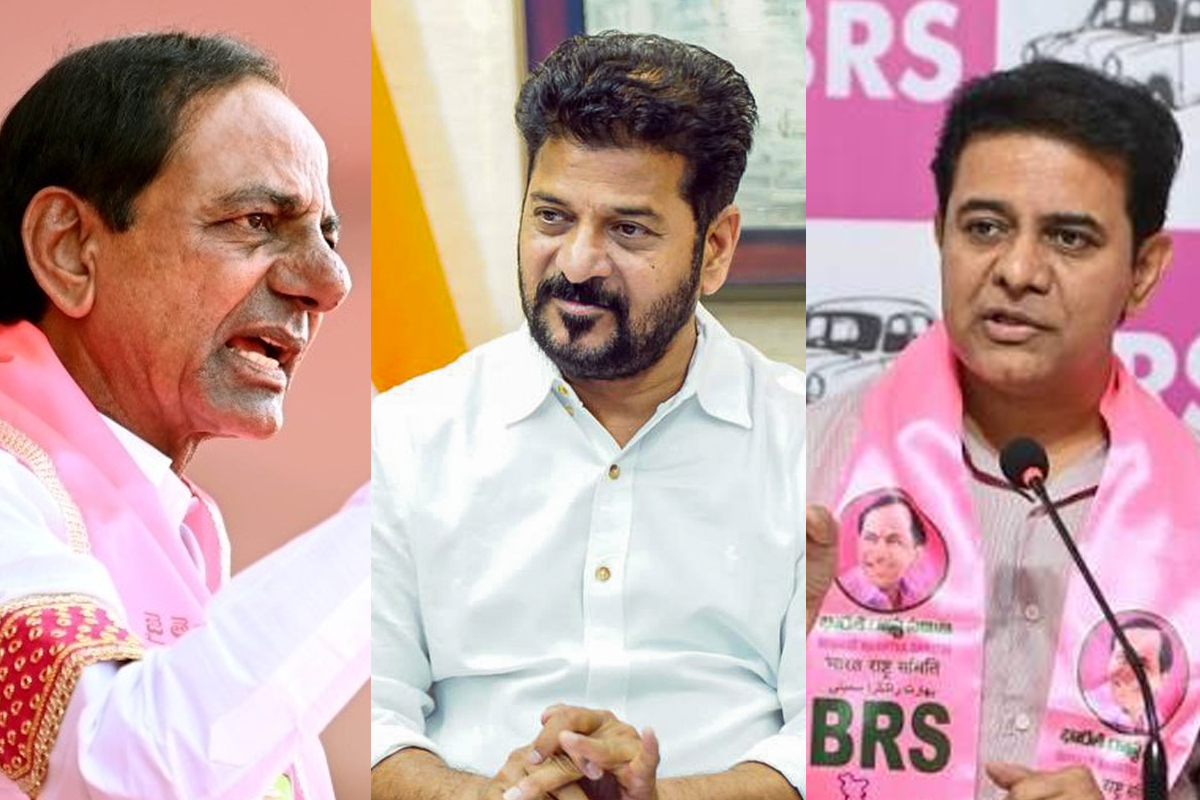
K Chandrasekhar Rao, Revanth Reddy and K T Rama Rao.

Synopsis: A recent Assembly debate and counter-charges have revived questions over whether the Telangana movement fought in the name of the poor and landless ultimately left vast tracts of land in the hands of powerful families. The standoff has also exposed deeper questions about transparency, accountability and whether land governance can escape the politics of selective outrage.
The recent debate in the Telangana Legislative Assembly has turned land ownership into one of the most charged political issues in the state.
Chief Minister A Revanth Reddy’s detailed presentation of alleged land holdings linked to former Chief Minister K Chandrashekar Rao (KCR), his son KT Rama Rao (KTR), nephew T Harish Rao and other Bharat Rashtra Samithi (BRS) leaders has triggered intense discussion. What began as a discussion on Section 22-A prohibited lands quickly expanded into mutual accusations of large-scale accumulation, ceiling violations and alleged misuse of digital land records. The episode has exposed deeper structural weaknesses in land governance while underlining how land continues to function as both an economic asset and a political weapon.
Revanth Reddy placed before the House figures claiming that members of the Kalvakuntla extended family and close associates held roughly 439 acres across nine districts, 24 mandals and 31 villages.
According to the Chief Minister, KCR and his wife held about 67 acres in Siddipet district villages, exceeding the agricultural land ceiling limits prescribed under the Telangana Land Reforms Act.
KTR’s family was listed at approximately 123 acres, Harish Rao’s family at around 30 acres, Kalvakuntla Kavitha’s family at 37 acres, and Joginapally Santosh Kumar’s family at about 79 acres, with further parcels attributed to other relatives.
The most striking claim concerned the Erravelli farmhouse, described as spanning nearly 700 acres, of which 388 acres were allegedly assigned government land originally meant for landless and Dalit families. Revanth Reddy alleged that the Dharani portal, introduced during BRS rule, had been used to identify and regularise such lands.
He ordered a fact-finding inquiry, directed notices to the former Chief Minister, and promised that any recovered assigned land would be redistributed to the poor. He framed the accumulation as having occurred during and after the Telangana statehood agitation and valued the overall alleged irregularities in the range of ₹1 lakh crore.
BRS leaders responded with equal force. Harish Rao dismissed the figures as inconsistent with earlier exaggerated claims of a 1,000-acre farmhouse and noted that the Chief Minister had now settled on far lower numbers for the core Erravelli holdings. He insisted that the lands in question were either disclosed in election affidavits or acquired legitimately, rejected the assigned-land characterisation, and demanded a judicial probe by a sitting Supreme Court judge into both the KCR family’s holdings and those of the Revanth Reddy family.
Harish Rao counter-alleged that the Chief Minister’s family held around 308 acres across villages such as Kotra and Kondareddypalli, citing documents for portions of that total and questioning incomplete disclosures in affidavits. KTR challenged the Chief Minister to deposit ₹1 lakh crore for the poor in exchange for the family’s transfer of all its land, while demanding a white paper on government lands and accusing the Congress government of diverting attention from pressing issues such as farmer distress, power cuts and irrigation problems. BRS leaders also highlighted the sharp expansion of the 22-A prohibited list and irregularities under the new Bhu Bharati system.
The controversy is not confined to the top BRS leadership. Congress legislators and MPs have inspected farmhouses and lands linked to various BRS figures in Siddipet, Janwada, Aziznagar and Moinabad, questioning the sources of acquisition and whether certain properties involved assigned or restricted lands.
Parallel allegations continue to surface against leaders across parties, including earlier claims by Harish Rao of a major government-land dispute in Nadergul involving hundreds of acres, and BRS protests over land allotments allegedly favouring companies linked to the Chief Minister’s relatives.
BJP leaders have also demanded recovery of lands allegedly encroached during the previous regime. This pattern of reciprocal charges reveals a long-standing culture in which political influence is widely perceived to intersect with land dealings.
Across the state, public conversation has largely turned critical of the previous BRS regime. In tea stalls, village gatherings, social media discussions and local debates, many ordinary citizens express strong resentment toward what they see as the “land thirst” of the earlier ruling party’s top leaders.
A significant section of people argue that while the Telangana movement was fought in the name of the poor and landless, a handful of powerful families allegedly accumulated vast tracts of land, including assigned government parcels meant for Dalits and marginal farmers. There is widespread anger that the Dharani system, introduced with promises of transparency, was allegedly used to regularise questionable holdings.
Farmers and landless families in particular voice the view that the previous government protected the interests of the powerful while ordinary assignees struggled with insecure titles. Many welcome the current disclosures as a necessary exposure and hope that any recovered land will finally reach the intended beneficiaries rather than remaining a political talking point. The dominant public sentiment is one of disappointment with the previous regime’s record on land equity, coupled with a demand that the present government move beyond rhetoric and deliver actual redistribution and accountability.
Analytically, the intensity of the current debate stems from multiple overlapping factors. Land ceilings and assignment rules were enacted precisely to prevent the concentration of agricultural holdings in a few hands and to protect the landless poor. When credible allegations emerge that these limits were systematically breached by those who once held the highest political offices, it strikes at the core of the social contract that underpins land reform legislation.
The Telangana Land Reforms (Ceiling on Agricultural Holdings) Act was never intended as a symbolic gesture; it was designed to redistribute excess land and create a more equitable agrarian structure. Any large-scale deviation from these norms, if proven, represents not merely an administrative lapse but a betrayal of the reformist promise that successive governments have claimed to uphold.
Equally significant is the role of digital land administration. The Dharani portal was projected as a modern solution to age-old problems of incomplete records, multiple claims and corruption. Yet the current controversy demonstrates how technology, without robust institutional safeguards and independent oversight, can become a tool for consolidating rather than democratising control over land.
When political actors of any hue are perceived to have influenced mutations, regularisations or the classification of assigned lands, public trust in the entire system erodes. The subsequent expansion of the Section 22-A prohibited list and the introduction of Bhu Bharati have only compounded the sense of uncertainty among ordinary title holders, many of whom find their legitimate properties suddenly locked in bureaucratic limbo.
Election affidavits, though imperfect, remain one of the few public instruments of transparency available to citizens. Significant growth in declared land holdings between successive electoral cycles, particularly among those who exercised executive power, inevitably invites scrutiny about the sources of such expansion. While not every increase is illegal, the absence of clear, contemporaneous explanations fuels suspicion. In a state where land is both a livelihood resource and a status symbol, unexplained accumulation by political families carries heavy symbolic weight.
The political timing of the disclosures cannot be ignored. Ruling parties have historically used land-related allegations to weaken their predecessors, just as opposition parties have used similar charges to question the integrity of those in power. This cycle of selective outrage undermines the possibility of genuine institutional reform. What Telangana requires is not another round of partisan score-settling but a transparent, time-bound process of verification that applies the same standards to all political families, past and present. Independent fact-finding teams, judicial scrutiny where necessary, and the public release of detailed white papers on both high-value political holdings and the status of prohibited lands would go further in restoring credibility than competing press conferences.
Ultimately, land remains Telangana’s most contested resource, binding questions of equity, development and democratic legitimacy. The Assembly controversy has illuminated alleged concentrations around influential families of the previous ruling party and the readiness of the present government to publicise them. Whether the outcome is genuine recovery of wrongly alienated assigned lands, enforcement of ceiling laws, and meaningful redistribution, or merely another cycle of accusation and counter-accusation, will determine if land governance moves toward greater transparency or remains trapped in the politics of selective outrage. Citizens are watching closely. They expect accountability that is consistent, not merely convenient to whichever party currently holds the microphone.
Also Read:
Telangana’s quiet double-engine Sarkar — Part 3: What the Congress and BJP protect
Even a dead worker’s family wasn’t spared: The decline and fall of Telangana’s police
Ageing India, faster-ageing Telangana: Opportunity or trouble?
(Views are personal.)



