

Published Sep 12, 2026 | 9:30 AM ⚊ Updated Sep 12, 2026 | 9:30 AM

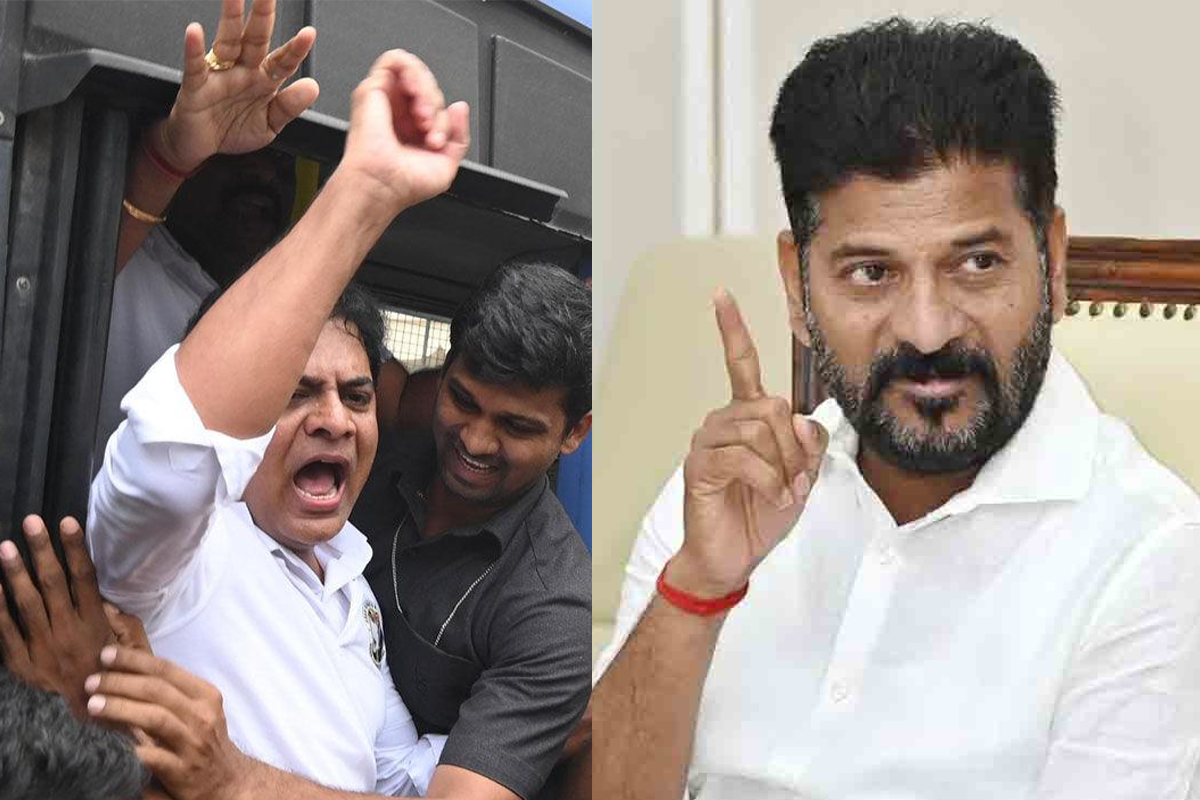
BRS working President KT Rama Rao and Telangana CM Revanth Reddy.

Synopsis: Telangana is suffering from a host of problems today. Sadly, the real issues have simply been thrown to the wind. For every social, political or economic problem, the answer is being given through the police.
When a Legislative Assembly session is announced, we normally expect important issues to come up for discussion, the Opposition to question the government over its neglect of people’s problems, and the government to respond.
The Telangana Assembly’s monsoon session began on Monday, September 7. Though the session is expected to last a week, the first three days have been consumed by protests and police repression, with hardly any substantive business taking place.
On Wednesday, 22 MLAs belonging to the Opposition Bharat Rashtra Samithi (BRS) were suspended for the remainder of the session. This means that the Opposition has effectively been denied any opportunity to raise people’s problems during the remaining days. The ruling party’s members, in any case, do not raise people’s problems. Even when they do, they boast about how wonderfully they have performed and pretend that people have no problems at all. The real issues, therefore, have simply been thrown to the wind.
The fact is that Telangana is suffering from a host of problems today. The Congress government, having completed 1,000 days in office, has not merely failed to fulfil its 2023 election promises; it has created a host of new problems. Not one of the six guarantees promised within 100 days has been fully implemented. As for the seventh guarantee personally promised by the Chief Minister—the restoration of democracy—the experience of these three days alone shows how little of it has actually been implemented.
There are numerous urgent issues that should be discussed in the Assembly and for which solutions should be devised and implemented. Among them are lands placed under the 22-A prohibited category, pending fee-reimbursement dues, the agitation by polytechnic students, drought, agricultural problems, unemployment, pensioners’ problems, the merger of the Road Transport Corporation with the government, and law and order.
Thousands of landowners around Hyderabad have been protesting that their private lands were declared prohibited under Section 22-A without proper procedure, due statutory process or notice. When the agitation reached a peak, the government tried to pacify the protesters with a few token assurances. But there is neither any visible attempt nor any intention to go to the root of the problem and resolve it.
Thousands of crores of rupees in fee-reimbursement dues have accumulated. Private college managements are harassing students and their parents, yet the government has not even begun to provide minimum relief. When polytechnic colleges were sought to be brought under the Young India Skills University, leaving the question of engineering admissions in a state of uncertainty, polytechnic students launched a major agitation. Some token assurances were given then too, but there is still no permanent solution.
Agriculture, the lifeline of the state’s economy, is likely to face an extremely difficult year. Rainfall during the past three months has been below the normal average. The Krishna, Godavari and other smaller rivers have not received adequate inflows. With groundwater reserves not being adequately replenished, the state is likely to face severe water scarcity once again before the next monsoon. Corruption and mismanagement in the old irrigation projects add to the problem. Meanwhile, despite grand announcements of new irrigation projects, both irrigation and drinking-water problems are likely to worsen.
The unemployment problem, which was a major part of the Congress’s election promises, remains exactly where it was. The promises of creating two lakh jobs every year and issuing a job calendar have proved to be mere writing on water. At the same time, employees’ problems are piling up. Retirement benefits due to employees are not being paid even months or years after their retirement. Government arrears are mounting on an enormous scale, from the smallest bills to the largest.
The proposed merger of the Road Transport Corporation with the government, announced as a key administrative decision, is still incomplete. For every social, political or economic problem, and even for the smallest demand coming from the people, the answer is being given through the police. Political dialogue has disappeared. The state has become a police state, where democracy and the Constitution appear to have ceased to function.
Since September 2 marked the Congress government’s 1,000-day milestone, the Assembly session beginning on September 7 should have been an opportunity for the ruling party to boast about its achievements. For the Opposition parties, BRS and BJP, it should have been an opportunity to question the government about the failures of these 1,000 days. Whether the monsoon session lasted seven days or longer, if it was genuinely intended to conduct business, there was work enough to fill the hands, issues enough to occupy the floor, and problems enough to require the collective wisdom of several minds. Even if all the people’s problems could not be solved, the government could at least have provided some relief.
But the ruling party does not want this discussion. It does not want people’s problems to come into the open. It does not want its failures exposed. It already has the media at its disposal to publicise its achievements and ample opportunities to shower advertisements on the press, whether government bills are paid or not. Congress therefore appears to have calculated that if the Assembly could somehow be prevented from functioning, it could escape the assault of criticism.
That is why, shortly before the Assembly session, Congress, including the Chief Minister himself, took steps to provoke the principal Opposition party. K Chandrasekhar Rao’s absence from the Assembly for 1,000 days may be an issue in itself, but it is hardly important enough for the ruling party to organise a Maha Dharna around it. There would have been nothing wrong in drawing public attention to his absence from the House. But Congress turned it into a major political agenda and organised a Maha Dharna on the eve of the Assembly session. Congress leaders made objectionable remarks about KCR at the dharna. At another meeting around the same time, Chief Minister Revanth Reddy himself made similar remarks. Political language, which had already sunk to a low level, was pushed even further down.
It appears that Congress calculated that BRS would react to these remarks, that there would be uproar in the Assembly, and that this would enable the government to avoid answering criticism of its 1,000-day record. In a sense, BRS fell into that trap. Or perhaps it was pushed into an unavoidable confrontation.
If BRS had silently entered the House and calmly raised the failures of the 1,000-day government and other people’s problems without responding to the insult to its leader, it could be seen as neglecting its own leader. But if it makes the insult to its leader the principal issue, people’s problems inevitably get pushed down the agenda. And there is another dilemma. Whatever issue BRS raises—the failures of the 1,000 days, the failure of the six guarantees, fee reimbursement, unemployment—it will inevitably face the counter-question: “What did you do during your ten years in power?”
In such a situation, BRS MLAs attempted to enter the Assembly wearing black shirts carrying slogans such as “Congress Failure in Implementing Promises” and “1,000 Days of Failed Government.” Instead of trying to resolve a problem through discussion, peacefully and in a spirit of accommodation, governments in this country have perfected the colonial art of suppressing questions through police force, lathis, bullets and brute power. Telangana has experienced such police repression for decades.
When the separate state was formed, and Telangana finally acquired political power of its own, with what was essentially a clean slate, people hoped that the Telangana Rashtra Samithi, drawing upon its own experience, would move away from police rule towards dialogue and consensual governance, and reduce the role of the police in dealing with political dissent. But the TRS government ran a police state that surpassed that of united Andhra Pradesh.
The Congress government now appears to have gone one step further. It deployed the police to stop BRS legislators at the very gates of the Assembly, objecting to their protest clothing and the slogans printed on them. The police resorted to the only lesson they seem to know—brute force. There was pushing and shoving, followed by heated exchanges. One BRS MLA abused the person who had stopped him or ordered that he be stopped. The abuse was in the form of a vulgar insult involving the mother and women, a form of abuse that has become commonplace in our political culture.
The truth is that none of our political leaders seems to have acquired the culture of refusing to use abuses directed at mothers and women, or indeed any form of abuse involving women. Those who are now sharpening their knives to punish one person for this offence know in their hearts how many hundreds of times they themselves have used such language, publicly or privately. We need to recognise this as an expression of the patriarchal and Manusmriti-based social mindset and fight it. How long will it take for such a struggle, awareness and political education to reach our political sphere?
The demonstrations, accusations and counter-accusations on Tuesday against Monday’s police excesses were bad enough. But the decision to take a procession to the Opposition leader’s residence, a hundred miles away from the Assembly, and beat death drums outside his house was even more despicable. Allowing those who wanted to carry out this despicable act to proceed, while using the police to stop those going there either to prevent it or to stand by their leader, was even more shameful. Finally, suspending all the principal Opposition members for the remainder of the session on Wednesday was undemocratic.
And so: repression, abuses, accusations, counter-accusations, suspensions and death drums—this is our democracy!
After spending thousands of crores of public money on an Assembly session, there are no people, no people’s problems and no discussion of problems. There is nothing except a ruckus. More powers of repression for the police; and for the government, an opportunity to escape both from discussing people’s problems and from solving them.
This, apparently, is our great and glorious parliamentary representative democracy!
Also Read:
Can a non-existent Varuna stop El Niño, Mr Chief Minister?
Telangana: A state rich in corruption
(Edited by R Rajesh Kumar.)



