

Published Aug 21, 2026 | 2:32 PM ⚊ Updated Aug 21, 2026 | 2:32 PM

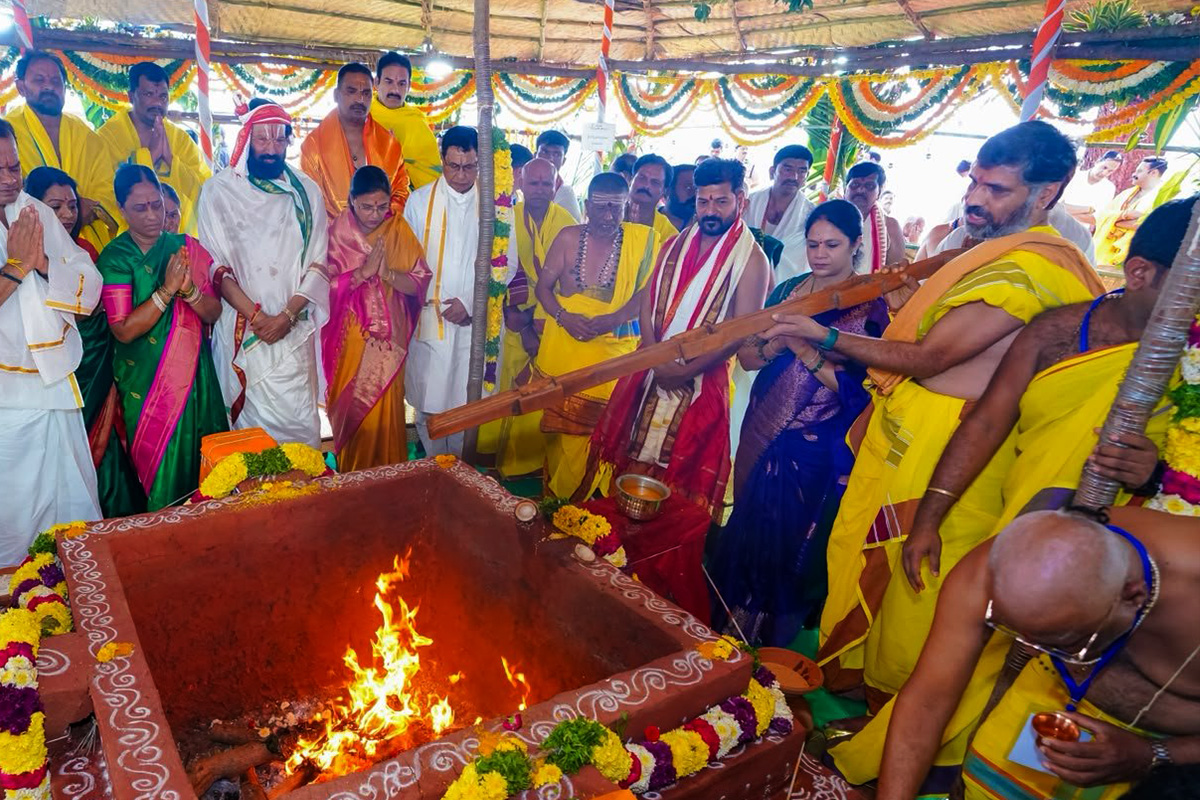
Telangana Chief Minister Revanth Reddy and his wife participated in the Purnahuti of the Varuna Yagam at Nagarjuna Sagar.

Synopsis: The state-sponsored Varuna Mahayagam in Telangana was troubling on many counts. It raises a larger question: can yajnas invoke rain or help counter a phenomenon like El Niño? At a time of growing climate uncertainty and water stress, the government needs scientific temper, sound water management and preparedness—not superstition masquerading as policy.
Last week, Telangana witnessed the strange spectacle of a Varuna Mahayagam, conducted under the auspices of the state government. The 108-priest ritual was held at Nagarjuna Sagar in Nalgonda district by the Irrigation Minister, along with his wife. The Chief Minister and his wife received the concluding purnahuti. Several ministers, legislators and government officials also participated. Since the government itself had taken the initiative, the media went to town describing how grand and spectacular the ceremony had been.
The yajna reportedly began at 4.05 am on the banks of the Krishna with gopuja and ended with the purnahuti at 3.24 pm. Dot on that time! If it had been a minute earlier or later, the yajna would have failed—and Varuna would have become angry and stopped the rains!
“We conducted the Varuna Yajna with the noble intention of ensuring abundant rainfall in the Krishna and Godavari basins and seeking the happiness and prosperity of the people of the state. Conducting yajnas, rituals and prayers for rainfall is a spiritual tradition inherited from our ancestors. We respect that tradition and therefore conducted this yajna. While the government continues to move forward on the basis of scientific assessments and planning, we also respect the culture and traditions that reflect the relationship between rain, agriculture, nature and human life, and pray for nature’s grace. We prayed that Varuna should show mercy and help us withstand El Niño,” the Chief Minister was reported to have said.
Whether those who organised this yajna are aware that the government is bound by the Constitution of India is difficult to say. The very Preamble of the Constitution describes India as a secular republic. Secularism means that supernatural beliefs should not be allowed to govern secular human affairs. A person may believe in supernatural powers if he or she wishes; such belief can remain a matter of personal life. But religion should not intrude into secular spheres such as government, education and public affairs. This is a value proclaimed during the French Revolution and subsequently accepted by the modern world.
In a country like India, with many religions and widely differing beliefs about supernatural powers, this principle has often been expressed through sarva dharma samabhava. But that is a principle of tolerance and peaceful coexistence in a plural society. It does not mean that the government should adopt the religious beliefs of the majority. The Government must remain religion-neutral and keep its distance from religious beliefs. Whatever the personal beliefs of those sitting in power, the actions performed from that seat of power should not give any one belief precedence.
The rulers of Telangana may not know even this basic constitutional value. It is certainly true that many of the country’s rulers have governed without knowing or respecting even this minimum principle. The present Chief Minister has justified the ritual by calling it a “tradition inherited from our ancestors”. In effect, he seems to be saying: others committed the same mistake, so I am allowed to commit it too.
The Constitution also declares that it is the duty of every citizen to develop “the scientific temper, humanism and the spirit of inquiry and reform”. Believing that rainfall is a gift from Varuna is not scientific temper. In the very ancient past, when human beings knew nothing about the laws governing natural phenomena, they assumed that events taking place before their eyes were controlled by supernatural powers. They gave names to those powers, worshipped them and performed rituals to appease them. Humanity has travelled thousands of years since then. It discovered and understood the scientific causes underlying natural phenomena. The Constitution expects governments and citizens alike to uphold that scientific outlook.
During droughts, marrying and parading frogs, conducting yajnas and rituals, and offering prayers have indeed continued as traditions inherited from the past. But it has also been repeatedly demonstrated that none of these practices has ever caused rainfall. The fact that such rituals are generally conducted not in the height of summer but during the rainy season, when the sky is already cloudy, reveals the real secret behind the superstition.
If a minister or a Chief Minister personally believes in such things and performs a yajna at home, one may simply pity their ignorance. But turning that ignorance into a public, official government programme, and making government officials attend it as a matter of duty, is contrary to the constitutional spirit. There is no accounting for how much public money has been wasted on this exercise in superstition.
So what exactly is El Niño? And what does it have to do with a non-existent Varuna?
El Niño is a natural phenomenon associated with the warming of waters in the Pacific Ocean. It occurs naturally, generally once every two to seven years, and affects the southwest monsoon over the Indian subcontinent.
This natural phenomenon is occurring alongside the steadily rising temperatures across the world. The cars, air-conditioners, electricity generation, cement production, industrial pollution, high-rise buildings and aviation that have become integral to modern life, along with deforestation and mining, are contributing enormously to the warming of the planet. On the one hand, El Niño can bring reduced rainfall or an erratic combination of excessive and deficient rainfall; on the other, rising temperatures are steadily reducing soil moisture. Higher temperatures are also causing greater evaporation from reservoirs. Together, these processes are increasing the amount of water required for both agriculture and human consumption. And when that water itself becomes scarce, agriculture and human life inevitably come under strain.
This is a vicious cycle. El Niño, being a natural phenomenon in itself, may not be something we can do much about. The modern lifestyle responsible for increasing global temperatures has spread across the world and is growing rapidly. Telangana alone cannot reverse that process, and even if it tries, the immediate effect may be limited.
But whenever such a phenomenon occurs, the minimum responsibility of a government is to ask why it happened, what preceded it, whether there are any possibilities of preventing it, and whether there are alternative ways of reducing its adverse effects while it is happening. It must think, act and inform the people accordingly. To forget that responsibility and imagine that mantras can make tamarind pods fall from a tree without a stick or a stone is to deceive oneself—and the people.
In any case, the agricultural season in Telangana has largely failed this year. In an agricultural society, season does not mean ordinary calendar time measured by the movement of the sun. Season means the rainy season.
“How is the season?” “Has the season arrived?” “Is the season good?”—these are natural questions in rural life. What they really mean is: Are the rains good?
Rain-fed agriculture, and the wells, streams, rivulets, tanks and ponds dependent upon rainfall, together with the agriculture sustained by them, constitute the very fabric of life in Telangana. Indeed, so important is rain to the life of the country that rain itself has historically served as a synonym for the year. Telangana has the Godavari at its head and the Krishna at its feet, besides countless small rivers, streams and rivulets, and yet it has historically been a land that struggled for every drop of water, for both cultivation and drinking. That is why water in Telangana is not merely a necessity of life or agriculture; it has also become a sentiment.
Even today, more than half of Telangana’s agricultural land remains dependent on rainfall. Of the state’s total 1.16 crore acres, the net area with irrigation facilities is less than 44 lakh acres. Even within this irrigated area, less than 20 per cent is served by canals; the rest depends on wells, borewells and tanks. That is why the importance of rainfall continues to grow.
Normally, the southwest monsoon should spread across Telangana by the first week of June and the rains should begin. They should continue intermittently and reasonably regularly until October. What is needed is neither one sudden cloudburst nor weeks and months without a drop of rain. Rain should come when and in the quantity required—for ploughing, sowing, crop growth and fruition. This intimate relationship between soil, rain, human beings and agriculture continued for thousands of years.
That does not mean there were never floods or droughts. But, by and large, reasonably regular rainfall, agriculture dependent upon it, and the smooth functioning of rural and social life became an established pattern. That pattern has now been disrupted.
The statistics tell their own story. By July 10, rainfall was 19 per cent below normal. By July 16, the deficit had risen to 35 per cent. There was some rain here and there towards the end of July and the beginning of August, but this was not really the result of the normal monsoon; it was largely associated with depressions in the Bay of Bengal. By August 10, the recorded deficit had fallen to just 6 per cent.
But these are averages and therefore do not present the complete picture. Even if the overall deficit appears small, heavier rainfall in some districts or areas may have offset severe deficits elsewhere. Of Telangana’s 32 districts, 21 have received below-average rainfall. Rain did not arrive when agricultural operations needed it; it came after the crucial period had passed. El Niño has further aggravated this unevenness.
Since the situation has been similar in the Western Ghats and the upper catchment areas, there have been no substantial floods in the Godavari and Krishna. Streams and rivulets have not flowed, tanks have not filled, and groundwater levels have therefore not risen.
Even in these circumstances, there are things the government can do if it chooses to act. It can try to capture and conserve whatever little rain has fallen. It can undertake campaigns urging farmers to use water judiciously. Tanks can be treated not merely as irrigation sources but also as instruments for recharging groundwater. Farmers can be advised against cultivating water-intensive crops, accompanied by appropriate government measures. Scientific research and forecasting can be strengthened.
Such measures may produce results. Yajnas and rituals will not.
Also Read:
Can any committee fairly identify Telangana movement’s real activists?
Telangana: A state rich in corruption
(Edited by R Rajesh Kumar.)



