
Published Aug 15, 2026 | 6:15 PM ⚊ Updated Aug 15, 2026 | 6:15 PM

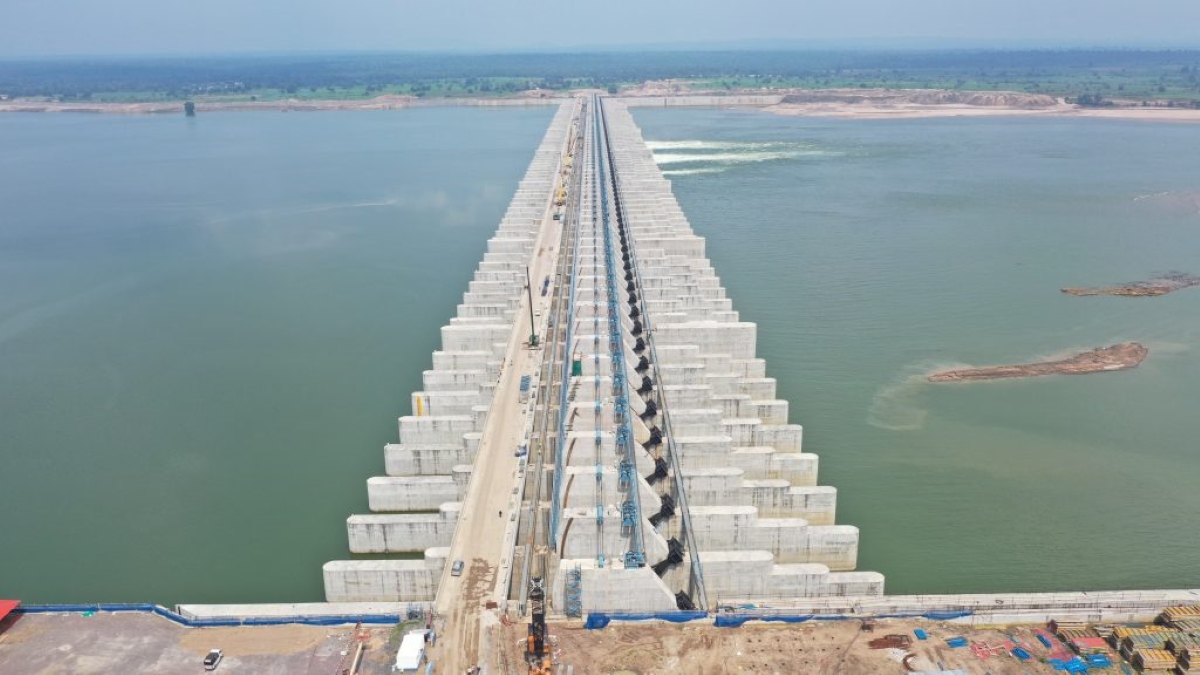
File photo of the Kaleshwaram project. (Supplied)

Synopsis: Could a functioning Kaleshwaram have cushioned Telangana’s farmers against the 2026 monsoon shock? The answer is not a simple yes or no — but the crisis underlines the need for a new irrigation doctrine. Kaleshwaram must be scientifically rehabilitated, not politically resurrected.
Telangana’s irrigation crisis in 2026 is not merely a story of deficient rainfall. It is a story of a State with an ambitious irrigation architecture struggling to convert infrastructure into dependable water security at precisely the moment climate uncertainty is testing its limits.
The looming “super El Niño” has sharpened that contradiction. Telangana entered the monsoon with large parts of its irrigation system dependent on reservoirs, groundwater and lift schemes. When rainfall turned erratic, the question was inevitable: could the Kaleshwaram Lift Irrigation Scheme have cushioned the blow? More specifically, could timely repairs to its damaged barrages or operation of the Kannepalli pump house have saved standing crops from serious stress?
The answer is neither the sweeping “yes” claimed by the Opposition nor the categorical “no” suggested by the government. Kaleshwaram could potentially have provided an important buffer, but it could not have been a magic shield against a prolonged rainfall deficit.
Limits of lift irrigation under climate stress
The scale of the problem is considerable. Telangana has been facing serious monsoon uncertainty, with large parts of the State experiencing rainfall stress at a time when agriculture is heavily dependent on timely precipitation. The possibility of a strong El Niño has only sharpened concerns about prolonged dry spells and uneven rainfall.
This is where the Kaleshwaram question becomes important.
The project was conceived precisely to reduce Telangana agriculture’s dependence on the vagaries of the monsoon by lifting Godavari water into reservoirs and irrigation systems across the State. When functioning, it contributed significantly to the expansion of irrigated agriculture and the rapid growth of paddy cultivation. Its failure, therefore, is not simply an engineering problem; it exposes a larger vulnerability in the State’s irrigation strategy.
Yet the political argument that the government could simply have switched on Kannepalli and saved agriculture oversimplifies the engineering reality.
Structural safety versus political pressure
The Medigadda, Annaram and Sundilla barrages suffered serious structural problems after the 2023 floods. Their operation has consequently become inseparable from questions of structural safety. The State has undertaken investigations and studies aimed at determining the extent of damage and the nature of rehabilitation required.
That makes indiscriminate pumping an unacceptable proposition. Water management cannot be separated from structural safety. A barrage is not merely a water container; it is a civil structure whose failure can endanger downstream populations.
But that does not absolve the State government of the larger question: why was the rehabilitation process not accelerated sufficiently before another vulnerable monsoon arrived?
The strongest criticism of the present administration is therefore not that it refused to take an unsafe structure and gamble with lives. It is that the State has not yet created enough alternative irrigation capacity to compensate for the prolonged unavailability of one of its most expensive irrigation systems.
The Opposition’s argument also deserves scrutiny. It has claimed that Godavari flows at Kannepalli could have been lifted without depending entirely on storage behind the damaged Medigadda barrage. There is an engineering debate here that cannot be settled by political assertion. Even if water could technically be lifted at certain river levels, that does not automatically mean that the entire downstream Kaleshwaram chain could safely receive, store and distribute it.
The more useful question is therefore not whether Kannepalli could have been switched on, but how much of the irrigation network could have been safely salvaged and operated in a contingency mode.
Had the barrages been repaired, certified and made operational before the 2026 agricultural season, the State would certainly have possessed a stronger buffer against rainfall variability. If portions of the pumping network could have been safely operated independently of the damaged structures, they might also have supplied relief to selected command areas. But neither scenario would have eliminated the consequences of a prolonged monsoon failure.
That distinction matters.
The need for a new irrigation doctrine
Telangana cannot build an agricultural policy around the assumption that one mega-project will compensate for climate variability. Lift irrigation itself is energy-intensive. It requires dependable power, functioning pumps, storage capacity, distribution networks and favourable river flows. Every link has to work.
The current crisis therefore exposes a deeper weakness: Telangana has invested heavily in creating irrigation capacity but has not invested equally in redundancy, maintenance and climate resilience.
The State needs a new irrigation doctrine. Kaleshwaram must be scientifically rehabilitated, not politically resurrected. Its structural safety must be certified transparently and its operating protocols redesigned around extreme-weather scenarios. At the same time, Telangana needs stronger reservoir management, groundwater recharge, tank restoration, micro-irrigation and crop diversification.
Paddy-heavy agriculture also needs reconsideration. Climate volatility makes water-intensive cropping increasingly risky in areas without assured irrigation. Farmers cannot be asked to bear the cost of a policy that encourages cultivation patterns while leaving them exposed when water systems fail.
Moving beyond the blame game
The Kaleshwaram controversy should therefore move beyond the familiar blame game. The BRS cannot escape questions about the design, construction and subsequent failure of the barrages. The Congress government cannot escape questions about the pace of rehabilitation and contingency planning.
El Niño may be an act of nature. An irrigation system remaining unavailable when farmers need it most is not entirely an act of nature.
The real lesson of 2026 is that Telangana needs irrigation infrastructure that does not merely look spectacular on paper, but remains dependable when the monsoon does not cooperate. Kaleshwaram, if safely restored, can be part of that solution. It cannot be the whole solution.
The State’s challenge now is to ensure that the next climate shock finds its farmers with more than political explanations—and with water.
From our archives:
Lord Rama wouldn’t mind drowning himself for Telangana’s farmers, dear Chief Minister
Telangana’s Kharif paradox: Arid fields, scarce pulses, yet cotton expands



