

Published Aug 09, 2026 | 9:00 AM ⚊ Updated Aug 09, 2026 | 9:00 AM

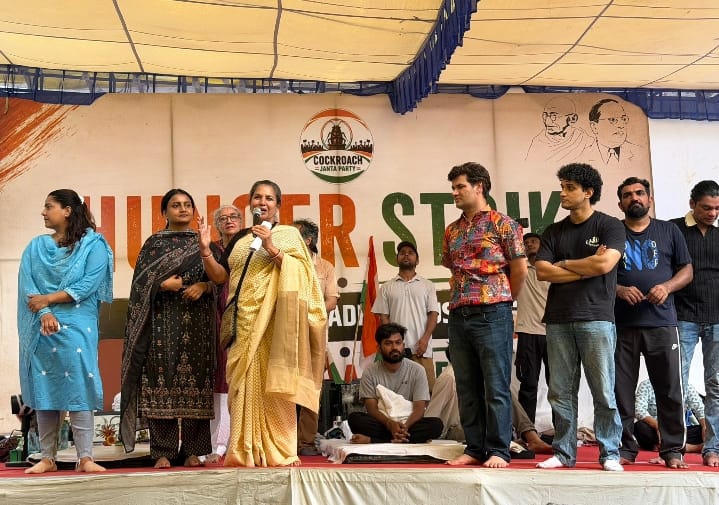
Actor-activist Shabana Azmi speaks in solidarity at Jantar Mantar in a coming together of generations. (Special Arrangement)

Synopsis: The 400-million-strong Gen Z are reshaping expectations as the recent Jantar Mantar protest showed. But Gen Xers and the Millennials haven’t lost their importance. How their strengths are blended will determine the India of tomorrow.
No, the era of Gen X and Millennials is not over in India. It is being forced into a more complex, layered coexistence.
The popular narrative that Gen Z’s emergence has rendered Gen X (roughly 1965–1980) and Millennials (1981–1996) obsolete is seductive but shallow. It mistakes rising numbers and cultural visibility for institutional displacement. In India, where Gen Z exceeds 400 million and forms a large and growing share of the future electorate, the shift is real and accelerating. Yet power, capital, institutional knowledge and decision-making still rest disproportionately with the preceding generations. What is unfolding is not succession but renegotiation.
India’s demographic reality is stark.
Gen Z (born 1997–2012) constitute around 28 per cent of the population, with projections showing roughly half a billion people in the broader 10–29 band. By 2029, they are expected to become the single largest adult and voting bloc. They are digital natives who treat AI as infrastructure, prioritise flexibility, purpose and mental health, and show lower tolerance for hierarchical grind. Surveys consistently show high AI adoption among both Gen Z and Millennials in India, strong interest in leadership yet stronger insistence on work-life balance, and greater willingness among the youngest to exit roles that feel misaligned.
These traits are reshaping expectations. Millennials, who entered the workforce amid liberalisation’s early turbulence and the post-2008 caution, often prioritised stability and gradual ascent. Many now carry EMIs, family responsibilities and mid-career pressures; some engage in quiet disengagement. Gen Z, entering with fewer fixed obligations in many cases and higher exposure to global digital norms, is more willing to job-hop, demand hybrid arrangements, or reject traditional power structures. The contrast is visible and sometimes frictional.
Yet the idea that Gen X and Millennials have been displaced collapses under scrutiny. The question, therefore, is not which generation will replace the other, but what each brings to the table.
Millennials are still hundreds of millions strong and form a large share of India’s earning population. They are the generation that remembers India’s economic transition. They occupy mid-to-senior roles and drive much of the consumption and savings that fuel growth.
Gen X, smaller in absolute numbers, still anchors senior leadership, entrepreneurship and policy continuity in many organisations and government structures. Experience, networks, capital accumulation and risk calibration do not transfer overnight. Leadership pipelines are not being emptied; they are being stretched across generations with different risk appetites and skill profiles.
Other constraints come in the way of a clean handover. India’s Gen Z faces elevated unemployment rates relative to older generations, skill mismatches, and uneven quality of employment, especially among graduates and in urban areas. Labour force participation for the youngest remains lower, partly because many stay longer in education. Housing affordability, cost of living pressures and delayed major life decisions affect both Gen Z and Millennials. Political mobilisation exists among them but is fragmented by region, caste, language and class; high digital connectivity has not automatically translated into high or uniform electoral turnout or unified national agendas. The country itself is not uniformly young: southern states are ageing faster while the overall median age remains low for now.
The more accurate picture is multi-generational interdependence. Organisations that thrive will blend Gen X resilience and institutional knowledge, Millennial operational experience and technological fluency, and Gen Z speed, digital fluency and insistence on values alignment. Consumption patterns, political messaging and workplace design must already account for this layering rather than treat one generation as the sole future. Cultural memory in India—shaped by liberalisation, the internet boom, family structures and regional diversity—does not map neatly onto Western generational labels anyway. Applying those labels without adjustment risks analytical distortion.
Claims of complete generational eclipse usually overstate cultural flashpoints and understate the slow mechanics of power, capital and competence. Gen Z’s numerical weight and distinct priorities are already altering markets, offices and, gradually, politics. That is consequential. It does not mean Gen X and Millennials have finished their work. Their time is not over; it is being shared, contested and redefined. India will be shaped by how effectively these generations learn to operate together rather than by any fantasy of one simply replacing the other.
Also Read:
In cold numbers: What brought the youth to Jantar Mantar and the streets of India
‘It’s the economy, stupid’: The making of India’s Gen Z discontent
(Edited by R Rajesh Kumar.)



