
Published Nov 10, 2026 | 6:57 PM ⚊ Updated Nov 10, 2026 | 6:57 PM

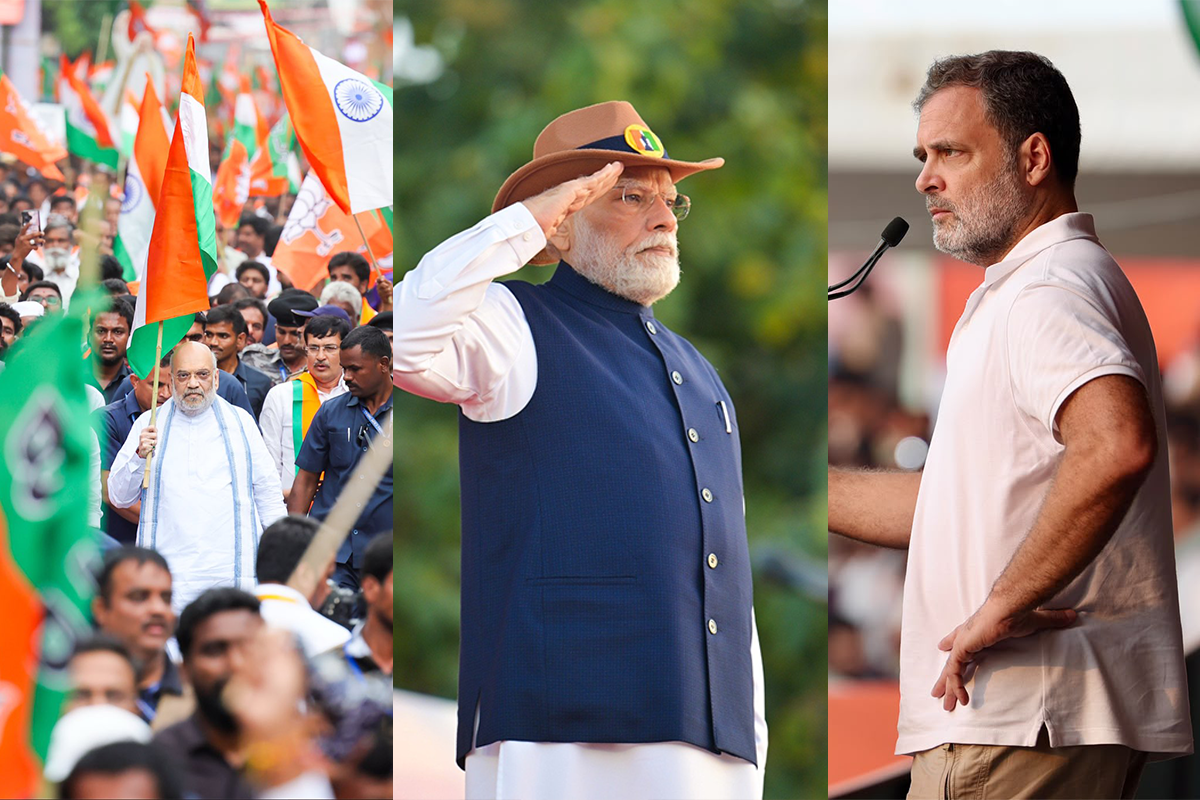
Home Minister Amit Shah, Prime Minister Narendra Modi and Leader of Opposition in the Lok Sabha, Rahul Gandhi. (Photo | X.com)

A social media influencer named Sheela Singh recently released a video. It showed a get-together associated with the Bharatiya Janata Party (BJP), attended by some prominent anchors from the national media.
In the video, some people were singing, “Modi kahin nahi jayega, jo ulti baat karega woh Italy jayega (Modi is not going anywhere; those who speak against him will go to Italy),” while others were cheering enthusiastically. Some media personalities were also clearly visible in the video.
Around the time this video was going viral, a prominent national media organisation announced on its channel a list of the most powerful leaders in the country. According to a survey it claimed to have conducted, Prime Minister Narendra Modi ranked first among the most powerful leaders, followed by RSS chief Mohan Bhagwat in second place and Union Home Minister Amit Shah in third.
Rahul Gandhi, the Leader of the Opposition in the Lok Sabha and a senior Congress leader, secured fourth place. Andhra Pradesh Chief Minister Nara Chandrababu Naidu stood fifth. It must be clarified that Sheela Singh’s video has absolutely no connection with this national media survey.
The channel prominently broadcast these five rankings throughout the day. It also offered explanations for why these leaders had secured their respective positions.
Let us set aside questions about how many people the channel interviewed and how accurate the survey results were. It is well known that the majority of media organisations today operate with an attitude of “Our channel, our choice.”
Also Read: Jagdeep Dhankhar at RSS event: Some questions and a ‘political conspiracy’
For some time now, particularly since Gen Z began protesting over various issues under the banner of the Cockroach Janata Party (CJP), the central government and certain media organisations supporting it have shown no hesitation in glorifying the government and its senior leaders at every available opportunity.
The Gen Z movement has also taken up the issue of alleged irregularities in the conduct of elections, reaching a point where Chief Election Commissioner Gyanesh Kumar’s position has come under threat. This has undoubtedly thrown the central government into confusion.
It is becoming increasingly apparent that, unsure of how to contain the damage, the government is resorting to such measures. Its actions suggest that it is making every possible effort to demonstrate its strength and convince the public of its authority whenever an opportunity arises.
One small example is the recent elections to the graduates’ and teachers’ constituencies of the Legislative Councils in four states. In reality, these elections are not significant enough to warrant a response from a leader of the Prime Minister’s stature.
Of India’s 28 states, only six have functioning Legislative Councils. Together, these councils have just 426 seats. The elections in question were held for around 28 of those seats.
As soon as the results were announced, Prime Minister Narendra Modi himself remarked that even when elections were conducted using paper ballots, the opposition had no chance of winning, and that the results of these Legislative Council elections were proof of this.
Moreover, the Congress party contested only 12 of these 28 seats. In Uttar Pradesh, the country’s most populous state, Congress did not contest at all.
In Karnataka, however, Congress lost all four seats, a result that should prompt the party to undertake some introspection, particularly because it is in power there. These results may not pose any immediate threat to the state government, but since the elections involved teachers and graduates, the party must recognise the signs of growing dissatisfaction with the ruling establishment among the state’s educated sections.
In Bihar, the Congress party’s sitting seat in Darbhanga went to Prashant Kishor’s Jan Suraaj Party (JSP). In Uttar Pradesh, the BJP won five of the 11 seats. The Samajwadi Party (SP) won the teachers’ constituency in Varanasi, Prime Minister Narendra Modi’s parliamentary constituency.
Leaving all this aside, what does the BJP, which is mocking Congress and other opposition parties by citing these results as evidence that their political relevance has ended, have to say about the Nagpur result?
In Nagpur, a stronghold of the RSS, Congress leader Govindrao Wanjari was elected to the Legislative Council from the graduates’ constituency for the second consecutive time.
Nagpur is not merely an RSS stronghold. It is also the hometown of prominent BJP leader and current Maharashtra Chief Minister Devendra Fadnavis.
The area also falls within the Lok Sabha constituency represented by another senior BJP leader, Union Minister Nitin Gadkari. Nagpur is renowned as a region where both the BJP and RSS have considerable influence.
What, then, does the Prime Minister have to say about the Congress victory in such a place? Why did Fadnavis, who had tweeted before the results were announced that Congress would draw a complete blank in these elections, delete that tweet after the Nagpur result came in? Why did the BJP lose in Nagpur despite deploying all its strength?
This is the style of functioning of the Prime Minister whom the national channel rated as the country’s most powerful leader.
Also Read: ‘India roars louder than ever’: Gyanesh Kumar SIR, please get out
Now consider the third most powerful leader, Union Home Minister Amit Shah. Just recently, he undertook a walk of about three kilometres in Hyderabad under the banner of a ‘Maha Padayatra’. The slogan of the march was “Loktantra Bachao, Arajkata Hatao (Save democracy, remove or eradicate anarchy).”
Who is making this appeal, and to whom? Protest is undoubtedly a democratic right. But who should be protesting? If such a situation exists in the country, protests, slogans and marches should be undertaken by those who are not in a position to rectify it, when the power to do so rests with someone else.
Why, then, did Amit Shah organise a protest march in Hyderabad? As Union Home Minister, is it not his responsibility to curb lawlessness and protect democracy?
Did that national media organisation recognise Amit Shah as the country’s third most powerful leader because he took to the streets to demonstrate his helplessness despite occupying such a powerful position? Or did the people surveyed by the organisation, as it claims, rank him third for precisely that reason? We do not know.
Also Read: Should you use a hammer to kill a fly?
While Amit Shah was marching through the streets of Hyderabad, raising slogans demanding an end to lawlessness, local body elections were taking place in Andhra Pradesh, where a coalition of which his party is a constituent is in power.
Municipal and municipal corporation elections were held first, followed by elections to the Zilla Parishads and Mandal Parishads.
While Amit Shah raised slogans against lawlessness in Hyderabad, the National Democratic Alliance (NDA) parties in Andhra Pradesh, including the BJP, showed the people of that state what lawlessness looks like.
Opposition party candidates were prevented from filing nominations. Those who dared to do so were attacked. With the cooperation of the police machinery, the ruling parties declared themselves winners in one-sided contests.
The coalition partners effectively sent Amit Shah a message from Andhra Pradesh that they themselves were the finest examples of lawlessness.
The person who led this lawlessness was none other than Andhra Pradesh Chief Minister Nara Chandrababu Naidu, whom the national media organisation had declared the fifth most powerful leader in the country.
In these elections, lawlessness did not stop at intimidating, threatening, attacking and arresting candidates, including women, to prevent them from contesting. After being reprimanded by the Supreme Court, members of the ruling parties went a step further and filed fraudulent nominations in the names of opposition party candidates, setting a new record.
Also Read: BJP’s North ‘fortress’ is being challenged by the youth; South doesn’t look easy either
Rahul Gandhi, who addressed a rally attended by lakhs of people at Delhi’s Ramlila Maidan last Sunday and declared, “We do not hate anyone. We love everyone,” was placed fourth on the list of the most powerful leaders by this national media organisation.
The organisation released its survey results just a day or two after the rally, which was held at the call of Rahul Gandhi.
Anyone who observed the rally at Ramlila Maidan would clearly acknowledge two things.
First, the country has not witnessed such a massive mobilisation of people in recent times. Second, the gathering demonstrated the extent to which opposition to the central government is growing.
The rally organised by the opposition against vote theft certainly served as a reminder that the ruling party needs to engage in serious introspection.
The future of the coalition currently in power at the Centre will depend on whether it respects the sentiments of the crowds that gathered at Ramlila Maidan or chooses instead to respect the opinion of a national media organisation that spoke to a handful of people in a perfunctory exercise and declared certain leaders the most powerful in the country.
It appears that this national media organisation has concluded that those who perpetrate lawlessness are the most powerful leaders.
Also Read: From Jantar Mantar to Indira Park: ‘Can you stop the waves of the sea?’
(Edited by Fayisa CA)



