
Published Oct 18, 2026 | 4:00 PM ⚊ Updated Oct 18, 2026 | 4:00 PM

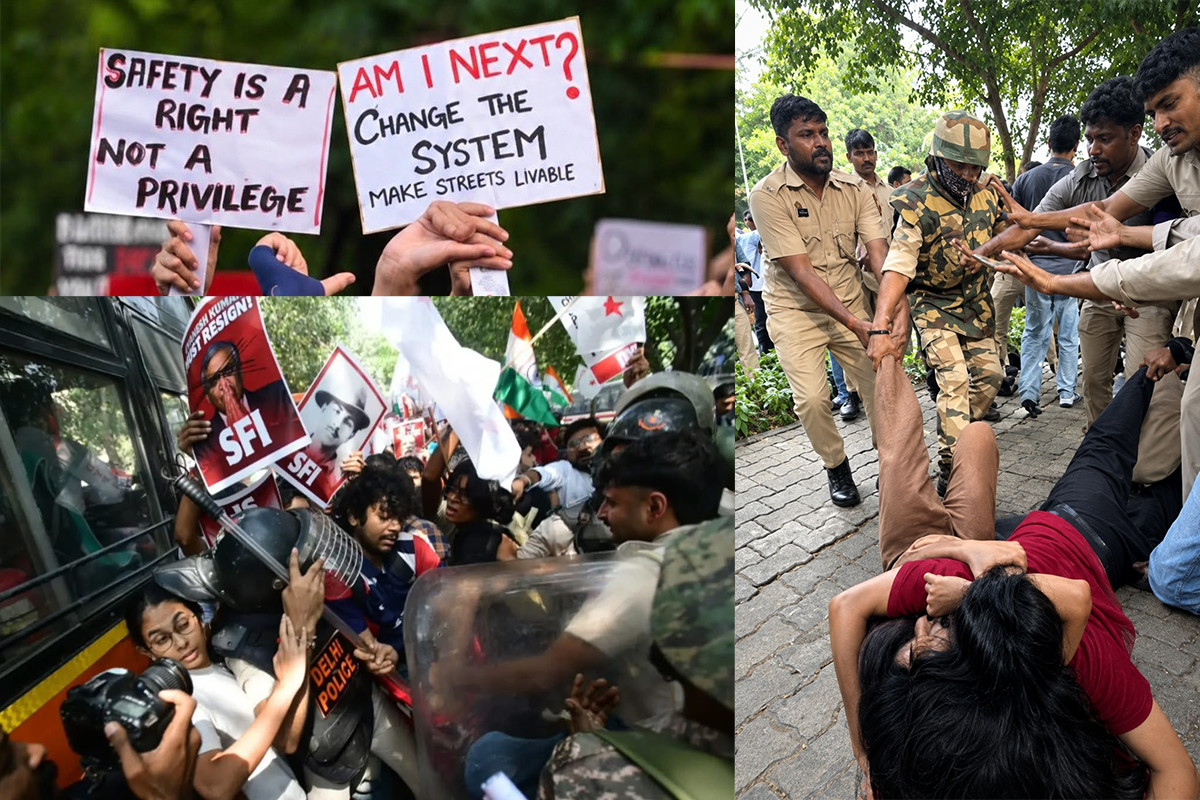
The youth of this country have been taking to the streets, using peaceful means to compel the government to acknowledge the problems they face.

Synopsis: When even Supreme Court judges threaten a dharna to secure citizens’ rights, what does it say about the state of affairs in India? From Hyderabad’s Dharna Chowk to Delhi’s Jantar Mantar, governments have pushed dissent away from centres of power. As Gen Z challenges these restrictions, Devulapalli Amar asks whether public anger can ever be contained by designated protest sites.
“We will stage a dharna at the main entrance of the Delhi High Court. If necessary footpaths are not constructed there for the convenience of pedestrians, we will have no choice but to stage this protest. We will make a government official sit with us at the dharna and will not allow him to go home either.”
These words did not come from any ordinary citizen. They came from two sitting judges of the Supreme Court of India, during the hearing of a case related to the central government’s failure to build a pedestrian crossing outside the Delhi High Court. Justices JB Pardiwala and KV Vinod Chandran observed that a footpath is a fundamental right under Article 21 of the Constitution.
Though the remarks may have sounded humorous, the judges’ statement carried a warning. It symbolised a normal reflex of the citizen in a democracy-protest!
When a problem remains unresolved, ordinary people generally resort to dharnas, protest demonstrations, rallies and public meetings to draw the government’s attention to it. Yet, young people who sought to hoist the national flag during a peaceful protest were arrested by the police and booked for “disturbing peace.” This is a peculiar episode in the history of Indian democracy.
While young people of Indian origin in Britain, Canada and other countries freely wave the Indian tricolour on the streets in support of the Cockroach Janata Party (CJP)’s struggle, is it not ironic that its leaders are being arrested for hoisting the national flag in India, while the country is governed by a party that claims to be the sole custodian of patriotism?
If judges of the country’s highest court are contemplating taking to the streets to protest, does one really need to say more about the plight of ordinary citizens?
Also Read: Democracy’s shame: Delhi Police’s violence reverberates across India
The youth of this country have been taking to the streets, using peaceful means to compel the government to acknowledge the problems they face. Such protests are taking place everywhere, from the national capital to the capitals, cities and towns of other states. Governments, however, have made it customary to designate specific locations for demonstrations.
There is something inherently absurd about telling people that if they have a grievance, they must go to a particular place to protest or question the government.
Anyone familiar with Hyderabad’s history over the past five or six decades will remember how things once worked. Political leaders and journalists of that era, in particular, will recall the protest camps that stood directly opposite the Secretariat gate, at the site where Lumbini Park stands today. They were a year-round presence.
Employees’ organisations, workers’ unions, Left groups and numerous other organisations would put up placards and banners, stage dharnas and sit on hunger strikes outside the Secretariat, seeking solutions to their respective grievances. Such protests were commonplace.
Journalists will remember the many occasions when ministers and officials stopped their vehicles near these protest camps while entering or leaving the Secretariat. On rare occasions, even chief ministers did so. They would get out, meet the protesters, hear their grievances and announce solutions to some of their problems on the spot. Anyone who covered such demonstrations in those days will remember these encounters.
Later, road-widening projects were undertaken, which we proudly celebrate as symbols of development. The area surrounding the Secretariat was beautified, too, and the protest camps were removed. A Dharna Chowk was established near Indira Park, far enough from the Secretariat.
Demonstrations were pushed away from government offices and the people in power. Indira Park in Hyderabad, Freedom Park in Bengaluru and Jantar Mantar in Delhi became designated venues for public protests.
The Bharat Rashtra Samithi (BRS, then the Telangana Rashtra Samiti) waged a prolonged struggle for nearly 13 years to achieve statehood for Telangana. Yet, soon after coming to power in the newly formed state, it removed the Dharna Chowk near Indira Park.
The protest site was shifted to a location beyond Shamshabad. Only after a prolonged campaign by democratic groups and the intervention of the courts was the Dharna Chowk restored near Indira Park.
This is a telling example of how even leaders who emerge from resistance movements can grow averse to the idea of ‘protest’ once they taste power. Any political system that believes in and respects democracy must allow peaceful protests.
Also Read: Re-thinking the governance of begging in Bengaluru
Meanwhile, the Gen Z, at the forefront of the ongoing protests, is not ready to contain their anger according to the whims of the government. They are questioning why citizens should have to seek permission to protest in the first place.
Why should people need the permission of those in power to protest against the wrongs those very people have committed?
Those in power are often surrounded by sycophants who ensure that unpleasant truths never reach them. Their job is to convince the ruler that everything is fine and that the administration is doing a splendid job, even when things are falling apart outside. They keep those in power trapped in an illusion.
History offers numerous examples of political leaders who believed such assurances, only to lose power eventually.
Protests provide one of the few ways for those in power to understand the problems ordinary people face. By listening to demonstrators, governments can identify grievances, attempt to resolve them and correct their mistakes.
At the same time, political leaders themselves champion the right to protest until they are the ones who are being challenged.
Karnataka Chief Minister DK Shivakumar participated in the INDIA bloc’s protests against Chief Election Commissioner (CEC) Gyanesh Kumar in Delhi. He takes pride in watching his leader, Rahul Gandhi, challenge the BJP-led government’s restrictions and lead mass protests in Delhi.
Yet, when young people seek permission to assemble at Town Hall in Bengaluru to protest over the same issue, their request is denied. They are directed instead to Freedom Park, the designated protest venue. The contrast is striking!
Also Read: Anti-SIR stir: SFI-UK urges international community to take note of India developments
The BJP-led central government has removed Jantar Mantar as a designated protest site, ending its long-standing role as one of the capital’s most recognisable venues for public dissent.
Jantar Mantar has a history of bearing witness to several movements that shaped the country’s political trajectory.
In 2011, social activist Anna Hazare staged a hunger strike at Jantar Mantar demanding the passage of the Lokpal Bill. The movement triggered a nationwide mobilisation against corruption and helped lay the groundwork for the emergence of the Aam Aadmi Party (AAP).
In 2012, following the gang rape and murder of a young woman in Delhi, thousands of people took to the streets, demanding stronger laws and greater protection for women. Jantar Mantar became one of the important venues for demonstrations linked to the wider movement.
In 2014, protests against racial discrimination and attacks on people from the northeastern states gathered momentum following the death of Nido Tania, a student from Arunachal Pradesh. Demonstrators raised their voices against discrimination and violence targeting people from the Northeast.
In 2019, Jantar Mantar became an important venue for protests against the Citizenship Amendment Act (CAA), as demonstrations against the legislation spread across the country.
Another significant episode unfolded in 2023, when prominent wrestlers, including Vinesh Phogat, Sakshi Malik and Bajrang Punia, staged a protest demanding action over allegations of sexual harassment against Brij Bhushan Sharan Singh, the then president of the Wrestling Federation of India.
Jantar Mantar also witnessed the Gen Z movement led by the CJP, against the NEET-UG paper leak, which eventually led to the resignation of then Union Education Minister Dharmendra Pradhan.
Also Read: CJP founder Dipke released on conditional bail: No ‘breach of peace’ for one year
With Jantar Mantar no longer a designated protest site, the Delhi Police has identified three alternative venues for demonstrations: Ramlila Maidan, approximately six kilometres from Parliament; CBD Ground in Shahdara, around 14 kilometres away; and Burari Ground, roughly 20–23 kilometres away.
These alternatives raise questions about accessibility, cost and whether demonstrations held there can command the same public attention as protests in central Delhi.
Ramlila Maidan frequently hosts public gatherings, including political and social programmes. Securing space there can be difficult, particularly during busy periods.
CBD Ground is also used for other events, while Burari Ground lies on the outskirts of the city. All three venues present practical challenges for protesters, including the costs associated with securing space.
Those who take to the streets to protest are not necessarily wealthy or well-connected. The need to protest is often greatest among the poor, workers and other disadvantaged sections of society. Yet these are precisely the people who may struggle to meet the costs associated with the venues designated by the government.
When public anger erupts, can such arrangements really contain it? People do not always wait for the right time and circumstances, or consult anyone about the appropriate location, before taking to the streets to protest.
A designated venue may offer a place for demonstrations, but it cannot substitute for a government’s willingness to listen to its citizens.
Looking at all this, does Sri Sri’s poetic question not come to mind: “Can you stop the waves of the sea?”
(Edited by Fayisa CA)



