
Published Oct 11, 2026 | 12:00 PM ⚊ Updated Oct 11, 2026 | 12:00 PM

In the long run, the central government will have no choice but to heed the demands of the country’s youth.

Synopsis: Peaceful protest conducted in the Gandhian tradition is not anarchy. It is true that laws are made in Parliament, not on the streets. But when legislatures fail to discharge their responsibilities, the people take to the streets to remind them of their duties.
“Should you use a hammer to kill a fly?” This was the remark made by the Supreme Court about the measures taken by the government to prevent the Cockroach Janata Party from holding a protest near Jantar Mantar on Saturday in Delhi.
Abhijit Dipke, founder of the Cockroach Janata Party (CJP), said that the arrangements made by the government across Delhi to stop people from attending the protest made it seem as though the Narendra Modi government had declared war on the people of this country.
“I have never seen Delhi like this in my life. Even during the Emergency, the situation was not like this,” senior Delhi-based journalist Tavleen Singh said on a national television channel on Saturday.
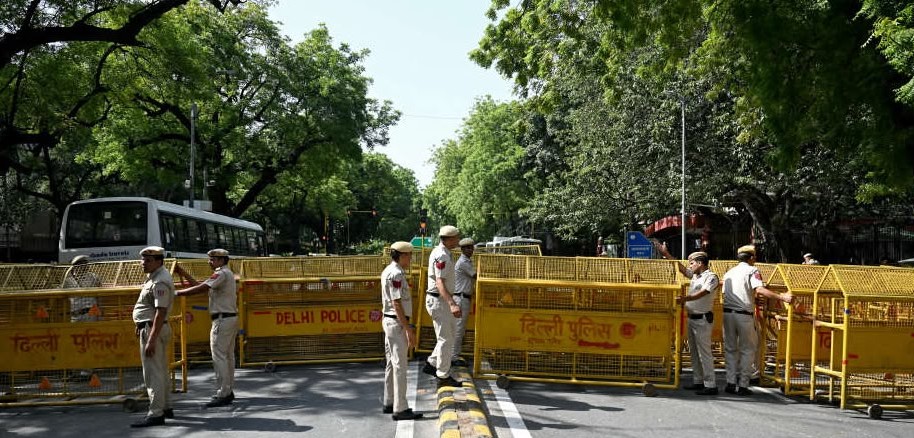
As many as 57 metro stations were shut down. Several trains arriving from different parts of the country at Nizamuddin and New Delhi railway stations were cancelled. Around 35,000 police personnel were deployed across Delhi. Internet services were suspended in several parts of the national capital.
Why all this commotion? Should the entire population be inconvenienced to prevent a protest by a small group of people? That was the question behind the Supreme Court’s remark about using a hammer to kill a fly.
Also Read: ‘No breach of peace for one year’: Delhi court orders release of three CJP leaders with rider
In recent months, remarks by Supreme Court judges, particularly Chief Justice of India Justice Surya Kant, have become controversial. The Cockroach Janata Party began as a sarcastic response to his comparison of unemployed youth to cockroaches a few months ago. Today, it has become a thorn in the side of the central government.
Moving beyond issues concerning education and employment for young people, the party is now focusing on fundamental questions about the threats facing democracy in the country. It is emerging as a force capable of putting the Centre under considerable pressure.
There are, of course, those who dismiss these street protests. What can such protests do to people occupying constitutional offices? How many such movements have we seen before? These protesters, they argue, will eventually fade away, just as Hardik Patel and Kanhaiya Kumar did.
Now, a three-judge bench of the Supreme Court, headed by the same Chief Justice Surya Kant, has drawn a comparison between the protesters and flies. It remains to be seen what consequences this remark will have. If another “Fly Janata Party” emerges in solidarity with the cockroaches, how much more trouble will the NDA government have to go through to seal off Delhi and protect its hold on power?
Leaving that aside for a moment, why was the central government so determined to crush the Cockroach Janata Party’s call for a protest at Jantar Mantar on Saturday?
The protest is part of the party’s campaign demanding the resignation and arrest of Chief Election Commissioner Gyanesh Kumar, the scrapping of the controversial Special Intensive Revision (SIR) exercise, and the repeal of the 2023 amendments that shielded the Chief Election Commissioner from legal action.
If the voting rights of 130 million people have been removed through the SIR exercise, who are these people? Why has the Chief Election Commissioner, who oversaw the process, not come forward to explain what happened?
Prominent journalist Rajdeep Sardesai has reportedly sought this information several times under the Right to Information Act. Yet the Union Home Ministry itself has replied that it does not have the details. Is it not absurd that the Chief Election Commissioner, Union Home Minister Amit Shah and Prime Minister Narendra Modi have all failed to address the public’s questions on this matter?
Instead, they have left it to parliamentarian Ravi Shankar Prasad and another BJP leader, Sambit Patra, to present what amount to dubious figures. As usual, they have resorted to whataboutery, asking whether the Congress, when it was in power, protected Election Commissioners and rewarded them with prestigious posts in return for their assistance. They then walk away from press conferences, believing they have discharged their responsibilities.
Some BJP leaders have gone further, portraying the current situation as a war between democracy and anarchy. In a desperate attempt to discredit the Gen Z movement, they have labelled the struggle to protect the democratic right to vote as anarchy.
On television debates, some BJP leaders have delivered lectures about how laws must be made or amended in Parliament, not on the streets.
Yet even within the NDA, there appear to be reservations about the conduct of the central government and Gyanesh Kumar. Union Minister and Lok Janshakti Party president Chirag Paswan’s remarks suggest that concerns exist within the ruling alliance itself.
At the same time, another NDA ally, Andhra Pradesh Chief Minister Chandrababu Naidu, has been posting messages praising Gyanesh Kumar’s virtues. The Gen Z protesters have been left wondering at this stance.
Adding to the spectacle, sections of the Telugu media, seemingly acting as cheerleaders, spent much of Friday breathlessly reporting that Naidu, a senior political leader, had rushed to Delhi to bolster Prime Minister Narendra Modi’s morale amid his apparent anxiety over the controversy. Naidu reportedly spent an hour and a half at the Prime Minister’s residence.
Why, then, is the Narendra Modi government so afraid of the Cockroach Janata Party’s protests?
Did any violence take place during a similar protest in Mumbai, in a state governed by the BJP? Why, then, was the government afraid that violence would erupt in Delhi?
To understand this, we must recall the events surrounding the Cockroach Janata Party’s first protest at Jantar Mantar.
Also Read: In groups of four, through back lanes: How students tried to reach a sealed Jantar Mantar
When Abhijit Dipke arrived from abroad, Delhi Police officials reportedly met him at the airport and handed him a letter granting permission for the protest even before he had fully disembarked from his flight.
How did Dipke become a disruptive force in the space of just a few months?
Why were Dipke and his colleagues, Ashutosh Ranka and Saurabh Das, arrested on board their flight on Saturday morning?
As CJP co-convenor Saurabh Das asked on Friday, why should someone have to seek permission from the very government they intend to protest against, especially at such short notice?
He made another important point: in a democracy, citizens do not need anyone’s permission to protest. They merely need to inform the relevant authorities so that the necessary precautions can be taken.
Perhaps the people of this country will now have to launch another struggle simply to secure their democratic right to protest.
The Modi government has already been compelled to make a senior leader and Union Minister, Dharmendra Pradhan, resign in response to demands from young people. Why, then, is it so reluctant to let go of an official?
Some intellectuals argue that forcing Gyanesh Kumar to resign would achieve little and would merely allow the central government to wash its hands of the matter.
However, the government’s own actions make it clear that securing Gyanesh Kumar’s resignation is not as straightforward as securing Dharmendra Pradhan’s.
Also Read: ‘Cowardice!’: Rahul, Priyanka slam government, back India’s youth
Pull the thread of Gyanesh Kumar’s resignation, and the entire web may unravel.
Numerous reports and allegations concerning the close relationship between Gyanesh Kumar, the BJP and its senior leadership are already circulating on social media. Efforts are also reportedly under way to secure statements of support for him from retired judges and civil service officers.
The additional security arrangements around the Election Commission’s offices are unprecedented. The Election Commission is an institution that should remain accessible to the public and, by extension, to their political representatives. Yet even when around 300 Members of Parliament went to meet its officials, they were stopped far away from the premises and detained.
The government should not congratulate itself merely because it managed to prevent Saturday’s protest at Jantar Mantar.
If Abhijit Dipke is jailed, Ajinkya Shinde will take the lead. That is democracy.
The central government will have no choice but to heed the demands of the country’s youth. The only question is whether that happens tomorrow or the day after.
India’s democracy cannot survive unless action is taken against Gyanesh Kumar, clarity is provided on the disappearance of 130 million voters from the rolls, and the Election Commission is thoroughly reformed. In addition, the country must abandon the use of electronic voting machines and return to paper ballots, as several other developed democracies do.
Gen Z must continue its movement to achieve these goals.
(Edited by Dese Gowda)



