

Published Aug 29, 2026 | 7:00 AM ⚊ Updated Aug 29, 2026 | 7:00 AM

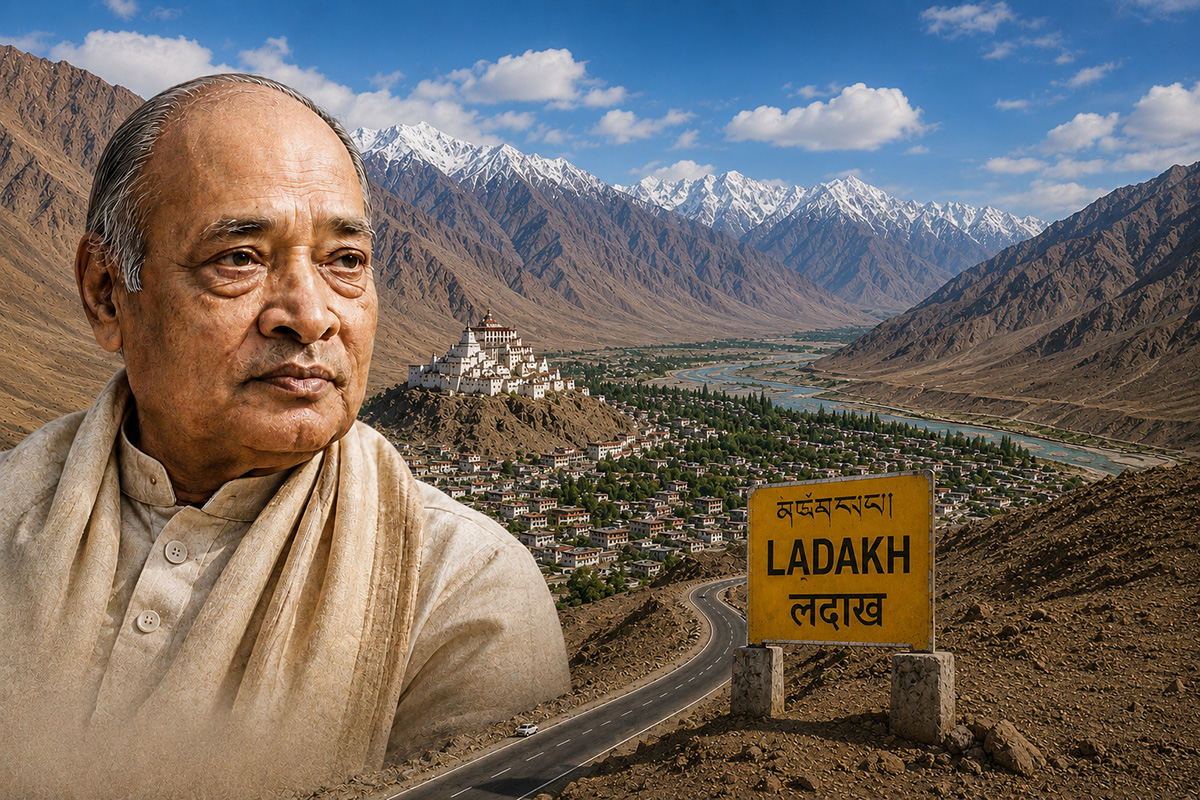
Image used for representational purpose only. (AI generated)

Synopsis: Ladakh is a test case of repeated failure to get the institutional design right precisely because of the lack of nuanced understanding of the region, a challenge even Prime Minister PV Narasimha Rao encountered. The issue is far from over, and a new set of challenges has emerged now as the next phase of talks is scheduled in September.
At the height of militancy, in 1994–95, Prime Minister PV Narasimha Rao invited a noted public intellectual and Jammu and Kashmir expert to discuss issues relating to the state. During the conversation, the expert pointed out that the newly-constituted council in the Ladakh region, intended to address local aspirations for self-government, covered only Leh district and excluded Kargil. Rao, visibly surprised, acknowledged that he had assumed the arrangement applied to the whole of Ladakh. When he turned to his officials, they confirmed that the expert was right.
The exchange revealed more than an administrative oversight. It underscored a deeper problem: even at the highest levels of government, and despite the best of intentions, New Delhi did not always possess the granular understanding needed to navigate the complex social, political and regional dynamics of one of India’s most strategically sensitive frontier regions. Three decades later, Ladakh has become a classic case of how the application of federalism can go wrong when structural realities are misdiagnosed, and the consequences of institutional decisions are not adequately thought through.
More than seven years after Ladakh was separated from Jammu and Kashmir on August 5, 2019, several rounds of talks between New Delhi and Ladakhi leaders have produced new challenges rather than a durable resolution. The entire process is a template for how a lack of understanding of structural realities can create avoidable problems. At this point, the talks have begun to resemble a broken record, with one round following another without bringing the process to a meaningful conclusion. Just when it appears that the two sides have reached an understanding, new challenges emerge, prolonging the cycle of negotiations.
Ladakh has a population of roughly 3.5 lakh, according to current projections, yet it sits at the heart of the India–China boundary contestation, giving it a strategic weight far out of proportion to its size. According to current population estimates, Leh has around 169,700 people and Kargil approximately 179,400. This demographic balance challenges the perception of Ladakh as predominantly Buddhist and underscores the importance of recognising the region’s religious and political diversity.
The demand for separation from the erstwhile state of Jammu and Kashmir was first articulated soon after independence by Kushok Bakula Rinpoche, Ladakh’s most influential Buddhist spiritual leader and statesman, but it remained largely confined to Buddhist-majority Leh. Shia Muslim-majority Kargil, by contrast, did not seek separation, since doing so meant leaving a Muslim-majority state of Jammu and Kashmir.
In July 1989, the Ladakh Buddhist Association launched an agitation for Union Territory status, marked by protests, boycotts and hunger strikes, that was called off only after Union Home Minister Buta Singh visited Leh and promised to consider an autonomous hill council. Protracted negotiations eventually produced the Ladakh Autonomous Hill Development Council for Leh in 1995, followed by a separate council for Kargil in 2003. In 1995, when the Leh Autonomous Hill Development Council was established, Jammu and Kashmir was under Governor’s Rule, as it was then termed under the constitutional framework of Article 370. By contrast, when the Kargil Hill Development Council was established in 2003, there was a PDP–Congress coalition government. These arrangements inadvertently institutionalised the communal distinction between the two districts.
Ladakh was granted Union Territory status in 2019. The outcome was the opposite of what many Ladakhis expected: instead of enhancing local self-governance, it diminished the powers Ladakhis had previously exercised, as decision-making shifted decisively to the Lieutenant Governor’s administration while the Hill Councils at the district level were left with only limited influence over development and public administration. It was a reminder of the old adage: be careful what you wish for.
The years since August 5, 2019 have marked Ladakh’s most significant political transformation since the Hill Councils were first established. Civil society groups from Leh and Kargil, long divided over Ladakh’s constitutional future, forged an unprecedented alliance to demand statehood and inclusion under the Sixth Schedule of the Constitution. This Leh–Kargil convergence was arguably the most consequential political realignment in Ladakh since independence: for the first time, the Centre faced a largely united regional voice, driven by concerns over political marginalisation, land ownership, employment and the erosion of local decision-making after the abrogation of Article 370.
What began as peaceful protest escalated into a prolonged and, at times, violent confrontation. In September 2025, demonstrations in Leh culminated in police firing that left at least four protesters dead and scores injured, while several government buildings were set ablaze.
In May 2026, the Centre and Ladakh’s representatives reached an in-principle agreement to establish an elected Union Territory-level institution with legislative, executive and financial powers under a customised framework based on Article 371 of the Constitution. The administration went further, announcing Autonomous Hill Development Councils for all seven districts, which was seen as the first substantive step toward restoring elected governance since the 2019 reorganisation. Five more districts were created as part of the new changes.
The issue is far from over, and a new set of challenges has emerged now as the next phase of talks is scheduled in September. The Leh Apex Body (LAB) and Kargil Democratic Alliance (KDA) have submitted a new draft of their “non-negotiable” demands. The demands include a Ladakh Legislative Assembly headed by a Chief Minister and Council of Ministers, with powers broadly corresponding to those under Lists II and III of the Seventh Schedule. They also want the Lieutenant Governor to act on the Assembly’s aid and advice to avoid institutional conflicts seen in other Union Territories.
The groups are seeking constitutionally protected financial powers over taxation, budgets, expenditure and public funds, as well as a directly elected legislature with constitutionally recognised delimitation. They also seek safeguards drawing on provisions such as Articles 371A, 371F and 371G. Other demands include placing home affairs, public order and policing under the elected government, along with a separate Public Service Commission, Ladakh-specific administrative and police services, and dedicated cadres.
Another issue concerns the Union Cabinet’s decision to set up a bench of the High Court of J&K in Leh, Ladakh. However, in Kargil, there is a demand that the bench should be established on a rotational basis between the two regions, along the lines of the Central Administrative Tribunal’s circuit-bench model, ensuring equitable access to justice for the people of both Leh and Kargil.
The striking feature of this seven-year-old saga, which began with the separation of Ladakh, is that every decision appears to generate a new set of challenges. Yet an alternative framework had been proposed decades earlier. As early as 1998–99, the public intellectual and Kashmir authority Balraj Puri proposed a comprehensive framework for regional autonomy that sought to accommodate the divergent aspirations of Jammu, Kashmir and Ladakh. His Regional Autonomy Report drew on Indian constitutional practice as well as comparative models of federalism, and was grounded in extensive consultations with stakeholders in Leh and Kargil.
Puri envisaged a broadly five-tier structure of governance—state, region, district, block and panchayat—that would have kept Ladakh united while providing meaningful autonomy at both the regional and local levels. The elected regional and district councils he proposed for Ladakh were not far removed, in their basic structure, from the arrangements eventually agreed in 2026, while retaining Ladakh within the broader constitutional framework of Jammu and Kashmir. Crucially, his model sought to address Ladakh’s distinct aspirations without separating it from Jammu and Kashmir: meaningful regional autonomy rather than political separation.
With the benefit of the experience of the past seven years, retaining Ladakh within Jammu and Kashmir along those lines could have demonstrated the strength and flexibility of Indian federalism: constitutionally guaranteed self-governance for Ladakh within the larger federal framework, while providing an institutional and political buffer between New Delhi and a strategically sensitive frontier region. This would have allowed everyday governance to be managed within the former state while the Centre focused on national security and external challenges.
The creation of five new districts, namely Zanskar, Drass, Sham, Nubra and Changthang, has stoked a fresh political controversy. While the government has presented the move as an administrative measure to improve governance and bring public services closer to remote communities, political groups in Kargil argue that it has altered the region’s demographic and political balance. The reorganisation has resulted in five Buddhist-majority districts and two Muslim-majority districts, even though Muslims constituted 46.4% of Ladakh’s population and Buddhists 39.65% in the 2011 Census. Kargil-based groups contend that the new configuration risks weakening the political unity that had emerged between Leh and Kargil and could marginalise the region’s Muslim population.
The overall new arrangement now under discussion still falls short of both statehood and the Sixth Schedule protections Ladakhi leaders have sought since 2019. A customised Article 371 framework can offer important safeguards, but not the same constitutional guarantees over land, local governance and customary rights that the Sixth Schedule would provide. Many of these protections could plausibly have been secured decades ago, had the 1998-99 Regional Autonomy Report’s recommendations been executed.
There are many lessons coming from Ladakh.
First, federalism succeeds not through rigid uniformity but through the willingness to craft asymmetric institutions that reflect regional diversity. Ladakh is a test case of repeated failure to get the institutional design right, and to channel legitimate aspirations in the right direction, precisely because of the lack of nuanced understanding of the region. Given the complex interplay of religious, ethnic and linguistic identities, territorial separation may not, in itself, be a panacea for addressing divergent aspirations. The challenge is to reconcile these competing aspirations within an institutional framework that accommodates the region’s diversity.
Second, delayed recognition of legitimate aspirations raises, rather than lowers, the political and constitutional price of accommodation. Had imaginative federal solutions been embraced when they were first proposed, much of the present debate over constitutional safeguards might have been unnecessary.
The Ladakh experience has taught us that the bigger picture must not be forgotten. The old problem of divergent political aspirations within Jammu and Kashmir has not disappeared. Only someone who has grown up within the region’s interconnected social, political and cultural ecosystem, and has engaged with its complexities for years, can fully appreciate the scale and nuances of the issue on an everyday basis.
More than three decades after Rao’s candid admission, Ladakh requires an intimate understanding of the region’s history, social composition and political aspirations, as well as the institutional imagination to translate that understanding into workable arrangements. With a host of innovative possibilities available within the Indian constitution, one way of addressing this gap would be to have parliamentarians from various parts of the former J&K state proactively serve as a bridge between the former state and the Centre. Durable federal settlements are built not by repeatedly adjusting structures after tensions emerge, but by diagnosing the underlying problem correctly and engaging those with the knowledge and legitimacy to help design the solution.
Ladakh’s experience shows the cost of getting that diagnosis wrong. The overall exercise requires a fresh look and organically developed proposals. The Regional Autonomy Report, with its proposed five-tier structure, should serve as an inspiration and foundation, not a rigid blueprint, for a broader conversation on asymmetrical federalism suited to the region’s new political reality. Such an approach would advance a more flexible federal architecture that accommodates diversity while safeguarding national unity and cohesion.
From our archives:
Beyond the Centre’s Reach: Why India needs to rethink the Union Territory model
Dachigam: Legacy, power and the question of renewal as Omar decides to march to Jantar Mantar
Who is a Kashmiri? The contradictions in Pakistan’s Kashmir discourse
(Edited by R Rajesh Kumar.)



