
Published Jul 04, 2026 | 9:15 AM ⚊ Updated Jul 04, 2026 | 9:15 AM

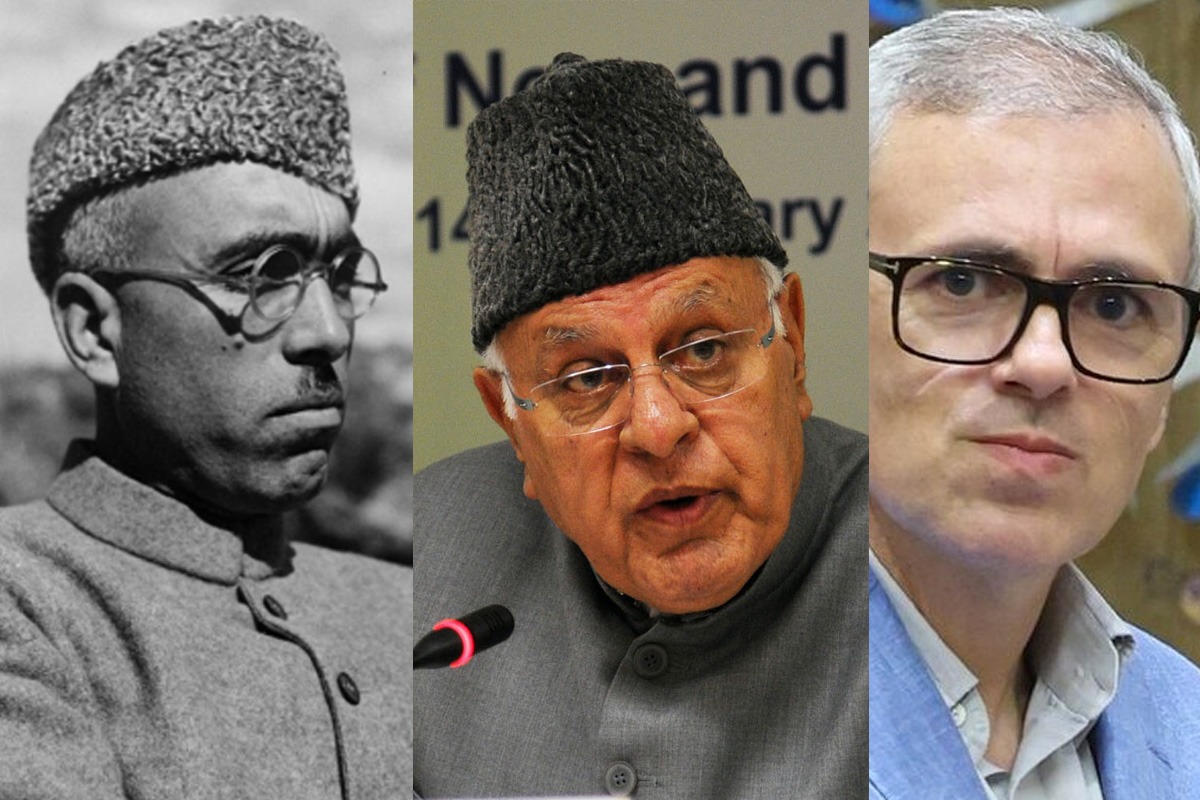
Sheikh Abdullah, Farooq Abdullah and Omar Abdullah.

Synopsis: It was at Dachigam that Omar Abdullah decided to stage a protest at Jantar Mantar when the Monsoon session of Parliament is on. Best known as the home to the endangered Hangul, the legacy of the place gives the latest meeting a meaning that goes beyond mere signalling…
It was 1986. Following the Rajiv–Farooq Accord, a newspaper article predicted that the net effect of the agreement would be that Kashmir would “go the Punjab way” and Farooq Abdullah would “go the Barnala way”. This was a reference to Punjab’s deteriorating security environment and the political weakening of then Chief Minister Surjit Singh Barnala.
A few months later, in the summer of 1987, Chief Minister Farooq Abdullah met the author and known Kashmir authority, Balraj Puri, at a public function in Srinagar and, in a joking tone, asked how many months were still left for him in his political calendar. This was an apparent reference to the trajectory that the author had predicted.
The exchange suggested that Abdullah remained unconvinced that the comparison with Punjab would ultimately hold and still believed Kashmir’s political circumstances would prove more resilient than many had anticipated. The main rationale behind Puri’s argument was that the accord created the impression among ordinary Kashmiris that any political party seeking power in J&K ultimately had to align itself with the party governing at the Centre. This, he argued, amounted to a negation of the principle of federalism.
Farooq invited Puri for a one-to-one meeting with him at Dachigam, the famed wildlife sanctuary that is home to the endangered Hangul, the Kashmir stag and is 20–25 km from central Srinagar. Until the early 2000s, visits to the sanctuary required permission routed through the Chief Minister’s office. This was less an assertion of political privilege than a reflection of its status as an ecologically sensitive and protected wildlife space. Today, access has become considerably more open, and visitors can apply online.
That memory of Dachigam acquires an unexpected contemporary resonance.
On June 3 of this year, Chief Minister Omar Abdullah took the National Conference legislators, ministers and MPs to Dachigam. It was publicly described as an off-site review meeting to assess governance and discuss the road ahead. The choice of venue immediately generated interpretations of its own. Some viewed it as an exercise in internal consultation and governance review; others saw in it political messaging or an attempt to manage expectations, preserve internal cohesion, respond to continuing debates around statehood or create space for more candid discussion away from routine politics.
The meeting also produced a more tangible political signal. A politically significant decision was taken that the National Conference legislators would travel to New Delhi and stage a protest at Jantar Mantar when the Monsoon Session of Parliament begins, pressing for the restoration of statehood and special provisions to Jammu and Kashmir that it lost after 2019. The choice appeared consistent with Omar Abdullah’s broader political approach, which has been to be assertive enough to register a position publicly, yet calibrated enough to remain within institutional and democratic boundaries rather than escalate into direct confrontation.
Dachigam, which once hosted a private conversation on political inheritance and warnings of drift, had again become a site of political introspection. When Farooq Abdullah met Puri there in the summer of 1987, the former appeared unfazed. Responding to the comparison with Punjab, he remarked that while Barnala “lives in a jail” metaphorically describing his protected status, he himself moved around freely. This implied that Kashmir’s circumstances remained fundamentally different.
Puri, who had shared a close friendship with Farooq’s father Sheikh Abdullah over several decades, cautioned him against drawing comfort from that contrast. He told Farooq that his father had left behind considerable political capital and legitimacy, which gave him more room and time than Barnala had enjoyed, but not immunity from broader political trends. If corrective steps were not taken, the trajectory, he warned, could still converge in important ways.
Puri suggested several measures aimed at addressing the alienation and political drift. For reasons that remain debated, those suggestions were never meaningfully acted upon. The rest, in many ways, is history. By 1989, militancy had arrived in Jammu and Kashmir with force. Farooq Abdullah resigned and, like many mainstream Kashmiri leaders in the years that followed, found himself operating under threat.
Omar Abdullah has, for the most part, been careful not to expend his political capital with the Modi government. His decision to take his legislators to Jantar Mantar was calibrated. It was politically expressive, yet unlikely to be interpreted as outright confrontation.
The complexities and constraints surrounding Omar Abdullah’s choices cannot be fully understood without some insider knowledge of the family’s difficult history after Sheikh Abdullah’s dismissal and the lessons drawn from it. The National Conference continues to rely substantially on Sheikh Abdullah’s legacy to retain political resonance in the Kashmir Valley, even if electoral dynamics outside the Valley differ.
Across villages and towns, that legacy continues to be invoked and, remarkably, has retained relevance more than four decades after Sheikh Abdullah’s passing. The reasons lie partly in the structural changes associated with his politics, particularly land-to-the-tiller reforms, women’s empowerment and broader social transformation. Those reforms altered Kashmir’s social structure in lasting ways. Yet material change alone does not explain the durability of Sheikh Abdullah’s appeal. At its core lies an idea of political dignity.
After 1996, as Chief Minister, Farooq Abdullah avoided direct or indirect confrontational politics with the Centre. Unlike the earlier experience that had created deep and lasting institutional strain, he sought to preserve Sheikh Abdullah’s political legacy while avoiding crossing red lines that could revive memories of the pre-1975 era. This approach was also shaped by the coup against him by his brother-in-law GM Shah, locally known as Gul Shah. The coup was largely seen as engineered by the Centre in 1986, creating a permanent, deep and enduring fissure within the family.
A larger challenge, however, is that the Indian political landscape itself has undergone profound change. Yet for the National Conference, Sheikh Abdullah’s legacy remains the principal source of political legitimacy and the foundation of its claim to remain the foremost political force in the Kashmir Valley.
This discussion, however, remains limited to one important political and social component of what was once among India’s most diverse and sensitive states. The interaction with other political vectors outside the Valley and how politics in the Valley shapes those regions and, in turn, is shaped by them is an altogether different and equally consequential discussion. Yet for any Chief Minister of Jammu and Kashmir, that wider equilibrium cannot remain outside the political bandwidth. An electoral majority in itself does not eliminate political vulnerability.
Perhaps that is also what gives the meeting of National Conference legislators at Dachigam a meaning beyond venue and optics. Four decades ago, in the same setting, Farooq Abdullah appeared confident that inherited political legitimacy still offered room to manoeuvre. The 1986 warning was not that history repeats itself in identical ways, but that political inheritance, however deep, cannot indefinitely substitute for adaptation.
Now, after a gap of 18 months of coming to power, Chief Minister Omar Abdullah appears to have shown willingness to treat his 2024 electoral mandate as a basis for political action even if, at this stage, much of it remains symbolic and carefully calibrated. The larger question is how far he will be able to generate the kind of political capital that his grandfather and his contemporaries accumulated over years of mobilisation, struggle and sustained public engagement. The bigger question is whether it will evoke a response from the Centre and whether at least statehood, as promised by Prime Minister Modi, will finally be restored.
Today, the questions, including the restoration of statehood, are different but not entirely unrelated. Whether that inheritance can once again be translated into a political language that speaks to contemporary realities and challenges of the region may determine not only Omar Abdullah’s political space but also the lurking question of sustainable peace. In that sense, Dachigam may once again have become a place where politics is less about the meeting itself and more about the questions it leaves behind.
(Luv Puri has authored two books on J&K, including Uncovered face of militancy and Across the Line of Control.)
Also Read:
Governors vs state governments: Can this 36-hour “constitutional fiction” from Brussels help?
The unfulfilled promise of India’s Leader of Opposition
(Edited by R Rajesh Kumar.)



