


Published Aug 19, 2026 | 12:00 PM ⚊ Updated Aug 19, 2026 | 12:00 PM

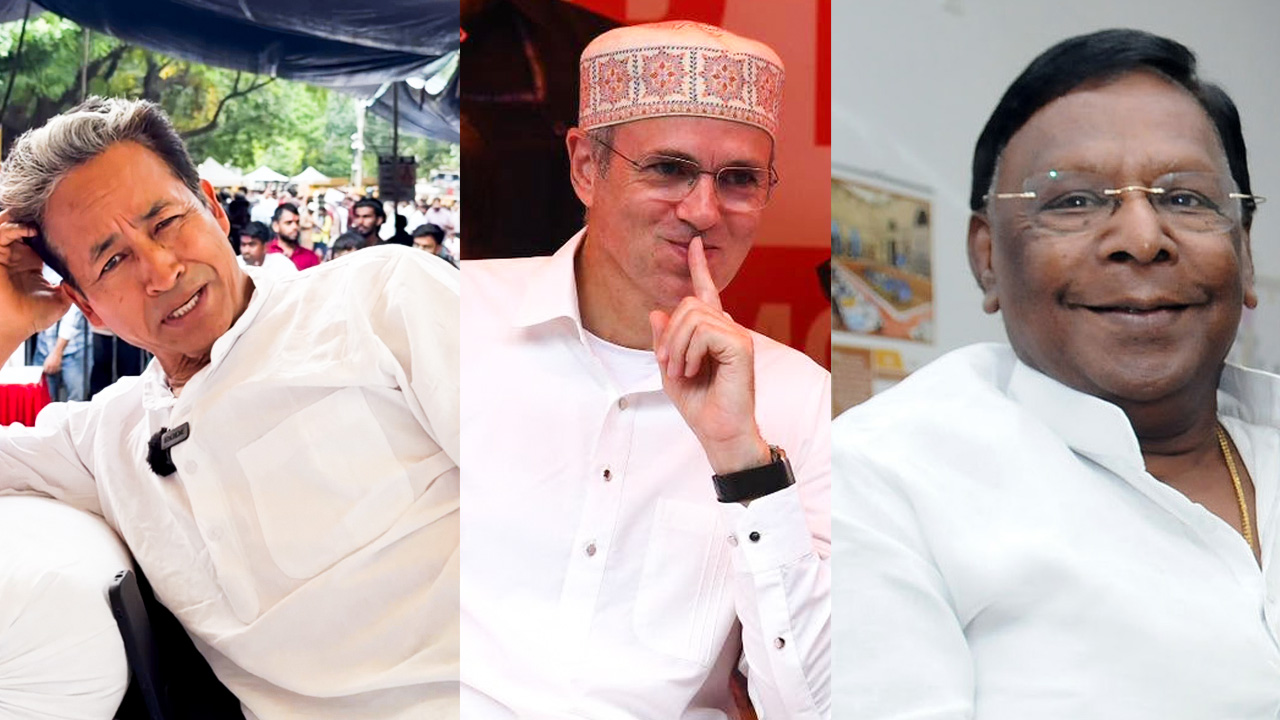
Sonum Wangchuk, Omar Abdullah and Narayanasamy would all welcome their regions being given Statehood.

Synopsis: Having Union Territories creates a democratic asymmetry as we have seen repeatedly and leaves millions with little control over their elected governments and regional affairs. The continued demands for statehood in Ladakh and Jammu and Kashmir must not be ignored anymore and the voices of leaders such as Omar Abdullah, Sonam Wangchuk and Narayanasamy must be heard.
As India enters its 80th year of Independence, we must introspect on many counts. The continuation of Union Territories is one such topic. Are we politically equal? Is Indian federalism uniform across the country? Do people have the power to elect and reject their own leaders at regular intervals at the state level? How does the Union Territory structure affect many of the basic features of the Indian Constitution?
The answers to these questions are largely uncomfortable. The Union Territory has paved the way for unitary form of governance, placing appointed Lieutenant Governors and administrators above elected representatives at various levels.
Last month, the entire nation witnessed an unprecedented mobilisation led by young people, generally labeled as Gen Z. It shook the dominant ruling party and forced the Education Minister to resign.
The entire episode began with the single man’s steadfast protest. Sonam Wangchuk, an engineer and educator from Ladakh, has long called for Statehood and protection of his region’s fragile landscape. Since 2019, he has consistently sought the restoration of Statehood for Ladakh and its inclusion under the Sixth Schedule of the Constitution to safeguard tribal identity and preserve ecologically sensitive land from unrestricted developmental activities.
Over the years, Wangchuk fought for the cause through a 21-day climate fast, a “Delhi Chalo” march, and a 35-day hunger strike supported by a large number of people from Ladakh. However, instead of addressing these concerns, the ruling government filed charges under the National Security Act against him and rerouted the demand with developmental activities and inflated budget figures. The people’s demand for statehood, their aspiration for autonomy, an accountable government and the right to exercise their democratic power cannot be replaced with bridges, underground tunnels and other new constructions.
Famous economists Govinda Rao and Nirvikar Singh titled their study on fiscal arrangement among Indian states as “Asymmetric Federalism in India” — a reference that fits the description of the arrangement with Union Territories too.
Delhi, the National Capital Territory, has its legislature headed by the Chief Minister, yet key departments like police and land are directly administered by the Union government.
Jammu and Kashmir, downgraded from a state with special status in 2019, has its own legislature and Chief Minister, but the Lt. Governor has been empowered with additional powers when it comes to the posting of key officials, reducing elected representatives to mere figureheads of government.
Puducherry’s former CM Narayanasamy publicly called the Lieutenant Governor there a “Titular head” who works against the interests of the people, while Rahul Gandhi said it was “remote-controlled from Delhi”.
Ladakh: From statehood demand to a UT without a legislature
The people of Ladakh have long demanded a Union Territory status separate from the state of Jammu and Kashmir, as they felt ignored by the state rulers who focused on the Valley, which has more political weightage than their geographically isolated region with limited voters. But their joy was short-lived as the abrogation of Article 370 and the state’s bifurcation came with unacceptable terms.
Ladakh was downgraded to a Union Territory without a legislature, and the appointed Lt. Governor runs its government.
The Andaman and Nicobar Islands and Lakshadweep are governed by the Administrators, without any form of legislature. Chandigarh is the only UT ruled by a full-fledged Governor. These differences have their roots in the administrative structure inherited from British rule.
At the time of Independence, the British did not hand over the entire country to Indian leaders; instead, they left behind multiple forms of governing structures and differing power dynamics. To effectively integrate and better administer these uneven subunits, the framers of the Constitution devised four-fold classifications (Parts A, B, C, and D).
Former British governors’ provinces with legislatures like Madras (now Tamil Nadu) and Bombay (Maharashtra) were designated as Part-A states.
The princely states of Kashmir and Hyderabad that joined post-August 1947 were listed under Part-B.
Provinces administered by Chief Commissioners became Part-C, and Andaman and Nicobar was placed under Part-D.
Part A and Part B had considerable self-governing powers, whereas the latter two categories were restricted and administered directly by the Union through their Lt. Governors and Administrators.
However, the entire arrangement underwent drastic changes with the State Reorganisation Act of 1956, which eliminated the four-fold classification and replaced it with two broad categories: full states and Union Territories. States with legislatures and elected governments were empowered with self-ruling powers, whereas UTs were severely restricted in federal dynamics, with their elected leaders being deprived of powers and placed under the authority of appointed Lt. Governors.
Also Read | Dachigam: Legacy, power and the question of renewal as Omar decides to march to Jantar Mantar
First, they create a clear distinction between people: some can elect their own regional governments, while others cannot. Federalism is an inherent part of the Indian Constitution, because to represent vast communities and administer them competently, we need strong state governments. The concept of UT undermines this federal foundation by stripping power from elected governments and vesting authority in unaccountable appointees.
The elected state government is not only a part of the basic structure doctrine but also the edifice of democracy, as it allows people to elect their governments regionally and nationally with different objectives and ultimately make them accountable and unseat them at regular intervals. UTs, instead, empower appointees and administrators who are technically outsiders but determine people’s lives without being accountable to them.
In February 2021, Lakshadweep administrator Praful Khoda Patel abruptly banned beef and imposed severe penalties for its consumption, in a Union Territory where 96% of the population is Muslim with beef an integral part of their diet. However, the judiciary intervened and stayed the order. The incident exposed the pathetic state of affairs in the absence of an elected government and with sweeping powers concentrated in the hands of Union-appointed administrators. This asymmetrical distribution of power and the scope of arbitrary policy decisions raise serious questions about the nature of India’s democratic republic.
Another major issue is that UT officials are generally empowered, and they report directly to Lt. Governors. This arrangement effectively replaces elected representatives with bureaucrats. The dominance of the executive over legislative guidelines has sidelined the principle of separation and balance of power.
Initially, the Union government justified the continuation of UTs for various reasons. National security concerns were cited in the case of the Andaman and Nicobar Islands and Lakshadweep, both of which lie far away from the mainland. There was also a professed desire to preserve the unique culture and identities of annexed territories like Puducherry and Goa. Also, it was argued that these regions were too small to govern themselves, fiscally unviable without central support, and unable to function as full state units given their negligible population or geographical constraints.
But history tells a different story. The Naga people’s demand for separate statehood was rejected by the States Reorganisation Committee in 1955, which stated that “it would be safer to have on our borders relatively larger and resourceful states rather than small and less resilient units.” Yet Nagaland emerged as a state immediately after the war with China in 1963. They were followed by Himachal Pradesh in 1971, Manipur and Tripura in 1972, and Mizoram, Goa and Arunachal Pradesh in 1987 to become full states with legislature, strong governments. This proved that smaller states also act as stronger frontiers against external adversaries while addressing their people’s grievances effectively and representing them fairly.
In reality, the deferral of statehood to Ladakh and Jammu and Kashmir has more to do with politics than other stated reasons. Just before the first election in the post-Article 370 period, the Union government empowered the Lt. Governor of J&K with additional powers and curtailed the authority of elected representatives. Despite the Union government’s promise to the Supreme Court in 2024 to restore statehood to J&K, it has been delayed for years. The reasonable time period, as it was termed back then, is now being treated by the Union government as indefinite.
In a recent court hearing, the government cited the Pahalgam attack and other security concerns, but this is a flawed argument since terrorist strikes have occurred deep inside the country as well, such as the Delhi car blast in the capital, where the Home Ministry is itself responsible for Law and Order.
In the long run, the Union government must decentralise power to regional governments and empower them, both politically and financially, to handle their state affairs effectively. Not every decision can be taken from New Delhi, nor should central authority substitute regional leaders. Time and again, State governments have proved their nationalism and contributed to national growth in numerous ways. It’s high time for the Union to revisit its commitment to Constitutional democracy, federalism and ultimately the people of India.
It has been almost seven decades since India introduced UTs; there now needs to be an empirical study on their strategic necessity, functional utility, and integral representation to justify their continuation. This should kick-start political debate, build community consensus, and drive an administrative overhaul to emancipate UTs into statehood, with adequate devolution of power, resources and representation.
The voices of Sonam Wangchuk, Omar Abdullah, Arvind Kejriwal, and Narayanasamy must be treated as the aspirations of lakhs of people from the concerned regions and should not be ignored simply as noise from opposition parties. The ongoing demands for Statehood are not just political; it reflects the deficit in democratic arrangements, the repercussions of unitary efforts and the results of arbitrary acts of Lt. Governors and Administrators.
Also Read:
‘If we could die together, can’t you live together?’: Freedom as Ashfaq and Bismil saw it
The chauvinism of clothing: What the “lungiwala” remark against John Brittas reveals about India
(Edited by R Rajesh Kumar.)



